
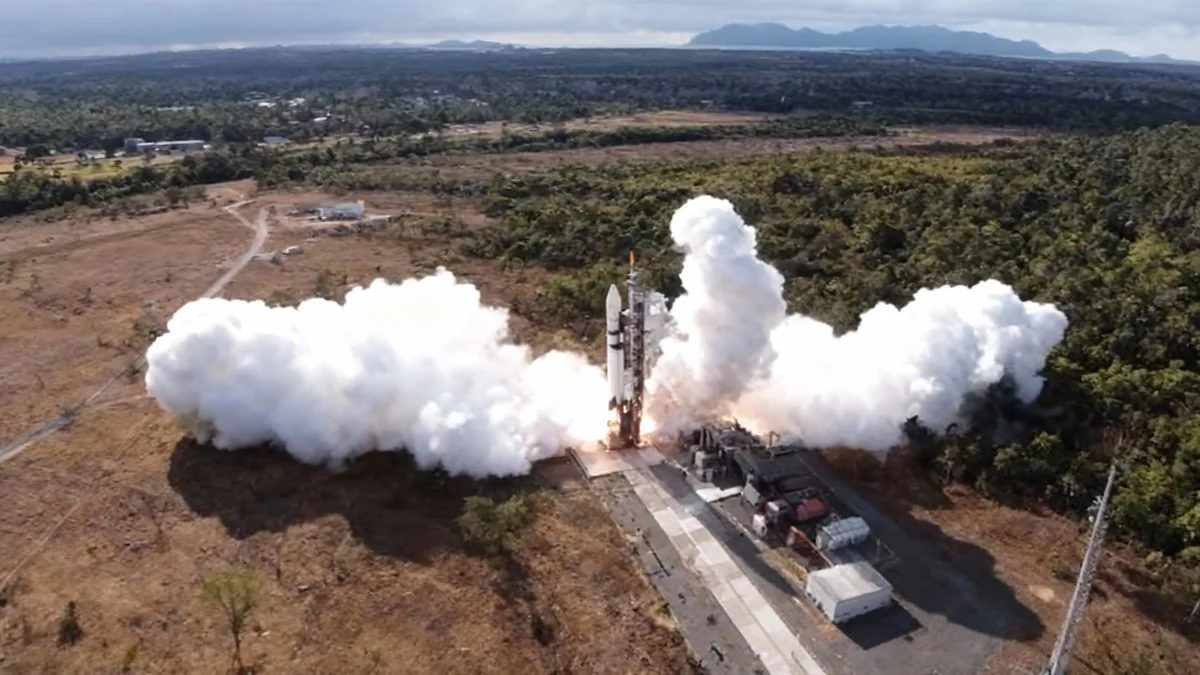


Singapore-based Transcelestial and Australian manufacturer Gilmour Space Technologies have formed a strategic partnership to integrate high-speed laser communication technology into satellites. The collaboration will begin with a demonstration mission launching later this year aboard a SpaceX Transporter rideshare flight.
The agreement aims to address a significant bottleneck in satellite operations: the speed and volume of data transmission from orbit to Earth. By testing laser-based systems, the companies hope to prove a viable, faster alternative to traditional radio-frequency communications.
Key Takeaways
- Transcelestial will integrate a laser communications terminal onto a Gilmour Space satellite for a demonstration mission on SpaceX's Transporter-18.
- The partnership aims to relieve the data transmission bottleneck from space to ground, offering speeds potentially thousands of times faster than current RF technology.
- If successful, the technology could be implemented across Gilmour Space's future satellite fleet.
- Transcelestial is expanding its network of optical ground stations to mitigate weather-related disruptions, a key challenge for laser communications.
A New Frontier for Satellite Data
The core of the partnership involves installing a Transcelestial optical communications terminal on a satellite built by Gilmour Space. This spacecraft is scheduled to launch on the Transporter-18 mission, a popular rideshare service operated by SpaceX.
The primary goal is to test the performance of laser technology for high-speed data links between the satellite and ground stations. For years, the space industry has relied on radio-frequency (RF) signals, but as satellites collect increasingly vast amounts of data, RF technology is becoming a limiting factor.
Mark Grimminck, head of satellites at Gilmour Space, highlighted the importance of this initiative. "One of the key limitations in satellite operations is data transmission from the platform to the ground," he stated. "Laser communication links are one of the clearest paths to relieving that bottleneck, and our collaboration with Transcelestial is about proving how it performs in real operations."
Overcoming Earth's Atmosphere
While laser communications promise significantly higher data rates—up to a million times faster than RF in some scenarios—they face a major obstacle: Earth's weather. Unlike radio waves, which can penetrate clouds and rain, laser beams can be blocked by atmospheric conditions.
Transcelestial plans to address this challenge with a multi-pronged strategy. Rohit Jha, the company's co-founder and CEO, explained that technologies developed for their terrestrial laser systems can help compensate for some weather interference by adjusting power levels.
"But heavy rain or dark clouds, obviously we can’t penetrate," Jha acknowledged. To counter this, Transcelestial is building a geographically diverse network of optical ground stations. The idea is that if one station is clouded out, a satellite can connect to another in a clear-sky location.
The company currently operates ground stations in Singapore and Barcelona. It plans to add new sites in Australia, Japan, Taiwan, and the United States within the next year, creating a resilient global network.
Leveraging Terrestrial Tech for Space
Transcelestial's space terminals share approximately 70% to 80% of their subsystems with the company's existing terrestrial products. This high degree of component reuse allows them to leverage a production line in Singapore capable of manufacturing thousands of units annually, driving down costs and speeding up deployment.
The Economics of Light-Speed Data
The long-term vision for both companies extends beyond a single demonstration. A successful test could lead to the integration of Transcelestial terminals across future Gilmour Space satellites. The partners are also exploring the establishment of a new optical ground station in Queensland, Australia, to support future missions.
Jha emphasized that the ultimate goal is to create the most cost-effective data transmission system. "If you have the lowest cost per bit, you win," he said. By combining the massive data rates of laser links with mass-produced, low-cost terminals, he believes their system can achieve a cost-per-bit that is "cheaper than anything else in RF."
Transcelestial's Broader Ambitions
This partnership is part of Transcelestial's larger strategy to build an "always-on network in space." The company plans to deploy its own constellation of 40 satellites in an equatorial orbit, offering network capacity exceeding 100 gigabits per second. This network would act as an orbital backbone, allowing other satellite operators like Gilmour Space to connect directly and transfer data with minimal delay.
A Growing Trend in Space Communications
Transcelestial's move into space is part of a broader industry shift. The company has already provided a terminal for the 6GStarLab cubesat, which launched in late 2025. On the same Transporter-18 mission as the Gilmour Space satellite, Transcelestial will also be flying inter-satellite laser terminals for a pair of spacecraft built by ST Engineering.
While inter-satellite links are becoming more common, particularly in large constellations like SpaceX's Starlink, direct space-to-ground laser communication remains less developed. This partnership represents a critical step in proving its operational viability for commercial satellite operators worldwide.
Jha sees laser technology as the space equivalent of the undersea fiber optic cables that carry the vast majority of internet traffic between continents. "We’ve always been in touch, and we said, ‘What does space really need? It needs an undersea cable alternative,’” he explained, referencing his long-standing relationship with the founders of Gilmour Space.
With its first major demonstration on the horizon, this collaboration could pave the way for a new era of high-bandwidth, low-latency data from orbit, transforming how we monitor, manage, and interact with our planet from space.