
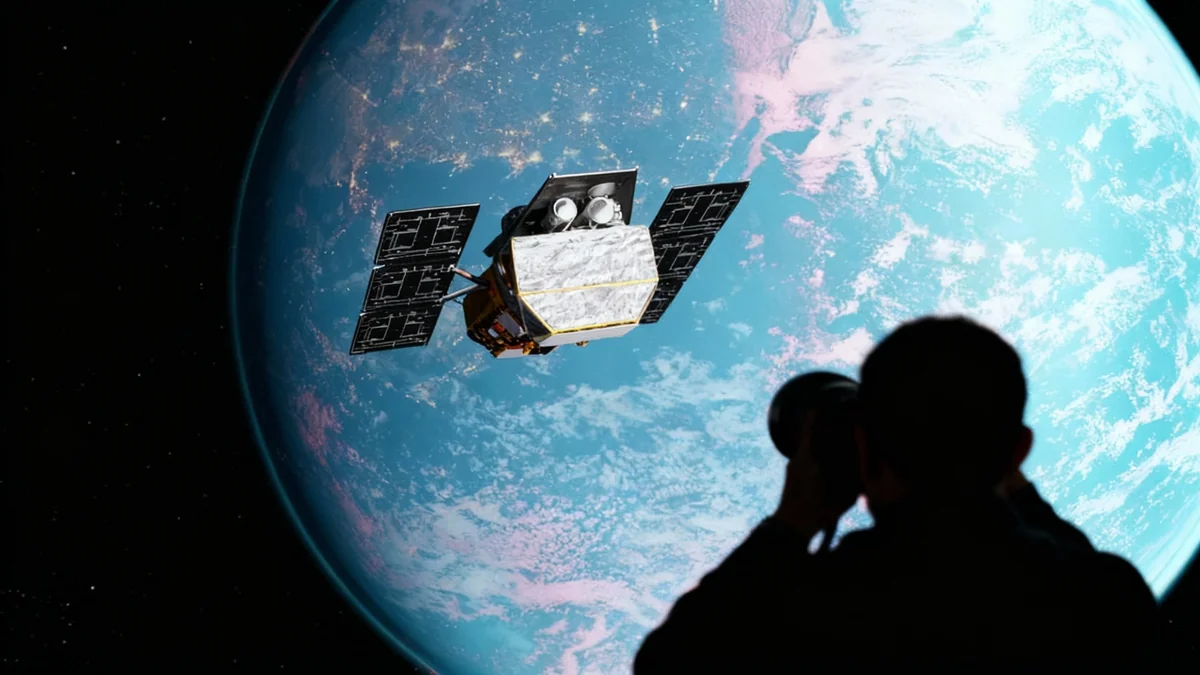


A private company will attempt a historic rescue of a key NASA space telescope in 2026, launching a robotic servicing spacecraft on a rocket dropped from a high-altitude aircraft. The mission aims to save the Neil Gehrels Swift Observatory from a decaying orbit that threatens to end its two-decade-long mission.
Arizona-based Katalyst Space Technologies is tasked with capturing and boosting the observatory, which has been instrumental in studying powerful cosmic explosions. The mission represents a critical test for the commercial space servicing industry and a race against time to prevent the valuable asset from burning up in Earth's atmosphere.
Key Takeaways
- Katalyst Space Technologies will launch a rescue mission for NASA's Swift Observatory in June 2026.
- The mission will use a Northrop Grumman Pegasus XL rocket, which is launched from a carrier aircraft at 39,000 feet.
- Swift's orbit has decayed from 600 km to 400 km and it could re-enter the atmosphere by late 2026 without intervention.
- The robotic mission will be the first time a private spacecraft has captured an uncrewed U.S. government satellite.
A Race Against Orbital Decay
Since its launch in November 2004, the Neil Gehrels Swift Observatory has been a cornerstone of high-energy astrophysics. Its primary objective has been to study gamma-ray bursts, the most powerful explosions in the universe. For nearly 20 years, it has provided invaluable data from its position in low Earth orbit.
However, the observatory's orbit has been steadily declining. Originally placed at an altitude of 373 miles (600 kilometers), it now orbits at approximately 249 miles (400 km). As it gets closer to Earth, the spacecraft encounters increased atmospheric drag, causing its descent to accelerate.
Swift's Declining Altitude
Without an onboard propulsion system to counteract this decay, projections show the $500 million observatory could make an uncontrolled re-entry into the atmosphere by the end of 2026. With no replacement mission planned, NASA turned to the private sector for a rapid solution.
In September, NASA awarded a $30 million contract to Katalyst Space Technologies to develop and execute a rescue plan. The company is now on an accelerated timeline to design, build, and launch a servicing vehicle to save the aging telescope.
An Unconventional Launch for a Unique Mission
To meet the tight deadline and specific orbital requirements, Katalyst has selected Northrop Grumman's Pegasus XL rocket. Unlike traditional ground-launched rockets, the Pegasus is carried aloft by a converted L-1011 Stargazer aircraft.
At an altitude of about 39,000 feet (12,000 meters), the rocket is released from the aircraft, ignites its solid-fuel motors, and carries its payload into orbit. This air-launch method provides significant flexibility in terms of launch location and timing.
"It's the only launch vehicle that can meet the orbit, the schedule and the cost to achieve something unprecedented with emerging technology," said Katalyst CEO Ghonhee Lee in a statement about the selection.
The Pegasus rocket has a long history, with 45 missions since its debut in 1990. The hardware for this specific mission is reportedly near completion, which is crucial for meeting the June 2026 launch window. "We are treating this launch date as a firm commitment," noted Kieran Wilson, vice president of technology at Katalyst.
The Intricate Task of a Robotic Capture
Once in orbit, the Katalyst servicing spacecraft—which stands about 4.9 feet (1.5 m) tall and weighs 770 pounds (350 kg)—will begin a delicate two-to-three-week approach to the Swift observatory.
A Non-Cooperative Target
The primary challenge is that Swift was never designed to be serviced. It lacks the docking ports or grapple fixtures found on modern satellites like the Hubble Space Telescope, which was famously serviced by astronauts multiple times.
Katalyst's team is engaged in what Wilson described as "fun detective work." They are meticulously studying pre-launch photographs and consulting with engineers from NASA and Northrop Grumman (which acquired Swift's original builder, Orbital Sciences) to identify safe points on the spacecraft's structure for their vehicle's three robotic arms to grab.
Protecting Sensitive Instruments
Another layer of complexity is protecting Swift's highly sensitive optics. The telescope's instruments can be permanently damaged if pointed toward the sun, Earth, or moon. The entire capture and boosting operation must be choreographed to avoid exposing these instruments to direct light.
After a successful capture, the Katalyst spacecraft will use its own thrusters to carefully raise Swift back to its original 600 km orbit. If successful, this maneuver could extend the observatory's operational life by another two decades.
Pioneering a New Era in Space Servicing
This mission is poised to be a landmark achievement. While not the first servicing of a space telescope, it would mark the first-ever capture of an uncrewed U.S. government satellite by a private, robotic spacecraft.
The rapid timeline—from contract award to launch in approximately nine months—could also establish a new paradigm for responsive space missions. "If we're able to do this for NASA in just eight months, I do think that opens up a new set of responsive missions in the future," Wilson explained.
Katalyst has already demonstrated some of its core technology with two spacecraft launched on a SpaceX mission in 2024. The Swift rescue, however, represents a significant increase in complexity and stakes.
Looking ahead, Katalyst plans to apply the lessons learned from this mission to more ambitious projects. The company aims to launch its first mission to geostationary orbit in 2027 with a larger, multi-mission robotic platform named Nexus, designed to provide life-extension and space awareness services to both government and commercial clients.