


China has surpassed its previous annual record for orbital launches following two successful missions conducted just hours apart late Saturday. The country completed its 69th and 70th orbital launches of the year, exceeding the 68 launches it conducted in all of 2024, with nearly two months still remaining in the calendar year.
The record-breaking launches involved a sea-based Long March 11 rocket carrying experimental satellites and a commercial Kinetica-1 rocket deploying a pair of Earth observation test satellites. These missions highlight the increasing pace and diversity of China's space activities, which involve both state-run and commercial entities.
Key Takeaways
- China conducted its 69th and 70th orbital launches of 2025, breaking its previous annual record of 68 set in 2024.
- A sea-launched Long March 11 rocket deployed three Shiyan-32 satellites for new space technology experiments.
- A commercial Kinetica-1 rocket launched two Chutian-2 satellites to test Very Low Earth Orbit (VLEO) technologies.
- The increased launch cadence is driven by the deployment of satellite constellations and a growing commercial space sector.
Dual Launches Mark a National Milestone
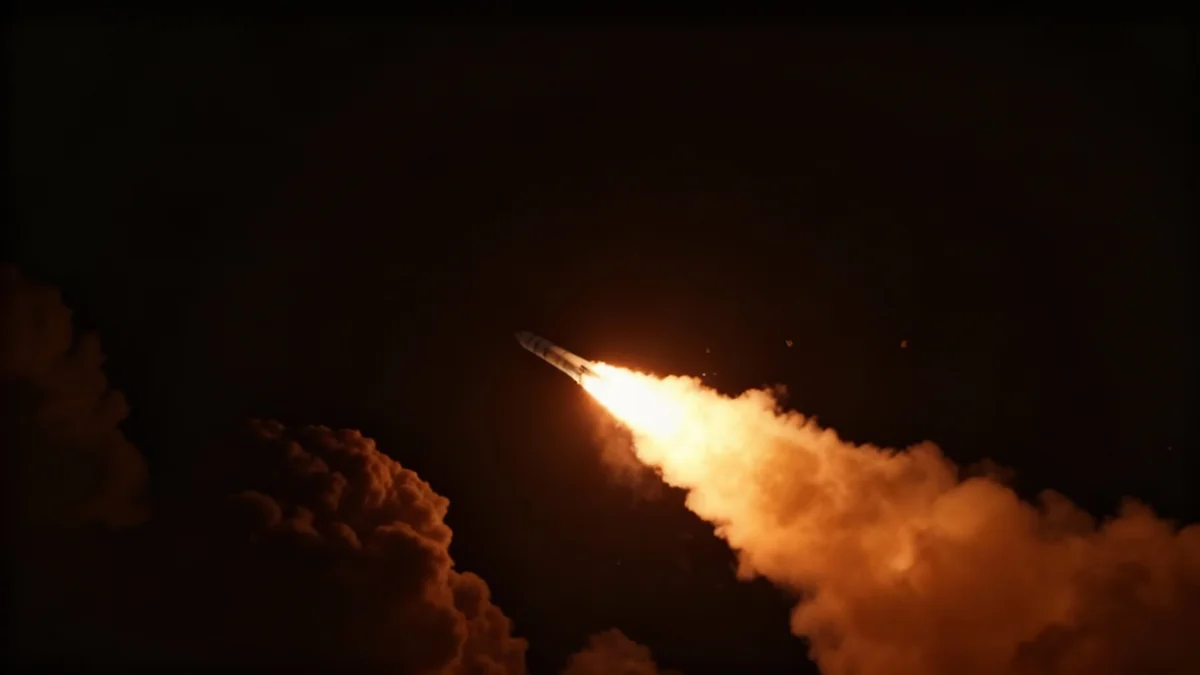
The first of the two missions began at 4:01 p.m. Eastern time when a Long March 11 solid rocket was launched from a mobile platform in the waters off Haiyang, Shandong Province. The rocket successfully carried three satellites, designated Shiyan-32 (01, 02, and 03), into orbit.
Official confirmation of the launch's success was delayed by nearly eight hours, a departure from the typical one-hour announcement, which led to some speculation about the mission's status. However, the China Aerospace Science and Technology Corporation (CASC) eventually declared the launch successful.
The Shiyan series of satellites are generally described as platforms for testing new space technologies. While specific details are often not disclosed, analysts believe these missions are used to validate a range of systems in orbit, including new sensors, communications hardware, and instruments for monitoring the space environment. These experimental flights are a critical part of China's strategy to advance its space capabilities.
Commercial Sector Pushes Boundaries with VLEO
Just hours after the Long March 11 mission, a second launch took place from the Jiuquan Satellite Launch Center in northwest China. At 10:32 p.m. Eastern, commercial company CAS Space launched its Kinetica-1 solid rocket.
This mission carried the Chutian-2 technology experiment satellites 01 and 02. These satellites are part of a project to test and verify capabilities for a future constellation operating in Very Low Earth Orbit (VLEO).
What is Very Low Earth Orbit (VLEO)?
VLEO refers to orbits below approximately 450 kilometers in altitude. Operating at these lower altitudes allows satellites to capture higher-resolution images of the Earth and reduces communication latency. However, it also presents significant challenges, as atmospheric drag is much stronger, requiring satellites to have advanced propulsion systems for drag compensation to maintain their orbit or accept much shorter operational lifetimes.
The Chutian-2 satellites are designed to test these very technologies. Display models have shown a distinctive bullet-shaped body, an aerodynamic design intended to minimize atmospheric drag. This mission is a key step in developing the necessary propulsion and operational systems for a sustainable VLEO constellation.
Analyzing China's Growing Launch Cadence
The achievement of 70 launches before the end of the year underscores a significant acceleration in China's space program. The country is on track to far exceed its 2024 record, demonstrating a robust and expanding launch infrastructure.
China's Launch Statistics for 2025 (so far)
- Total Launches: 70
- Busiest Spaceport: Jiuquan (23 launches)
- State-Run Long March Launches: 51
- Commercial & SOE-Affiliated Launches: 19
Several factors are contributing to this growth. One major driver is the build-out of large satellite constellations, such as Guowang and Qianfan, which require numerous launches to deploy hundreds or even thousands of satellites. This is similar to the Starlink and OneWeb constellations being deployed by Western companies.
Additionally, China's commercial space sector is becoming increasingly active. Companies like CAS Space, Galactic Energy, and Landspace are now regularly conducting their own launches, adding to the national total and fostering innovation in rocket technology.
A Shift in Rocket Technology
The data also reveals a technological shift in the types of rockets being used. While older-generation Long March rockets that use hypergolic propellants are still in use, there is a clear trend towards newer models.
Rockets like the Long March 5, 6, 7, and 8 series, which use cleaner and more efficient propellants like kerosene and liquid hydrogen, are being flown more frequently. These newer launchers represent a modernization of China's rocket fleet and are crucial for supporting more complex missions, including the construction of its space station and future lunar exploration plans.
Of the 70 launches this year, CASC's Long March family accounted for 51. The remaining 19 were conducted by a mix of state-owned enterprise affiliates and private commercial firms, highlighting a dynamic public-private ecosystem.
What Lies Ahead in the Coming Weeks
The pace of launches from China is not expected to slow down. Several more missions are already scheduled for the immediate future. A Long March 12 rocket is slated for its inaugural flight, and commercial provider Galactic Energy is planning to launch another Ceres-1 rocket soon.
The continued high frequency of launches demonstrates China's commitment to expanding its presence and capabilities in space. By breaking its annual launch record with weeks to spare, the country is signaling its ambition to be a leading power in space exploration, satellite deployment, and technological innovation for the foreseeable future.