
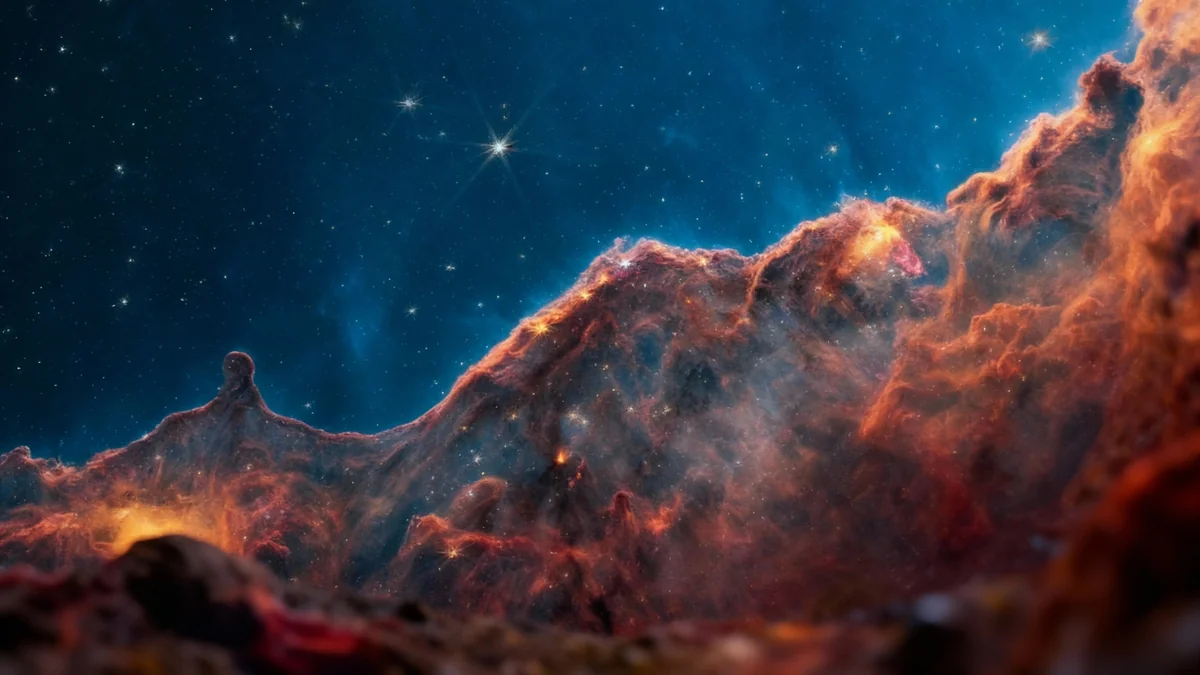

The James Webb Space Telescope has captured an unprecedented view of a stellar nursery, revealing a landscape of cosmic mountains and valleys glittering with infant stars. The image, nicknamed the "Cosmic Cliffs," provides a detailed look inside a star-forming region at the edge of the Carina Nebula.
Located approximately 9,100 light-years from Earth, this region, known as NGC 3324, is a dynamic area where intense ultraviolet radiation and stellar winds from massive, young stars are sculpting a giant cavern of gas and dust. This new perspective from Webb is helping scientists understand the complex processes that govern star birth.
Key Takeaways
- The James Webb Space Telescope has imaged a star-forming region named NGC 3324, located near the Carina Nebula.
- The image, known as the "Cosmic Cliffs," shows previously hidden baby stars and detailed gas and dust structures.
- This region is about 9,100 light-years away, and the star cluster within it is estimated to be only 12 million years old.
- The data helps scientists study the initial stages of star formation and the impact of massive stars on their environment.
A New Window into Star Formation
The image released by NASA, in collaboration with the European Space Agency (ESA) and the Canadian Space Agency (CSA), showcases the Webb telescope's powerful infrared capabilities. It pierces through the cosmic dust that previously obscured our view of these nascent stars, offering a clarity never before achieved.
The so-called "cliffs" are the edge of a gigantic, gaseous cavity within NGC 3324. The tallest peaks in this image are about 7 light-years high. The cavernous area has been carved out by the intense ultraviolet radiation and powerful stellar winds from extremely hot, young stars located in the center of the bubble, above the area shown in this image.
This erosion of the nebula's wall is a key process in star formation. As the massive stars sculpt the gas and dust, they create high-density pockets that can collapse under their own gravity, forming the next generation of stars.
Understanding NGC 3324
NGC 3324 is a young, open star cluster located in the southern constellation of Carina. It is part of the larger Carina Nebula complex, one of the largest and brightest nebulae in the night sky. The cluster itself is relatively young in cosmic terms, with an estimated age of about 12 million years. Its proximity and the presence of massive, hot stars make it an ideal laboratory for studying the feedback between stars and their natal clouds.
The Power of Infrared Vision
Previous images of this region from telescopes like the Hubble Space Telescope showed the glowing gas, but Webb's sensitivity to infrared light reveals the hidden stellar nurseries and individual protostars within.
What appears as a rugged, mountainous landscape is actually a dynamic boundary of ionized gas and dense molecular clouds. The blueish, hazy area at the top of the cliffs is the hot, ionized gas being blasted away by the radiation from the nearby massive stars. The orange and red sections below represent the dense pillars of dust and gas that are more resistant to this erosion.
Facts About the Cosmic Cliffs
- Distance from Earth: Approximately 9,100 light-years.
- Location: Star cluster NGC 3324, near the Carina Nebula.
- Age of Cluster: Roughly 12 million years.
- Image Credit: NASA, ESA, CSA, and STScI.
- Telescope: James Webb Space Telescope (JWST).
Embedded within these pillars are hundreds of previously unseen stars, as well as numerous jets and outflows emanating from protostars. These outflows, appearing as red streaks, are material being ejected by the forming stars at high speeds, a clear sign of active star birth.
"This is a truly transformative moment for astronomy. What we are seeing in the 'Cosmic Cliffs' is not just a beautiful picture, but a snapshot of creation in action. Every dot of light could be a new solar system in the making," stated an astronomer involved with the JWST program.
Unraveling Cosmic Mysteries
The data gathered from this single image will keep scientists busy for years. By studying the structure, composition, and temperature of the dust and gas in NGC 3324, researchers can build a more complete picture of how stars are born and how they influence their surroundings.
Key questions that this image will help answer include:
- How quickly do stars form in these environments?
- What percentage of gas and dust is converted into stars?
- How does the feedback from massive stars trigger or inhibit the formation of new stars?
The level of detail is extraordinary. Scientists can now analyze the chemical makeup of the dust grains and the properties of the gas with high precision. This information is crucial for understanding the building blocks of both stars and planetary systems, including our own.
The Broader Impact
The imagery from Webb, especially dramatic visuals like the Cosmic Cliffs, serves a dual purpose. It provides invaluable data for the scientific community while also capturing the public's imagination and inspiring a new generation of scientists and explorers.
The image is a composite from Webb's Near-Infrared Camera (NIRCam) and Mid-Infrared Instrument (MIRI). Each instrument provides a different layer of information, which, when combined, creates a comprehensive and visually stunning portrait of this distant cosmic landscape.
As the James Webb Space Telescope continues its mission, it is expected to deliver many more such groundbreaking images. Each one will offer a new piece of the puzzle, helping humanity to understand its place in the vast and dynamic universe.