

Astronomers using the James Webb Space Telescope have identified what may be the most distant supernova ever observed. The massive stellar explosion is linked to a powerful gamma-ray burst that occurred when the universe was just 730 million years old, offering a rare glimpse into the cosmic dawn.
The discovery provides crucial new data on the life and death of the universe's first stars and challenges some assumptions about how they differed from stars in our modern cosmos.
Key Takeaways
- Astronomers detected a gamma-ray burst, GRB 250314A, originating from the early universe.
- Follow-up observations with the James Webb Space Telescope suggest the burst was caused by a supernova.
- The event took place just 730 million years after the Big Bang, potentially making it the most distant supernova ever recorded.
- The ancient supernova appears surprisingly similar to modern stellar explosions, questioning theories about early star composition.
An Explosion at the Edge of Time
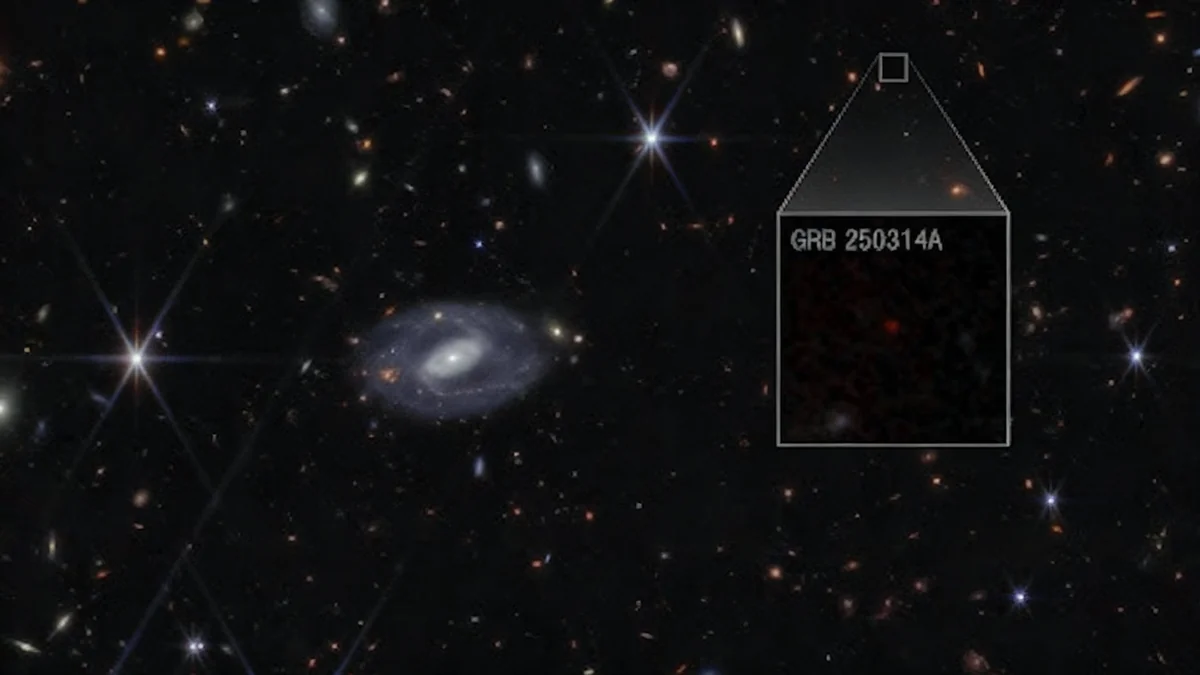
A team of international researchers has pinpointed a cataclysmic event from the universe's infancy. The initial signal, a brilliant flash of high-energy light known as a gamma-ray burst (GRB), was first detected in March by the Space Variable Objects Monitor, a collaborative telescope project between China and France.
Designated GRB 250314A, the burst lasted for approximately 10 seconds. This duration placed it in the "long-duration" category, which scientists typically associate with the collapse of a massive star — an event known as a supernova.
The immense distance to the source meant its light traveled for over 13 billion years to reach us. This provided a unique opportunity for astronomers to study a star from the first billion years of cosmic history, a period that is still poorly understood.
Webb's Crucial Follow-Up
To confirm the supernova hypothesis, two independent research teams turned to the powerful infrared vision of the James Webb Space Telescope (JWST). Months after the initial burst, Webb observed the location of the event, long after the transient gamma-rays and their immediate afterglow had faded.
"We were amazed that our predictions worked so well, and that we had been able to demonstrate that JWST could see individual exploding stars at such extreme distances," said A.J. Levan, a professor at Radboud University and the University of Warwick, who led one of the studies.
"This leaves us to disentangle the [light from the] galaxy and the supernova," Levan explained, highlighting the challenge of separating the light from the dying star and its faint host galaxy.
The teams analyzed the light recorded by Webb. They determined that the faint host galaxy alone could not account for the brightness observed. The most plausible explanation was that the residual light came from the supernova itself, which continues to glow for months after the initial explosion.
Understanding Gamma-Ray Bursts
Gamma-ray bursts are the most energetic explosions in the universe. They are categorized by their duration:
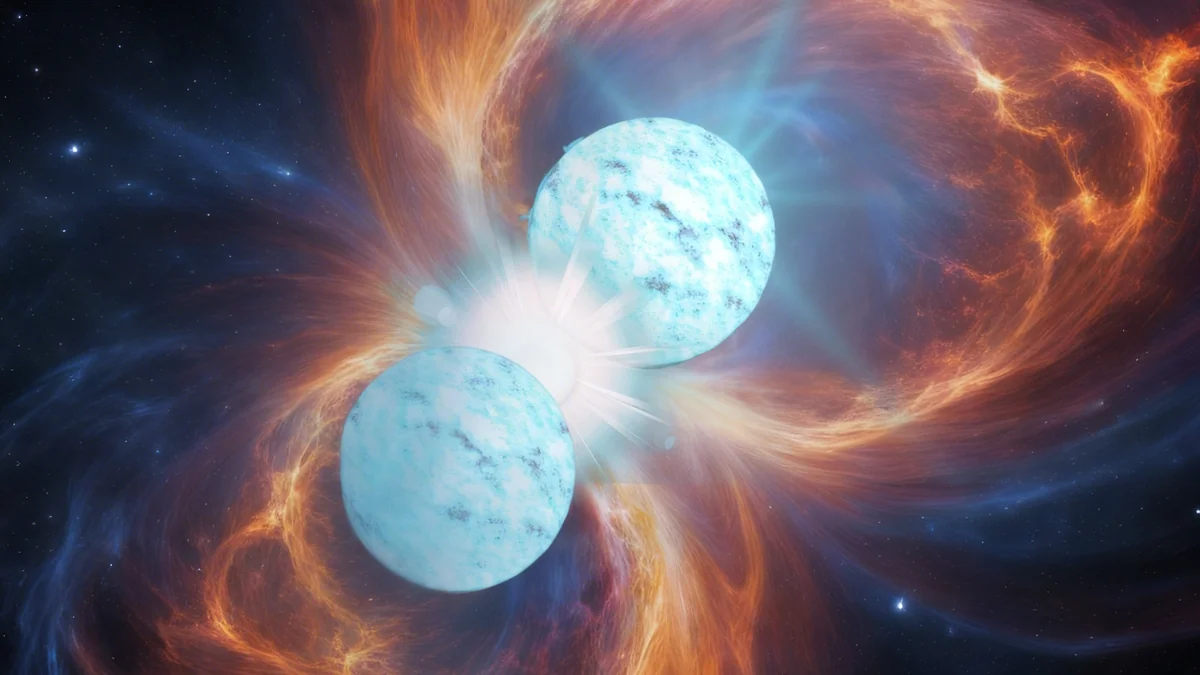
- Short GRBs: Lasting less than two seconds, these are thought to be caused by the merger of two neutron stars.
- Long GRBs: Lasting longer than two seconds, these are associated with the death of massive stars, which collapse to form a black hole or neutron star, resulting in a supernova.
A Surprisingly Modern Star
One of the most intriguing findings from the observation is the nature of the supernova itself. Scientists have long theorized that the first generations of stars were chemically different and potentially more massive than stars existing today. This would mean their explosions should also look different.
However, when researchers compared the light signature of GRB 250314A to known supernovas in the nearby, modern universe, they found a remarkable similarity. The brightness of the explosion, which is tied to the amount of radioactive material ejected, was not unusual.
Cosmic Time Machine
Because light travels at a finite speed, looking at extremely distant objects is like looking back in time. Observing an object 13 billion light-years away means we see it as it was 13 billion years ago. The JWST is specifically designed to capture this ancient light, which has been stretched into infrared wavelengths by the expansion of the universe.
"This may be a chance; after all, it is only one object," Levan noted. "However, it could also suggest that the exploding stars [in the early universe] — and thus the overall stellar population — aren't as different as we think."
This single data point could prompt a re-evaluation of models describing star formation and evolution in the primordial cosmos. It suggests that the fundamental processes governing the death of massive stars may have been in place very early in the universe's history.
Confirmation on the Horizon
While the evidence strongly points to a supernova, the teams plan to conduct final follow-up observations. In about a year, the light from the supernova itself will have completely faded away. At that point, Webb will observe the location again.
This final look will allow astronomers to get a clear measurement of the host galaxy's light without any contamination from the supernova. By subtracting the galaxy's light from the previous measurements, they can definitively isolate the supernova's signature and confirm its properties.
If confirmed, GRB 250314A will not only be a new record-holder for the most distant supernova but will also serve as a vital benchmark for understanding the violent and formative era of the early universe.