

The James Webb Space Telescope has captured the light from the most distant and oldest supernova ever observed, an event that occurred 13 billion years ago. This discovery provides an unprecedented look into the death of a massive star in the early universe, just 730 million years after the Big Bang.
The supernova, linked to a powerful gamma-ray burst, offers new insights into the conditions of the cosmos when it was merely 5% of its current age. The observation confirms the telescope's remarkable capability to detect individual stellar events at the dawn of time, pushing the boundaries of cosmic exploration.
Key Takeaways
- The James Webb Space Telescope (JWST) has identified the most distant supernova ever seen.
- The stellar explosion, designated GRB 250314A, occurred 13 billion years ago, only 730 million years after the Big Bang.
- The discovery was a coordinated effort involving multiple satellites and ground-based telescopes, culminating in JWST's targeted observation.
- This finding demonstrates Webb's ability to study individual stars and their life cycles in the very early universe.
A Cosmic Detective Story
The journey to find this ancient explosion began on March 14, when the French–Chinese SVOM satellite first detected a powerful blast of gamma rays. This initial alert triggered a rapid response from the global astronomical community. About 90 minutes later, NASA’s Neil Gehrels Swift Observatory followed up with X-ray observations, which helped astronomers zero in on the burst's location in the sky.
This gamma-ray burst, or GRB, was cataloged as GRB 250314A. These events are among the most energetic phenomena in the universe, often signaling the collapse of a massive star into a black hole.
Eleven hours after the Swift detection, the Nordic Optical Telescope in the Canary Islands captured the faint, fading afterglow of the explosion. This light is produced as material ejected from the dying star collides with surrounding gas. A few hours later, the Very Large Telescope in Chile performed a crucial measurement, confirming the event's redshift was an astounding 7.3. This value placed the explosion firmly in the early universe, 13 billion years in the past.
The Power of Webb
While the GRB afterglow was significant, the ultimate goal was to see the supernova itself. An international team of astronomers, led by Andrew Levan of Radboud University, understood that the universe's expansion would affect their observations. This cosmic expansion stretches light waves and also creates a time-dilation effect, meaning events in the distant universe appear to unfold more slowly from our perspective.
Cosmic Time Dilation
Due to the expansion of space, astronomers calculated that the supernova associated with GRB 250314A would reach its peak brightness not in a few weeks, but approximately three and a half months after the initial gamma-ray burst was detected.
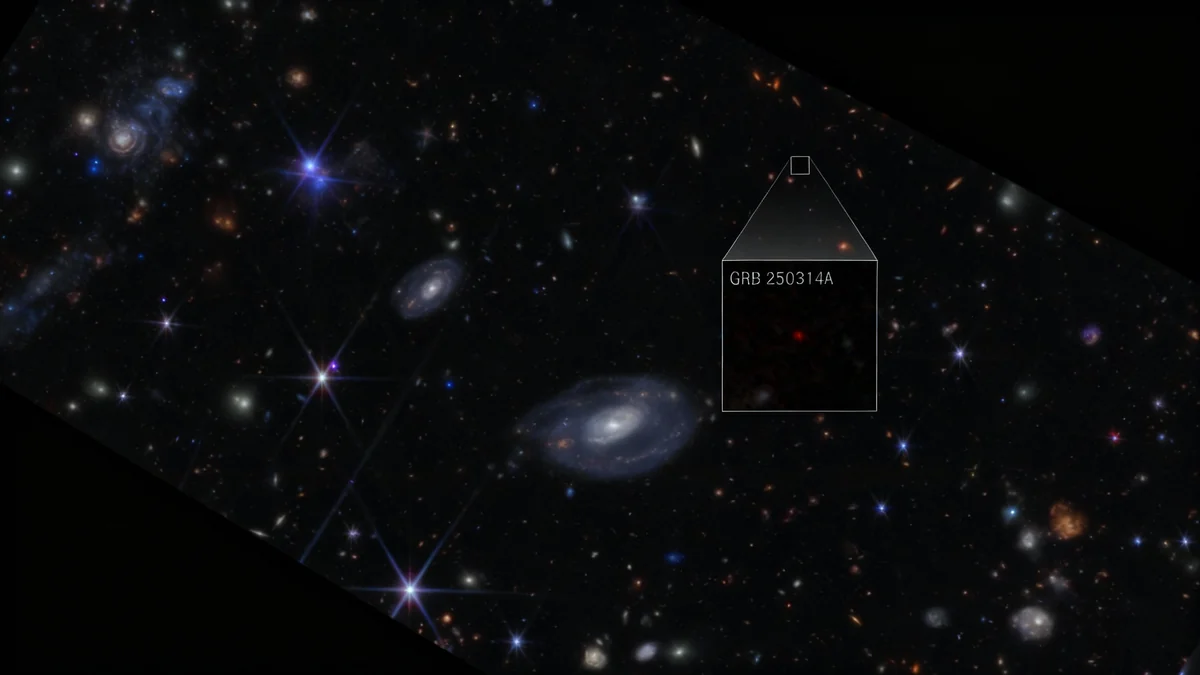
Armed with this prediction, the team secured special discretionary time on the James Webb Space Telescope, the only instrument capable of seeing such a faint and distant object. On July 1, they pointed Webb's powerful Near-Infrared Camera (NIRCam) at the precise coordinates and successfully detected the distinct light of the supernova.
"Only Webb could directly show that this light is from a supernova — a collapsing massive star," stated Andrew Levan in a release. "This observation also demonstrates that we can use Webb to find individual stars when the universe was only 5% of its current age."
Insights from the Early Universe
The successful detection is more than just a new record; it opens a new window into the universe's formative years. The previous record for the oldest supernova was an event that occurred 1.8 billion years after the Big Bang. This new discovery, at just 730 million years post-Big Bang, is a significant leap further back in time.
Webb's observations also provided a glimpse of the supernova's home. The host galaxy appears as a small, smudged collection of pixels, yet it offers valuable context. Emeric Le Floc'h of CEA Paris-Saclay, a member of the research team, noted that the data indicates this distant galaxy is similar in nature to other galaxies known to exist at that early epoch.
A Familiar Explosion in an Alien Environment
One of the most surprising findings is how familiar the supernova appears. Its light spectrum, which reveals its chemical composition and physical properties, looks remarkably similar to supernovae observed in the modern universe. This suggests the star that exploded was not unusually massive compared to stars that go supernova today.
However, this similarity is also a puzzle. The early universe had a much lower concentration of heavy elements, often called "metals" by astronomers. These elements are forged inside stars and scattered by supernova explosions. A star born in such a metal-poor environment would have had a different composition, which scientists expected might lead to a different kind of explosion.
Further detailed analysis of the supernova's spectrum will be required to tease out subtle differences that could reveal more about the star's unique environment. These findings, published in the journal Astronomy & Astrophysics, pave the way for future studies of the first generations of stars and the chemical enrichment of the cosmos.