
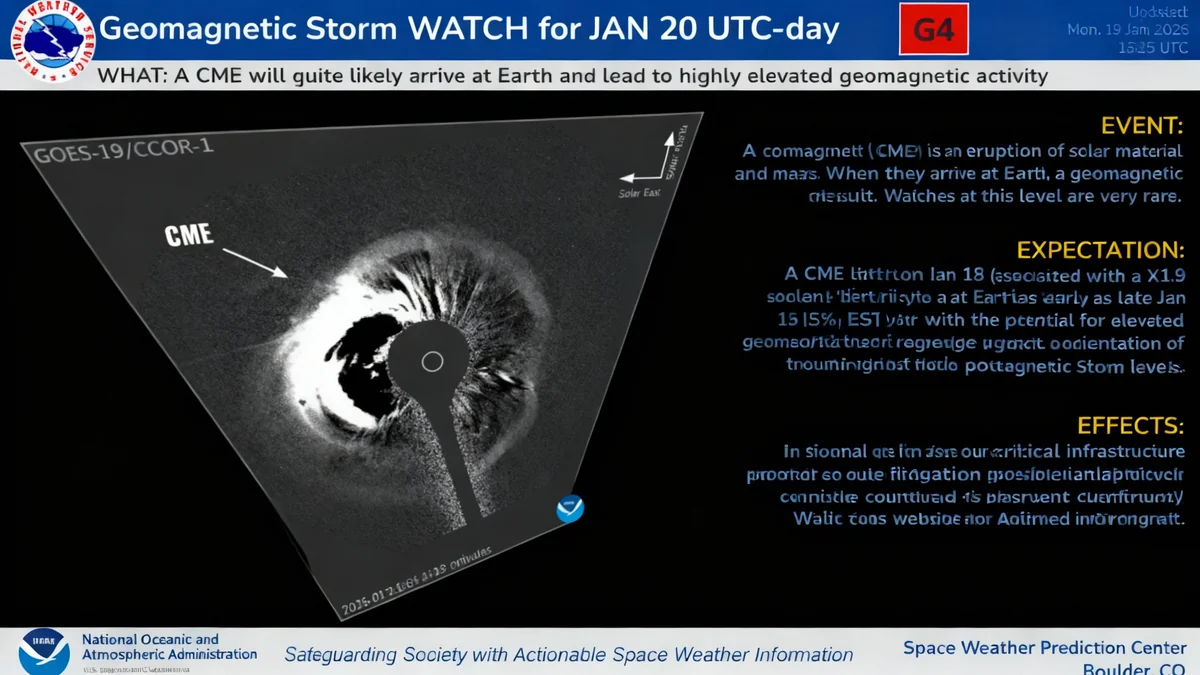

Space weather forecasters have issued a G4 (Severe) geomagnetic storm watch for January 20, 2026, following a significant solar event. A powerful eruption on the Sun has sent a cloud of charged particles, known as a coronal mass ejection (CME), hurtling towards Earth, with its arrival expected to trigger notable atmospheric and technological effects.
The event originated from a strong R3 solar flare on January 18. Officials have expressed a fair measure of confidence in the timing of the CME's arrival, which could begin impacting Earth's magnetic field as early as late January 19 Eastern Standard Time.
Key Takeaways
- A G4 (Severe) geomagnetic storm watch is in effect for Tuesday, January 20, 2026.
- The storm is caused by a coronal mass ejection (CME) from a strong R3 solar flare that occurred on January 18.
- Initial impacts could begin late on January 19, with storm levels potentially ranging from G1 to G3 before intensifying.
- Potential effects include widespread voltage control problems, disruptions to satellite navigation (GPS), and spectacular aurora visible at lower latitudes.
The Solar Eruption and its Journey
The sequence of events began on January 18 when a sunspot region near the center of the Sun's disk erupted. This eruption produced an R3 (Strong) solar flare, a powerful burst of radiation. More significantly, it launched a massive cloud of plasma and magnetic field—a coronal mass ejection—directly at our planet.
Because the eruption occurred near the center of the Sun as viewed from Earth, the CME is on a direct trajectory. Forecasters are tracking its progress across the solar system and anticipate its arrival at Earth late on January 19, with the most significant effects expected throughout January 20.
While the peak intensity is predicted for January 20, the storm's influence may linger. Geomagnetic conditions could remain unsettled, with G1 (Minor) storm levels possible into January 21 due to residual effects from the CME's passage.
What is a Coronal Mass Ejection?
A Coronal Mass Ejection (CME) is a massive expulsion of plasma and magnetic field from the Sun's corona. These solar winds travel at immense speeds, sometimes reaching Earth in just a day or two. When a CME collides with Earth's magnetosphere, it can trigger a geomagnetic storm, which is a major disturbance of our planet's magnetic field.
Understanding the G-Scale and Potential Impacts
Geomagnetic storms are ranked on a scale from G1 (Minor) to G5 (Extreme). The current watch for a G4 (Severe) storm indicates a significant event with the potential for widespread impacts on technology.
A G4 storm is a rare occurrence and can pose serious challenges to our increasingly tech-dependent society. The primary concerns revolve around the electrical power grid, satellite operations, and radio communications.
The Geomagnetic Storm Scale
- G1 (Minor): Weak power grid fluctuations can occur. Minor impact on satellite operations possible.
- G2 (Moderate): High-latitude power systems may experience voltage alarms. Long-duration storms may cause transformer damage.
- G3 (Strong): Voltage corrections may be required; false alarms triggered on some protection devices. Satellite navigation (GPS) problems may occur.
- G4 (Severe): Widespread voltage control problems and some protective system problems can occur. Satellite navigation may be degraded for hours.
- G5 (Extreme): Widespread voltage control problems and protective system issues can occur; some grid systems may experience complete collapse or blackouts.
Impact on Power Grids and Satellites
During a severe geomagnetic storm, induced currents can flow through power lines, potentially overloading systems and causing widespread voltage control issues. Grid operators are typically notified of these events in advance to take protective measures, but the risk of instability remains.
Satellites in orbit are also vulnerable. The increased radiation can affect their electronics, and changes in the upper atmosphere can increase drag on low-Earth orbit satellites, requiring them to make course corrections. Services that rely on satellites, such as GPS and high-frequency radio communications, can experience significant disruptions, impacting aviation, maritime navigation, and everyday users.
The Silver Lining: A Global Light Show
While geomagnetic storms pose technological risks, they also produce one of nature's most breathtaking displays: the aurora. Normally confined to the polar regions, a G4 storm can push the aurora borealis (Northern Lights) and aurora australis (Southern Lights) to much lower latitudes.
"During a G4 event, the aurora can be seen as far south as Alabama and northern California in the United States. It's a rare opportunity for millions of people to witness this beautiful phenomenon."
Skywatchers in regions that are not used to seeing the aurora should look towards the northern horizon (or southern horizon in the Southern Hemisphere) in dark, clear skies on the night of January 20. The lights can appear as shimmering curtains of green, pink, and purple light, offering a spectacular visual reminder of the powerful connection between the Sun and Earth.
Preparation and Monitoring
Officials are continuously monitoring the CME as it approaches Earth. Space weather prediction agencies use a combination of satellite data and computer models to refine their forecasts for the storm's arrival time and intensity.
For the general public, the direct impact is minimal. The storm poses no physical danger to people on the ground. However, awareness of potential disruptions to power, communication, and navigation systems is important.
Experts advise the public and critical infrastructure operators to stay informed through official channels for the latest updates and forecasts as the event unfolds. The storm's effects are expected to begin weakening later on January 20, with conditions gradually returning to normal over the following day.