


Scientists have discovered a new way to study the harsh space weather around distant stars, a critical factor in determining if their orbiting planets could support life. By observing strange, repeating patterns of dimming light from young, cool stars, researchers have identified massive rings of plasma that act as natural observatories.
This breakthrough, presented at the American Astronomical Society meeting, offers a novel method for understanding the particle-filled environments that can either nurture or destroy a planet's atmosphere. The study focuses on M dwarf stars, the most common type of star in our galaxy, which are known to host numerous Earth-sized planets.
Key Takeaways
- Scientists have identified doughnut-shaped rings of plasma, called tori, around young M dwarf stars.
- These plasma rings cause periodic dimming in the stars' light, which was previously a mystery.
- The structures act as natural "space weather stations," allowing researchers to study stellar winds and magnetic fields from light-years away.
- Understanding space weather is crucial for assessing the habitability of exoplanets, especially those orbiting volatile M dwarf stars.
The Challenge of Studying Alien Weather
Understanding the conditions on planets outside our solar system requires more than just knowing their size and distance from their star. The constant flow of charged particles, known as stellar wind, and powerful magnetic storms—collectively called space weather—play a decisive role in a planet's ability to hold onto an atmosphere and liquid water.
While astronomers are adept at measuring a star's light, directly observing its space weather is incredibly difficult across interstellar distances. "Stars influence their planets. That’s obvious," explained Luke Bouma of the Carnegie Institution for Science. "They do so both through light, which we’re great at observing, and through particles—or space weather—like solar winds and magnetic storms, which are more challenging to study at great distances."
This information gap is a major hurdle in the search for life, as a planet that seems perfect in terms of temperature could be rendered sterile by intense radiation from its star.
What Are M Dwarf Stars?
M dwarfs, also known as red dwarfs, are the smallest and coolest type of star. They are much dimmer than our Sun but make up about 75% of the stars in the Milky Way. While many host rocky, Earth-sized planets in their habitable zones, they are also known for being magnetically active, frequently releasing powerful flares that could be detrimental to life.
Solving a Celestial Mystery
The key to this new discovery came from a peculiar type of young M dwarf known as a "complex periodic variable." These stars spin rapidly and exhibit regular, brief dips in their brightness. For years, astronomers were unsure what caused this dimming, with leading theories pointing to large starspots on the surface or clouds of material orbiting the star.
To find the answer, Bouma collaborated with Moira Jardine of the University of St. Andrews. The team created what they call "spectroscopic movies" of one of these stars. By breaking down the star's light into its constituent colors and observing how it changed over time, they could map the material around the star.
"For a long time, no one knew quite what to make of these oddball little blips of dimming," Bouma said. "But we were able to demonstrate that they can tell us something about the environment right above the star’s surface."
Their analysis revealed that the dimming was not caused by starspots. Instead, it was linked to something much larger and more significant trapped just above the star.
A Natural Space Weather Station
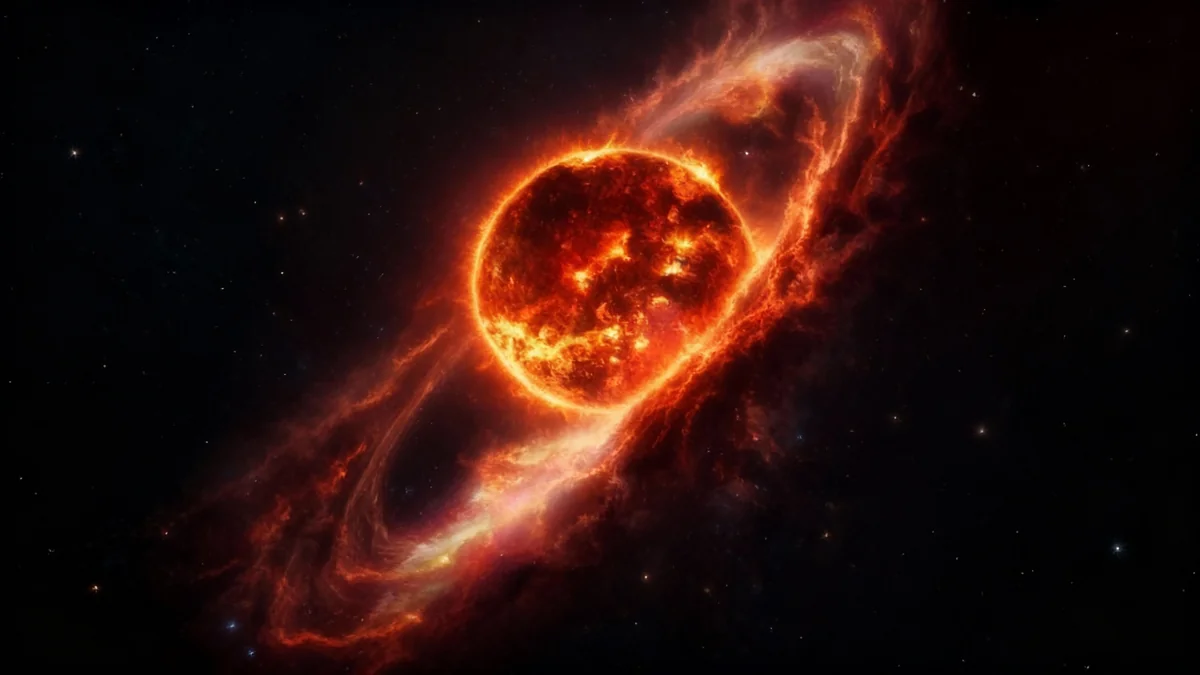
The spectroscopic data showed that the dimming is caused by two dense clumps of cool plasma—a state of matter where atoms are stripped of their electrons. This plasma is caught within the star's powerful magnetic field, which forces it into a giant, doughnut-shaped structure called a torus that co-rotates with the star.
As the star spins, the dense sections of this plasma ring periodically pass in front of the star from our point of view, causing the observed dips in light. This realization transformed the mysterious dimming from a curiosity into a powerful analytical tool.
A Common Phenomenon: Bouma and Jardine estimate that at least 10% of M dwarf stars may develop these plasma tori early in their lifetimes, providing numerous potential targets for future study.
"Once we understood this, the blips in dimming stopped being weird little mysteries and became a space weather station," Bouma stated. "The plasma torus gives us a way to know what’s happening to the material near these stars, including where it’s concentrated, how it’s moving, and how strongly it is influenced by the star’s magnetic field."
Implications for Habitable Worlds
This discovery provides a much-needed method for probing the high-energy environments around the most common planetary hosts in the galaxy. By studying these plasma rings, scientists can better model the intensity of space weather that nearby planets must endure.
This information will help determine which planetary systems are most likely to have conditions suitable for life. A planet might be in the so-called "habitable zone" where liquid water could exist, but if it's constantly bombarded by stellar particles, its atmosphere could be stripped away over time.
The next step for the research team is to determine the origin of the plasma. It could be material ejected from the star itself or drawn from an external source. Answering this question will provide even deeper insights into the complex interactions between stars and their young planetary systems.
"This is a great example of a serendipitous discovery, something we didn’t expect to find but that will give us a new window into understanding planet-star relationships," Bouma concluded. "We don’t know yet if any planets orbiting M dwarfs are hospitable to life, but I feel confident that space weather is going to be an important part of answering that question."