
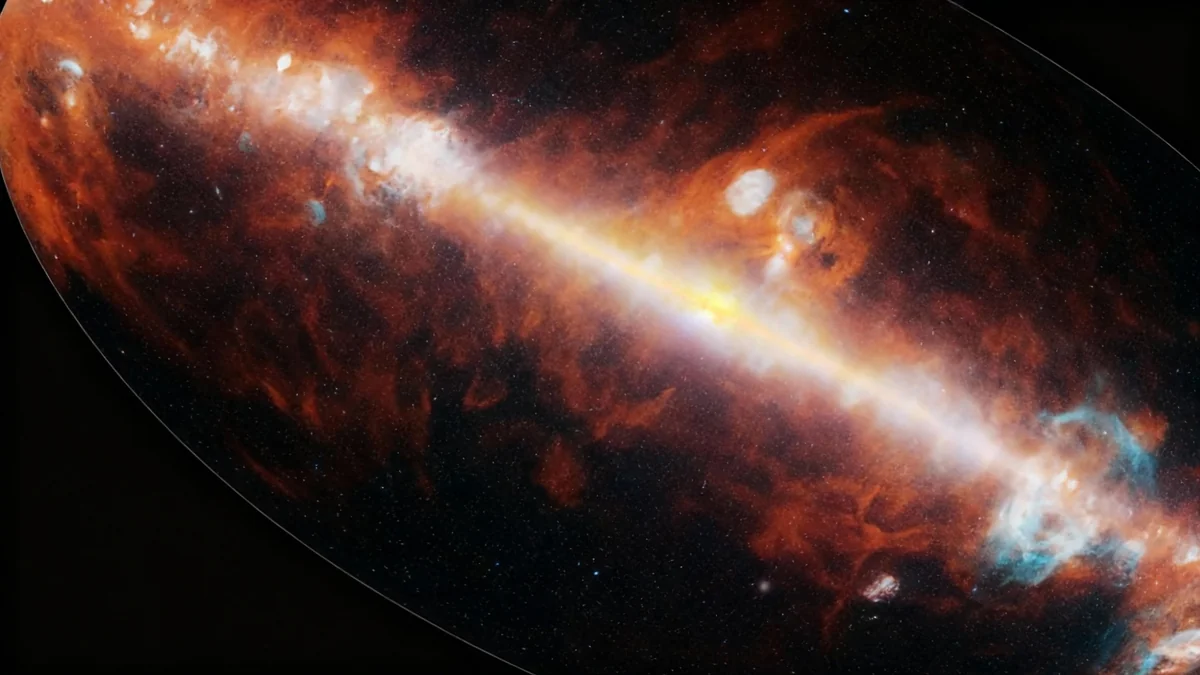


NASA has released the first complete, all-sky map from its Spectro-Photometer for the History of the Universe, Epoch of Reionization, and Ices Explorer (SPHEREx) telescope. The composite image, created just six months into the spacecraft's mission, combines over 100 individual observations to provide an unprecedented view of the cosmos in 102 different infrared colors.
This initial map is the first of at least four planned during the telescope's two-year mission. It provides a massive dataset that scientists will use to investigate the universe's earliest moments and the origins of life-sustaining molecules.
Key Takeaways
- NASA's SPHEREx telescope has produced its first full-sky map of the universe.
- The map combines data across 102 infrared wavelengths, offering unique details invisible to the human eye.
- Primary mission goals include studying the rapid expansion after the Big Bang and tracing icy materials that could seed life on planets.
- The mission faces a significant challenge from the growing number of satellite megaconstellations, which could interfere with observations.
A New Vision of the Cosmos
The SPHEREx telescope, launched on March 12, 2025, surveys the entire sky every six months. Its primary strength lies in its ability to split incoming light into 102 distinct infrared wavelengths, creating a unique spectral map with each pass.
This technique effectively generates 102 separate maps of the sky simultaneously. Each one highlights different celestial features, from distant galaxies to clouds of interstellar dust within our own Milky Way.
"We essentially have 102 new maps of the entire sky, each one in a different wavelength and containing unique information about the objects it sees," said Shawn Domagal-Goldman, the acting director of the Astrophysics Division at NASA Headquarters.
The data collected is vast. During its mission, the $488 million observatory is expected to gather information from over 450 million galaxies. To achieve this, it captures approximately 3,600 images each day, layering them to build an increasingly detailed picture of the universe.
The 'Mantis Shrimp' of Telescopes
The telescope's wide-field, multi-color vision has earned it a unique nickname from its project team.
"That's an amazing amount of information to gather in a short amount of time," noted Beth Fabinsky, the deputy project manager for SPHEREx. "I think this makes us the mantis shrimp of telescopes, because we have an amazing multicolor visual detection system and we can also see a very wide swath of our surroundings."
SPHEREx by the Numbers
- Mission Duration: 2 years
- Sky Scans: 4 total (one every 6 months)
- Infrared Colors: 102
- Galaxies Observed: Over 450 million
- Daily Images: ~3,600
- Project Cost: $488 million
Unlocking Cosmic Secrets
The enormous dataset from SPHEREx is designed to help scientists tackle some of the biggest questions in astronomy. Two of its primary objectives are studying the aftermath of the Big Bang and searching for the building blocks of life.
Probing the Universe's First Moments
One of the central goals is to study cosmic inflation, a theoretical period of extremely rapid expansion that occurred a fraction of a second after the Big Bang, nearly 14 billion years ago. This event is believed to have smoothed out the early universe, leaving behind subtle patterns in the distribution of matter.
By creating a three-dimensional map of hundreds of millions of galaxies, SPHEREx can chart their positions on a massive scale. Scientists will analyze this distribution for statistical ripples left over from the inflationary epoch, which could provide crucial clues about the physics that governed the universe's birth.
What is Cosmic Inflation?
Cosmic inflation is a leading theory explaining several features of our universe, such as its large-scale uniformity. It proposes that in the first tiny fraction of a second of its existence, the universe expanded exponentially, faster than the speed of light. SPHEREx aims to find indirect evidence of this event by mapping how galaxies are clustered today.
Searching for the Ingredients of Life
Closer to home, SPHEREx will act as a cosmic scout within the Milky Way. The telescope will survey vast clouds of gas and dust, looking for the signatures of frozen water, carbon dioxide, and other organic compounds.
These icy materials coat interstellar dust grains, which eventually clump together to form planets and asteroids. By identifying and mapping these ices, scientists hope to better understand how the necessary ingredients for life are delivered to new planetary systems.
"I think every astronomer is going to find something of value here," Domagal-Goldman added, noting the data's wide-ranging applications. "NASA's missions enable the world to answer fundamental questions about how the universe got its start, and how it changed to eventually create a home for us in it."
A Sky Crowded with Satellites
While the initial results from SPHEREx are promising, the mission operates under a growing threat that affects all space-based astronomy: satellite megaconstellations.
Recent studies have modeled the impact of the rapidly increasing number of satellites in low-Earth orbit. Because each SPHEREx image covers a very large area of the sky—about 200 times the size of the full moon—it is highly susceptible to being photobombed by passing spacecraft.
One analysis published in the journal Nature found that more than 96% of SPHEREx exposures could be negatively affected by satellite streaks. This issue also impacts other major observatories, including the Hubble Space Telescope.
With the number of active satellites projected to grow from around 15,000 today to as many as 1 million by the end of the 2030s, astronomers are concerned. Once a faint cosmic signal is obscured by a bright satellite trail, that scientific information can be difficult, if not impossible, to fully recover.