
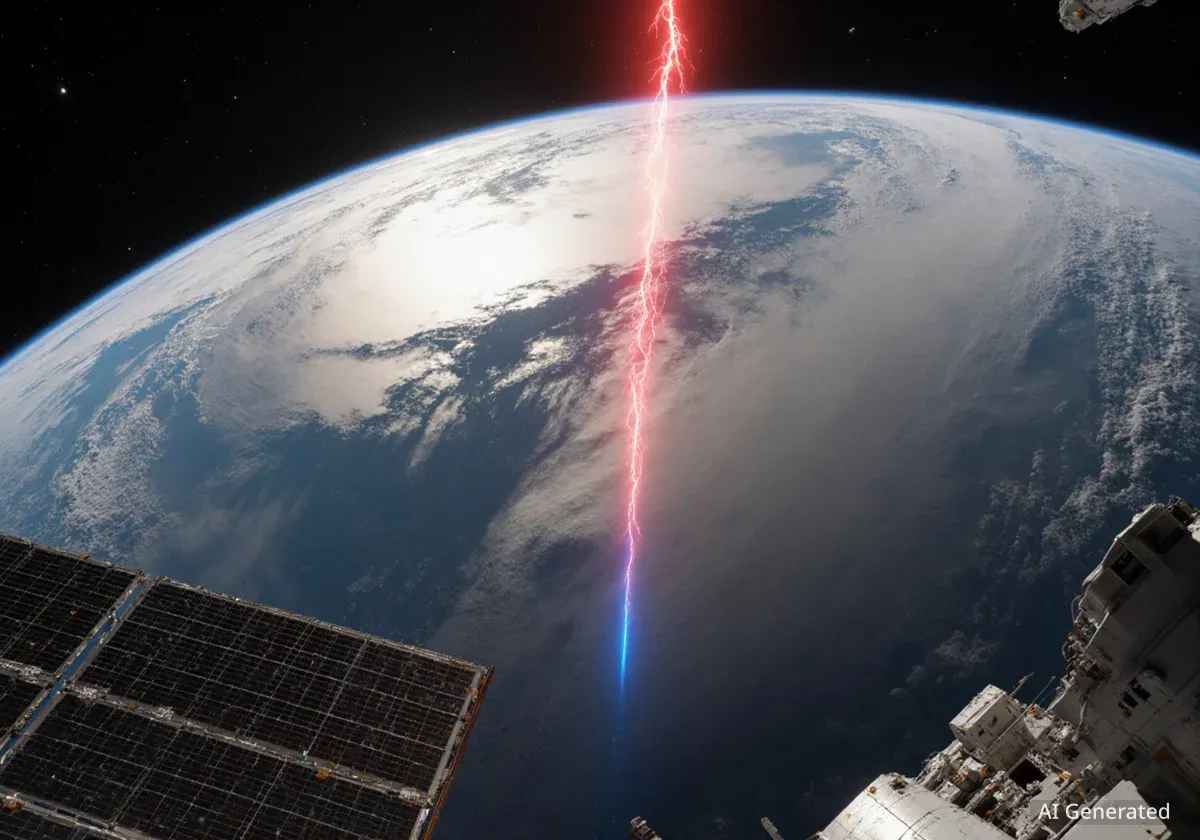

From its vantage point 250 miles above our planet, the International Space Station is revealing a hidden world of spectacular electrical events that occur high above thunderstorms. These fleeting flashes of light, once the subject of pilot folklore, are now being systematically studied, providing crucial new insights into Earth's atmosphere, climate, and the safety of modern technology.
Known as transient luminous events, or TLEs, these phenomena include vibrant red sprites, powerful blue jets, and expanding ultraviolet rings. For years, their existence was difficult to prove, but a suite of advanced instruments aboard the ISS is capturing them in unprecedented detail, changing our understanding of the connection between Earth and space.
Key Takeaways
- The International Space Station (ISS) provides an unobstructed view for studying electrical phenomena in the upper atmosphere.
- Instruments like ESA's ASIM are capturing high-speed data on events like red sprites, blue jets, and ELVES.
- These events can disrupt long-distance radio communications, impact aviation safety, and influence atmospheric chemistry.
- Data collected helps improve climate models and our fundamental understanding of lightning.
A Secret World Above the Clouds
While we are familiar with the lightning and thunder of storms on the ground, a different kind of light show takes place far above. In the thin air up to 55 miles overhead, brilliant and colorful electrical discharges detonate in silence. These events are incredibly brief, some lasting only a few milliseconds, making them nearly impossible to study from Earth's surface.
For decades, sightings were limited to anecdotal reports from high-altitude pilots who described strange, jellyfish-like flashes of red light or blue streams shooting upwards from thunderclouds. Without concrete evidence, these transient luminous events remained on the fringes of atmospheric science. The ISS, orbiting above the weather, has transformed this field of study.
What are Transient Luminous Events (TLEs)?
TLEs are a category of upper-atmospheric electrical discharges that occur above thunderstorms. They are not the same as traditional lightning. The main types include:
- Red Sprites: Large but weak reddish-orange flashes that appear like jellyfish or carrots, occurring in the mesosphere.
- Blue Jets: Cones of blue light that propagate upward from the top of a thundercloud into the stratosphere.
- ELVES: Rapidly expanding rings of ultraviolet and optical emissions in the ionosphere, spanning hundreds of miles.
The View from Orbit
The ISS serves as the premier platform for observing these elusive events. Its consistent orbit and clear view downward, unhindered by clouds, allow specialized sensors to monitor vast regions of the planet for storm activity. Several key experiments are dedicated to this mission, turning the space station into a world-class atmospheric observatory.
The primary tool is the Atmosphere–Space Interactions Monitor (ASIM). Installed on an external platform in 2018, this European Space Agency instrument uses high-speed cameras and photometers to record flashes that are both incredibly faint and extraordinarily fast. ASIM's data has already exceeded expectations, providing a wealth of information on how these events are created and what they do.
Another project, the Thor-Davis experiment, uses the station's famous seven-window Cupola. Astronauts attach an advanced camera capable of filming storms at up to 100,000 frames per second. The resulting slow-motion footage reveals the intricate branching of electrical filaments in ways that were previously only theoretical.
Decoding the Flashes
Impacting Global Communications
ASIM's observations have confirmed that certain discharges atop thunderclouds can energize the upper atmosphere in dramatic ways. One such event, known as an ELVES, is an enormous ring of ultraviolet light that ignites and expands across the ionosphere. This process can alter the electrical charge of this atmospheric layer for hundreds of miles.
Since the ionosphere is used to bounce long-distance radio signals around the curve of the Earth, any disturbance can have significant consequences. Sudden changes in its charge can disrupt or block communications, affecting everything from maritime navigation to emergency broadcasts.
Did You Know?
Some upper-atmospheric events trigger Terrestrial Gamma-ray Flashes (TGFs). These are bursts of high-energy radiation so powerful that a passing airliner could be exposed to a dose equivalent to a chest X-ray in an instant. A CubeSat called Light-1 was deployed from the ISS to map these invisible hazards.
Ensuring Aviation Safety
Understanding TLEs is not just about communications; it's also critical for aviation. Blue jets, which shoot upward from cloud tops toward the stratosphere, represent a powerful transfer of electrical energy into altitudes where aircraft fly. While planes are designed to withstand traditional lightning strikes, the electrical fields associated with these upward-moving events are less understood.
By using ASIM to pinpoint the exact altitude and intensity of blue jets, scientists can refine models of storm behavior. This information feeds directly into aviation guidelines, helping to create safer flight plans on routes that cross major storm systems, particularly over the equator and polar regions.
"By observing these phenomena from the ISS, we are essentially watching the hidden electrical engine of our planet's atmosphere at work. Each flash gives us a new piece of the puzzle."
A New Perspective on Climate
The impact of TLEs extends beyond technology and safety; they also play a role in Earth's climate system. These powerful electrical events can alter the chemistry of the upper atmosphere. They are capable of shuffling chemicals like nitrogen oxides between different atmospheric layers.
These chemical changes can affect the concentration of ozone and alter the radiative balance—how the atmosphere traps and releases heat. By incorporating this vertical mixing process into global climate models, scientists can improve the accuracy of future warming predictions. The data from the ISS is providing the first large-scale measurements of this previously overlooked factor.
As the ISS continues its mission, its storm-watching instruments will build an ever-growing library of these once-invisible events. Future detectors are already being designed to be faster, more sensitive, and capable of seeing an even broader spectrum of light. The space station has shown that to truly understand the weather on Earth, we must sometimes look down from the edge of space.