
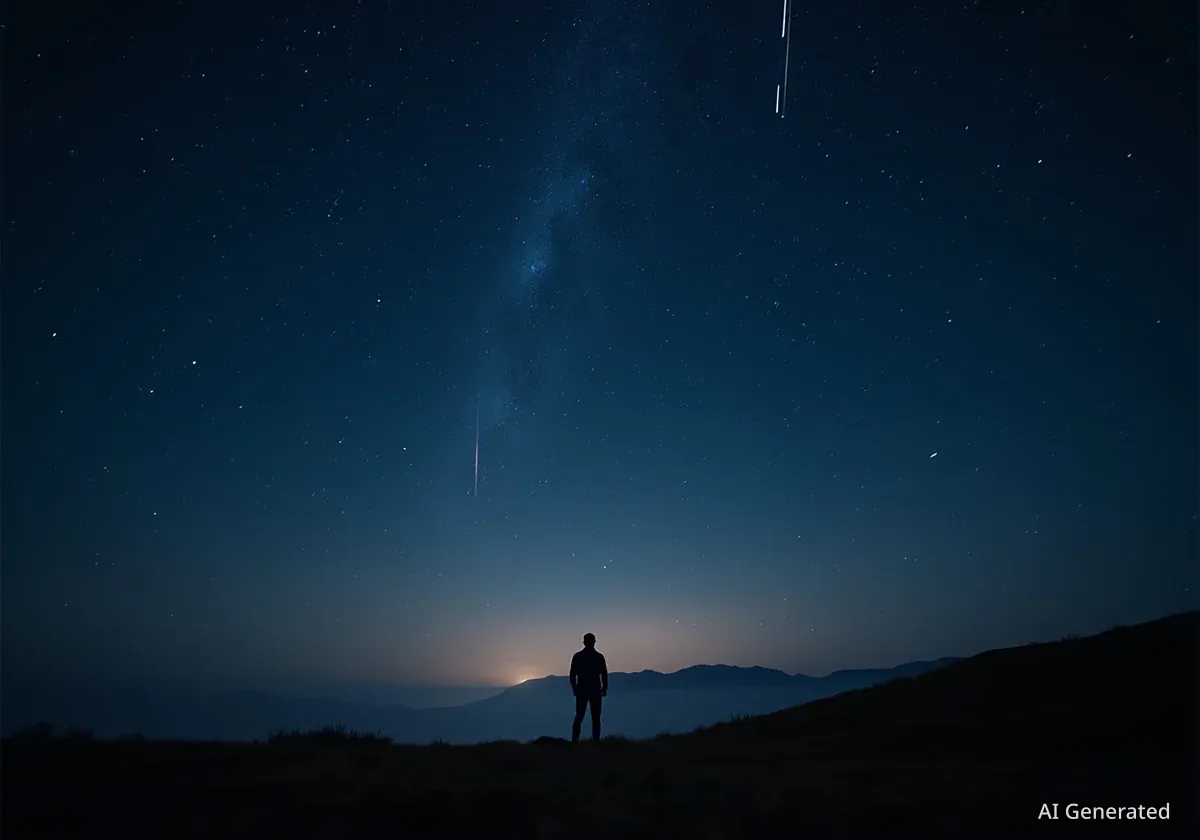

Bright streaks of light that flash across the night sky, often called shooting stars, are a common celestial event. These phenomena, known as meteors, are the visible result of small space debris entering and burning up in Earth's atmosphere. Understanding their origin and the terminology used to describe them provides a clearer picture of our planet's interaction with the cosmic environment.
Key Takeaways
- A meteoroid is a small rock or particle orbiting the sun in space.
- A meteor is the streak of light produced when a meteoroid enters Earth's atmosphere and vaporizes.
- A meteorite is any part of a meteoroid that survives the atmospheric journey and lands on Earth's surface.
- Most meteor showers are caused by the debris trails left behind by comets.
Defining the Celestial Visitors
The terms used to describe space rocks can be confusing, but they refer to different stages of the same object's journey. The distinctions are based on the object's location and state.
Meteoroids: Drifting in Space
A meteoroid is a piece of rock or metal, smaller than an asteroid, that orbits the sun. These objects range in size from tiny dust grains to small boulders. Most meteoroids are fragments broken off from comets or asteroids, products of cosmic collisions that occurred long ago.
They travel through the solar system at high speeds, and their paths can sometimes intersect with Earth's orbit. It is at this point that they have the potential to become visible from the ground.
What's the Difference Between an Asteroid and a Meteoroid?
The primary distinction between an asteroid and a meteoroid is size. Asteroids are generally defined as rocky bodies larger than one meter in diameter, while meteoroids are smaller. Both orbit the sun and are remnants from the formation of our solar system.
Meteors: The Fiery Descent
When a meteoroid enters Earth's atmosphere, it is traveling at tens of thousands of miles per hour. The immense friction and compression of air in front of the object cause it to heat up rapidly, creating a glowing trail of light. This visible phenomenon is what we call a meteor, or more commonly, a "shooting star."
The bright streak is not the rock itself burning, but rather the glowing, ionized air molecules in its path. Most meteors are caused by particles no larger than a grain of sand and typically burn up completely at altitudes of 50 to 75 miles.
How Long Does a Meteor Last?
The visible life of a typical meteor is incredibly brief. The streak of light we see in the sky usually lasts for only a few seconds before the particle is completely vaporized in the atmosphere.
Meteorites: Survivors on Earth
If a meteoroid is large enough to survive its fiery passage through the atmosphere and strike the ground, it is then called a meteorite. These objects are scientifically valuable as they provide physical samples of celestial bodies, offering direct clues about the composition and history of our solar system.
Finding a meteorite is rare, as most burn up entirely or land in oceans or remote areas. They are typically classified into three main types: iron, stony, and stony-iron.
The Spectacle of Meteor Showers
While sporadic meteors can be seen on any given night, certain times of the year bring dramatic increases in activity known as meteor showers. These events occur when Earth passes through a dense trail of debris left behind by a comet or, occasionally, an asteroid.
"Meteor showers are predictable celestial events that offer a fantastic opportunity for skywatching. They are a direct connection to the comets that travel through our solar system, leaving cosmic breadcrumbs for Earth to pass through each year."
Cometary Debris Trails
As a comet approaches the sun, its ice vaporizes, releasing trapped dust and rock particles. This material spreads out along the comet's orbital path. When Earth's orbit intersects one of these debris streams, we experience a meteor shower. The particles enter our atmosphere at roughly the same time and from the same direction, creating the appearance of meteors radiating from a single point in the sky, known as the radiant.
Annual Meteor Showers to Watch
Several meteor showers occur annually, each named after the constellation from which they appear to radiate. Some of the most well-known include:
- Quadrantids: Peaking in early January, this shower is known for its short, intense peak.
- Perseids: One of the most popular showers, the Perseids peak in mid-August and are known for their bright, fast meteors. They originate from debris left by Comet Swift-Tuttle.
- Orionids: This shower occurs in October and is associated with one of the most famous comets, Halley's Comet.
- Geminids: Peaking in mid-December, the Geminids are unusual because their parent body is an asteroid, 3200 Phaethon, not a comet. They are often bright and intensely colored.
When Meteors Make Headlines
Occasionally, a much larger object enters the atmosphere, creating a spectacular and sometimes dangerous event. These exceptionally bright meteors are known as fireballs or bolides.
Fireballs and Bolides
A fireball is a meteor that is brighter than the planet Venus. A bolide is a particularly large and bright fireball that often explodes in the atmosphere, an event known as an air burst. These explosions can create a loud sonic boom that is audible on the ground.
These events are much rarer than typical meteors but serve as a powerful reminder of the dynamic nature of our solar system.
The Chelyabinsk Event
One of the most significant modern meteor events occurred in February 2013 over Chelyabinsk, Russia. An asteroid approximately 20 meters in diameter entered the atmosphere and exploded in a massive air burst. The resulting shockwave caused extensive damage, shattering windows and injuring over 1,500 people, primarily from broken glass.
The Chelyabinsk event highlighted the potential hazards posed by near-Earth objects and prompted increased international efforts to detect and track them. It was a stark illustration of how even relatively small space rocks can have a significant impact when they intersect with our planet.