


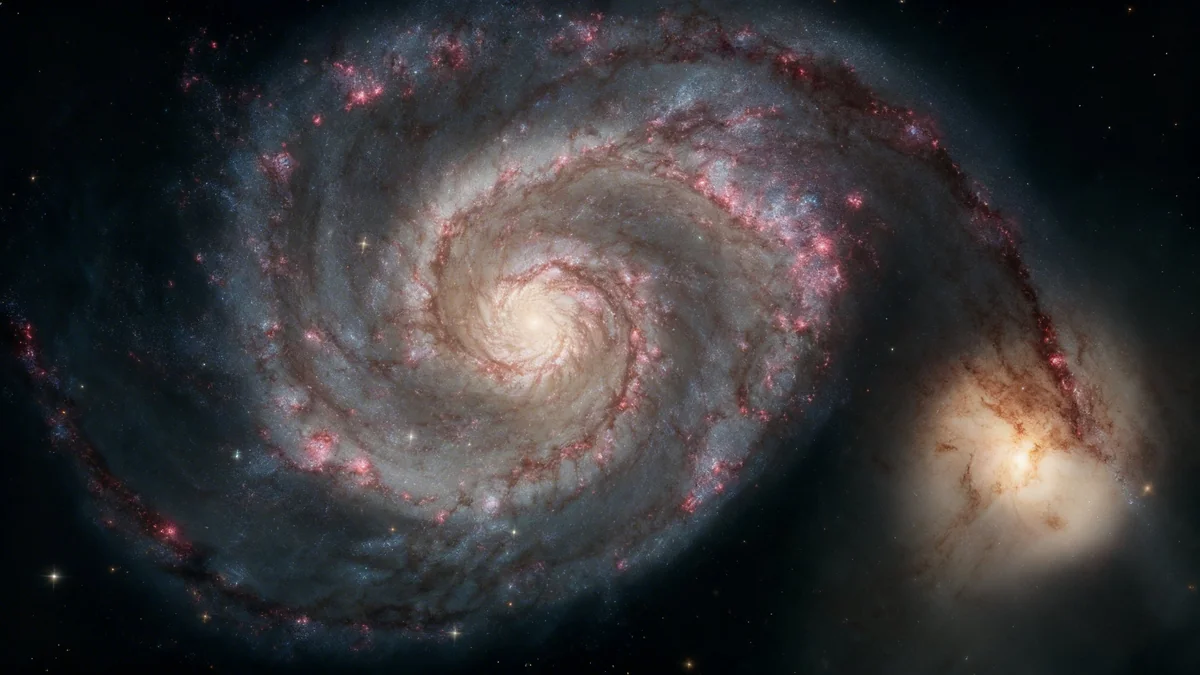
The Hubble Space Telescope has provided detailed images of NGC 2775, a galaxy located 67 million light-years from Earth. This cosmic structure presents a puzzle for astronomers, as it displays characteristics of both spiral and elliptical galaxies, making its classification difficult.
The galaxy's appearance combines a large, smooth central bulge with faint, feathered spiral arms in its outer disk. This unusual combination challenges standard models of galaxy formation and evolution, prompting further study into its history.
Key Takeaways
- NGC 2775 is a galaxy situated 67 million light-years away, meaning we observe it as it was in Earth's distant past.
- It features a large, smooth central region typical of an elliptical galaxy, but also has structured outer arms characteristic of a spiral galaxy.
- Evidence, such as a massive hydrogen gas tail, suggests NGC 2775 has merged with smaller galaxies in its history.
- Astronomers continue to debate whether to classify it as a spiral, elliptical, or a transitional lenticular galaxy.
A View Across 67 Million Light-Years
NGC 2775 is located at a significant distance from our own Milky Way galaxy. At 67 million light-years away, the light captured by the Hubble Space Telescope began its journey toward Earth around the time the dinosaurs went extinct.
This vast distance means that observing NGC 2775 is like looking through a time machine. Astronomers are not seeing the galaxy as it is today, but as it existed millions of years ago. This provides a valuable snapshot of galactic evolution at a different point in cosmic history.
Understanding Galaxy Classification
Galaxies are vast systems of stars, gas, dust, and dark matter bound together by gravity. Scientists classify them based on their visual shape. The primary types include:
- Spiral Galaxies: Characterized by a central bulge and distinct, winding arms where new stars are actively forming. Our Milky Way is a spiral galaxy.
- Elliptical Galaxies: Appear as smooth, oval-shaped collections of older stars with very little dust or gas for new star formation. They are often the result of galactic mergers.
- Lenticular Galaxies: An intermediate type that has a central bulge and a disk, but lacks prominent spiral arms. They share traits with both spiral and elliptical galaxies.
- Irregular Galaxies: Lack any distinct shape and are often chaotic in appearance, sometimes due to gravitational interactions with other galaxies.
The Conflicting Features of NGC 2775
Images from the Hubble Space Telescope reveal the complex and contradictory nature of NGC 2775. The galaxy's structure forces astronomers to question how it should be categorized.
An Elliptical-Like Center
At its core, NGC 2775 has a massive, bright central bulge. This region is remarkably smooth and appears largely devoid of distinct features or active star formation. This characteristic is a hallmark of elliptical galaxies, which are typically composed of older, more settled star populations.
Elliptical galaxies are often thought to be the end result of major cosmic collisions. When galaxies merge, the intense gravitational forces can disrupt orderly structures like spiral arms, resulting in a more uniform, blob-like appearance.
Spiral-Like Outer Regions
In stark contrast to its smooth center, the outer disk of NGC 2775 shows clear signs of structure. It features what astronomers describe as compacted or flocculent spiral arms. These arms are not as well-defined as those in classic spiral galaxies but are clearly present.
Furthermore, these outer arms contain patches of blue and red light. The blue patches indicate the presence of hot, young stars, a clear sign that star formation is still occurring in this part of the galaxy. This active star birth is a defining feature of spiral galaxies, not ellipticals.
A Tale of Two Structures
The central mystery of NGC 2775 is its dual personality. Its enormous, featureless center suggests a history of mergers, typical of an elliptical galaxy. However, its structured outer disk with ongoing star formation is a classic trait of a spiral galaxy.
Evidence of a Turbulent Past
One of the key challenges in studying distant galaxies is our limited perspective. We can only view them from a single angle from Earth, unlike planets in our solar system which can be studied by orbiting spacecraft.
Despite this limitation, other forms of observation provide clues about NGC 2775's history. Astronomers have detected a massive tail of hydrogen gas stretching an incredible 100,000 light-years around the galaxy. This feature is not visible in the Hubble images, which primarily capture visible and infrared light.
This immense gas tail is considered strong evidence of past galactic mergers. It is likely the remnant of one or more smaller galaxies that were torn apart and consumed by the gravitational pull of NGC 2775.
Such a merger event, or series of events, could help explain the galaxy's unusual structure. The collision might have funneled gas and stars toward the center, creating the large bulge, while leaving some material in the outer disk to form the faint spiral arms we see today.
An Unresolved Cosmic Puzzle
So, what kind of galaxy is NGC 2775? The answer remains uncertain, and it continues to defy easy definition. Its unique characteristics place it at the crossroads of galactic classification.
Possible Classifications
- A Spiral Galaxy: It could be a type of spiral galaxy with an unusually large central bulge and less-defined arms.
- A Lenticular Galaxy: This category is often used for galaxies that seem to be in transition between spiral and elliptical. Lenticulars may be former spiral galaxies that have used up most of their gas for star formation or have had their arms disrupted by mergers.
- A Unique Post-Merger System: NGC 2775 might represent a specific stage in galactic evolution following a major merger, where some disk features have managed to survive or reform.
For now, NGC 2775 serves as an important natural laboratory for studying how galaxies evolve. Its strange and beautiful appearance, captured by Hubble, reminds us that the universe is filled with objects that do not always fit neatly into our established categories. The jury is still out, and this cosmic beast continues to be a subject of fascination and study.