
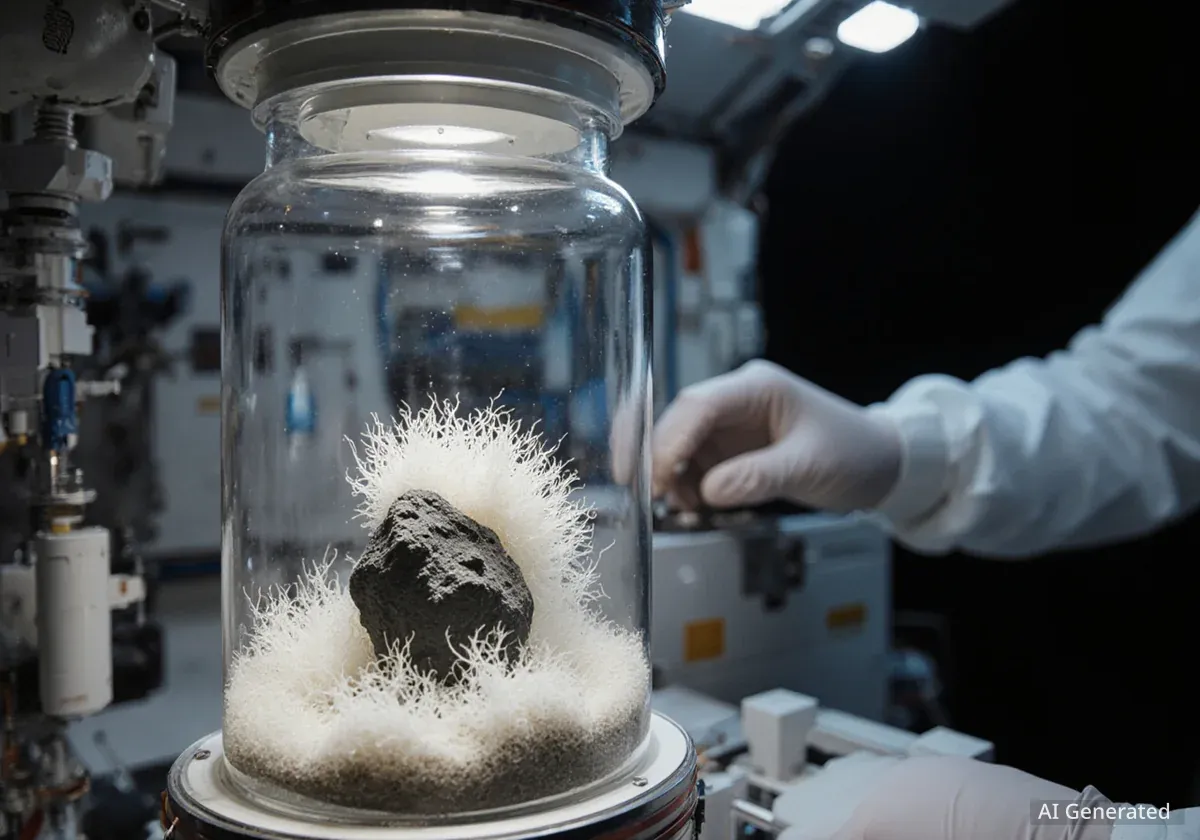

In a groundbreaking experiment aboard the International Space Station (ISS), researchers have successfully used microbes to extract valuable metals, including platinum, from a meteorite. This achievement marks a significant step toward developing self-sustaining colonies on the Moon and Mars.
The study, part of a collaboration between the University of Edinburgh and the European Space Agency (ESA), demonstrates that biological mining, or 'biomining,' is a viable method for harvesting resources in microgravity. The findings could dramatically reduce the cost and logistical challenges of long-duration space missions by allowing astronauts to process materials found in space.
Key Takeaways
- Scientists used bacteria and fungi on the ISS to extract metals from a meteorite sample.
- A fungus, Penicillium simplicissimum, became more efficient at extracting platinum and palladium in microgravity.
- The experiment confirms that biomining is a feasible technology for future missions to the Moon and Mars.
- This method could help future space colonies become self-sufficient by using local resources.
An Experiment in Orbit
The research was conducted as part of the BioAsteroid project, which sent specially designed "biomining reactors" to the ISS in late 2020. Inside these containers, NASA astronaut Michael Scott Hopkins placed samples of an L-chondrite meteorite, a common type of space rock, and introduced two specific microorganisms.
The microbes chosen for the mission were the bacterium Sphingomonas desiccabilis and the fungus Penicillium simplicissimum. Scientists on Earth conducted a parallel control experiment to compare the results between microgravity and standard Earth gravity.
Researchers from Cornell University and the University of Edinburgh led the analysis. "This is probably the first experiment of its kind on the International Space Station on a meteorite," said Rosa Santomartino, an assistant professor at Cornell and a lead author of the study. "We wanted to understand what and how, but keep the results relevant to a broader perspective, because not much is known about the mechanisms that influence microbial behavior in space."
Harnessing Nature for Space Resources
Biomining is not a new concept on Earth, where microbes are used to extract metals from ore. The process relies on the natural ability of certain bacteria and fungi to produce acids that dissolve rock and release minerals.
The organisms in the ISS experiment secrete carboxylic acids, which bind to elements within the meteorite and leach them out into a liquid solution. This biological method offers a low-energy, sustainable alternative to traditional chemical extraction, which would be difficult and dangerous to implement in a space environment.
Why Biomining Matters for Space Exploration
Launching materials from Earth is extremely expensive, costing thousands of dollars per kilogram. To establish a permanent presence on the Moon or Mars, astronauts will need to live off the land, a concept known as In-Situ Resource Utilization (ISRU). Biomining could allow them to extract iron for building materials, rare metals for electronics, and other essential elements directly from the local soil and rock (regolith).
The goal of the BioAsteroid project was to see if this process, which is well-understood on Earth, could function effectively without the influence of gravity.
Surprising Results in Microgravity
After analyzing the data from the ISS, the research team found that the microbes were highly effective. The experiment successfully extracted 18 different elements from the meteorite through biological processes.
"We don’t see massive differences, but there are some very interesting ones," explained Alessandro Stirpe, a research associate at Cornell and the University of Edinburgh. "We split the analysis to the single element, and we started to ask, OK, does the extraction behave differently in space compared to Earth?"
While both microbes performed consistently, the fungus, Penicillium simplicissimum, delivered a surprising result. In the microgravity environment of the ISS, it actually became more efficient. The fungus increased its production of certain molecules, leading to enhanced extraction of valuable metals like palladium and platinum compared to the control experiment on Earth.
Key Finding: Fungus Thrives in Space
The analysis revealed that the fungus increased its production of carboxylic acids in space. This change in its metabolism made it a more effective miner in microgravity, a crucial and unexpected discovery for future space resource applications.
Interestingly, the experiment also showed that non-biological leaching was less effective in space than on Earth. This suggests that the microbes not only work in space but may be essential for making resource extraction practical.
The Future of Off-World Industry
This successful demonstration of biomining in orbit has profound implications for the future of human space exploration. It provides a proof-of-concept for technologies that could support long-term habitats on other celestial bodies.
By using microbes to process local regolith, future astronauts could:
- Create building materials for structures and landing pads.
- Manufacture tools and spare parts.
- Extract water and oxygen trapped in minerals.
- Source rare earth elements for advanced electronics.
The technique also has potential applications back on Earth. Biomining could offer a more environmentally friendly way to extract metals from low-grade ores or even from electronic waste, contributing to a more sustainable, circular economy.
However, researchers caution that more work is needed. "Depending on the microbial species, depending on the space conditions... everything changes," Santomartino noted. "Bacteria and fungi are all so diverse... the space condition is so complex that, at present, you cannot give a single answer. So maybe we need to dig more."
This experiment has opened a new frontier in space resource utilization, proving that some of Earth's smallest organisms may be the key to humanity's biggest adventures.