

The Euclid satellite, a mission developed with key contributions from UK scientists, is two years into its six-year task of creating the largest-ever 3D map of the universe. The project aims to provide new insights into the nature of dark matter and dark energy, which together are believed to constitute 95% of the cosmos.
Led by the European Space Agency and launched by SpaceX, the satellite is gathering high-quality images of billions of galaxies. A team of 2,000 researchers worldwide, including experts from the University of Surrey and the University of Oxford, is analyzing the data, which has already exceeded performance expectations.
Key Takeaways
- The Euclid satellite is on a six-year mission to survey one-third of the sky, mapping billions of galaxies.
- Its primary goal is to investigate dark matter and dark energy, which make up about 95% of the universe.
- Professor Adam Amara of the University of Surrey, who helped design the satellite, reports that its performance and image quality have surpassed initial expectations.
- Unlike the James Webb telescope's high-resolution focus, Euclid is designed for a wide, deep, and sharp survey of the cosmos.
- The project involves a global collaboration of 2,000 scientists and is expected to inspire a new generation of astrophysicists.
Euclid's Six-Year Cosmic Survey
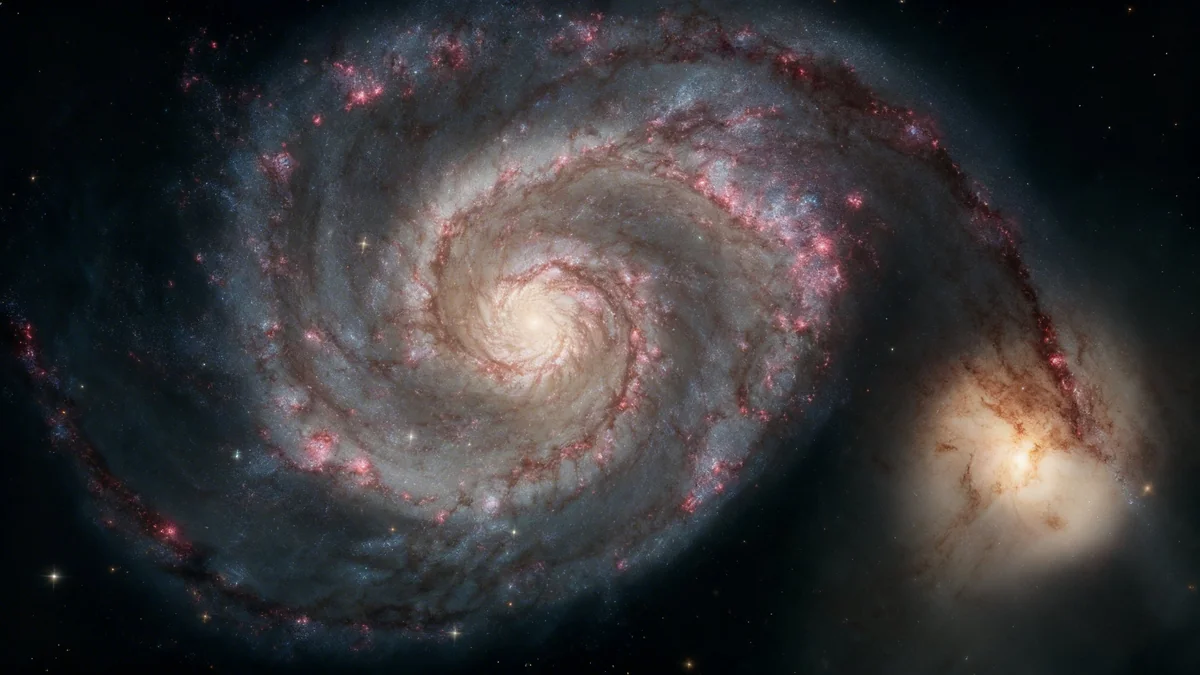
The Euclid satellite is currently engaged in a comprehensive survey of the cosmos. Over its six-year operational lifespan, it will observe a vast portion of the sky, capturing data on the shapes, distances, and movements of billions of galaxies. Some of the light from these galaxies has traveled for nearly the entire age of the universe to reach the satellite's instruments.
This extensive mapping project is designed to create the most detailed three-dimensional chart of the universe ever assembled. Scientists believe that hidden within the statistical patterns of this map are the clues needed to understand the universe's fundamental components and its accelerating expansion.
A Global Scientific Effort
The analysis of Euclid's data is a massive undertaking. According to Professor Adam Amara of the University of Surrey, a key figure in the satellite's development, a team of 2,000 people across the globe is dedicated to processing the images. This continuous effort, happening day and night, is essential for extracting meaningful scientific discoveries from the vast amount of information Euclid provides.
Professor Amara noted the dedication of the international team and the quality of the initial results. "We have 2,000 people across the world working every day, night and day, to process these images and look for little gems in what we can find out about the universe," he said.
The Mystery of the Dark Universe
One of the central goals of the Euclid mission is to address the puzzle of the "dark universe." Current cosmological models suggest that the matter and energy we can directly observe, such as stars, planets, and gas clouds, account for only a small fraction of the cosmos.
The remaining 95% is thought to be composed of two mysterious components: dark matter and dark energy. While their existence is inferred from their gravitational effects on visible matter, their true nature remains unknown. Euclid is designed to detect their subtle influences on the structure and distribution of galaxies.
Composition of the Universe
Based on current experiments and observations, scientists estimate the universe's contents are divided as follows:
- Approximately 68% is dark energy, the force believed to be driving the accelerated expansion of the universe.
- Approximately 27% is dark matter, an unseen substance that provides the gravitational scaffolding for galaxies to form.
- Approximately 5% is normal, or baryonic, matter—the atoms that make up everything we can see and touch.
By precisely measuring the shapes and positions of galaxies, scientists can map the distribution of dark matter. Simultaneously, by charting the expansion history of the universe, they can study the properties of dark energy. Euclid's data is expected to provide the most accurate measurements of these phenomena to date.
A Unique Instrument for Astronomy
The Euclid satellite possesses a unique combination of capabilities that set it apart from other space telescopes. While instruments like the James Webb Space Telescope offer extremely high-resolution images of small sections of the sky, Euclid is built for breadth and scale.
It is engineered to capture a wide field of view in a single observation, allowing it to survey large areas of the sky efficiently without sacrificing depth or sharpness. This makes it the ideal tool for a large-scale cosmic census. "There isn't an experiment like it in space. It's unique," stated Professor Amara.
"To see the images come through and be even better than expected was absolutely incredible because we all had sleepless nights," Professor Amara shared, reflecting on the initial data. He described the images as "just breathtaking in themselves" and "almost works of art."
The mission has already delivered results that are, in his words, "as good as and better than we expected." These early findings, many led by UK-based researchers, confirm that the satellite is performing flawlessly and is on track to achieve its ambitious scientific goals.
Inspiring the Next Generation
The groundbreaking work of the Euclid mission is also serving as an inspiration for students pursuing careers in astrophysics and cosmology. At the University of Surrey's Space Centre, students under Professor Amara's guidance are closely following the project's progress.
Harry, a master's student, expressed his interest in dark matter, stating, "I just want to keep answering questions about astronomy and astrophysics." Another student, Astha, who is working on her PhD, believes the UK provides "abundant opportunities" for aspiring scientists in the field and sees herself analyzing satellite data in the future.
Sriraksha, also a master's student, was drawn to the field by her "love of star gazing." Her goal is to "understand how everything is connected."
Professor Amara sees these students as a vital part of the mission's legacy. "My greatest ambition is to make sure UK scientists, especially the young ones, have more opportunities going forward," he said. He views Euclid as a multi-generational project that will take time to yield its ultimate discoveries but will fundamentally reshape our view of the cosmos.