

New research presents conflicting explanations for organic molecules detected in plumes erupting from Enceladus, one of Saturn's icy moons. One study suggests space radiation could create these compounds on the moon's surface, while another analysis of mission data indicates they originate from deep within its subsurface ocean, intensifying the debate over the moon's potential for life.
The findings from two separate research teams highlight the complexities of searching for life beyond Earth. They force scientists to reconsider how to interpret data from distant worlds and what processes, biological or otherwise, could produce the chemical building blocks of life.
Key Takeaways
- A new laboratory study shows that space radiation can create organic molecules on simulated Enceladus ice, offering a non-biological origin for compounds detected by the Cassini spacecraft.
- A separate analysis of Cassini data found complex organic molecules in fresh ice grains, suggesting they came directly from the moon's subsurface ocean.
- These conflicting findings complicate the scientific search for habitability on Enceladus, a prime target for astrobiology research.
- The debate influences the design of future missions to Enceladus and other icy moons in the solar system, such as Jupiter's moon Europa.
The Enceladus Plume Mystery
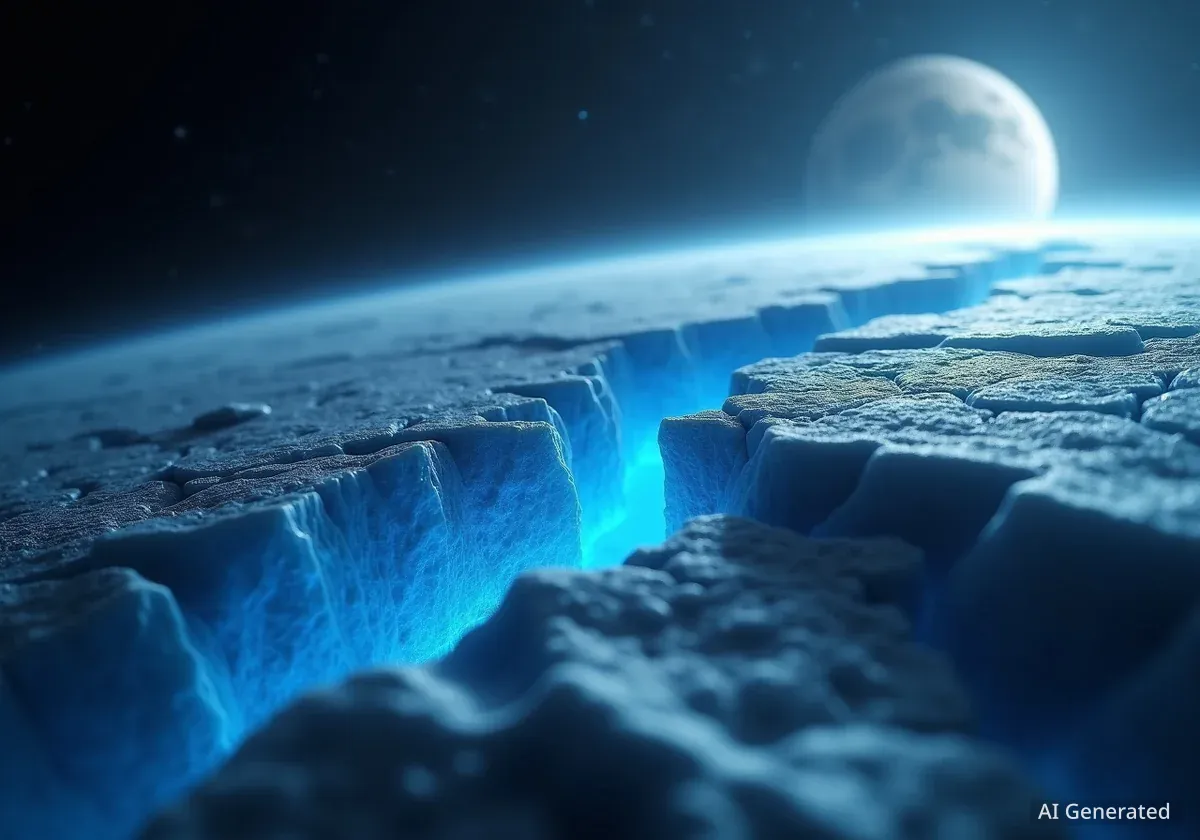
Saturn's moon Enceladus is a key target in the search for extraterrestrial life. Beneath its thick ice shell lies a global ocean of liquid water. This ocean is not entirely sealed off; massive plumes of ice particles and gas erupt from cracks near the moon's south pole, jetting material hundreds of kilometers into space.
Between 2005 and 2015, NASA's Cassini spacecraft flew through these plumes multiple times. Its instruments detected a variety of organic molecules, which are compounds containing carbon. This discovery was seen as strong evidence that Enceladus's ocean could be a habitable environment, potentially containing the necessary ingredients for life.
What Makes Enceladus Special? Enceladus is one of the few places in the solar system known to possess the three key ingredients for life as we know it: liquid water, an energy source (from tidal forces and potential hydrothermal vents), and the right chemical elements, including carbon, hydrogen, nitrogen, and oxygen.
However, the exact origin of these organic molecules has remained an open question. Do they come from chemical reactions within the deep ocean, or are they created by other processes after being ejected into space? Two recent studies provide different answers to this critical question.
Radiation as a Chemical Factory
One team of scientists explored whether the harsh environment of space could be responsible for creating some of the observed organic molecules. Led by planetary scientist Grace Richards from the National Institute for Astrophysics in Rome, the researchers simulated the conditions on the surface of Enceladus in a laboratory.
They created an ice mixture of water, carbon dioxide, methane, and ammonia—the primary components expected on the moon's surface. This mixture was cooled to -200°C (-328°F) inside a vacuum chamber to mimic the cold, airless environment.
The team then bombarded the ice with water ions, which are a major part of the radiation that constantly surrounds Enceladus. The results, presented at the Europlanet Science Congress, showed that this radiation triggered a series of chemical reactions.
The experiment successfully produced a range of molecules, including carbon monoxide, various alcohols, and even molecular precursors to amino acids like formamide and acetaldehyde. These are some of the same types of simple organic compounds detected by Cassini.
This finding suggests that at least some of the organic material seen in the plumes may not originate from the ocean at all. Instead, it could be formed on the surface ice after material is ejected or from radiation processing of the plume particles themselves.
"When you’re trying to infer this ocean composition from what you’re seeing in space, it’s important to understand all the processes that go into modifying this material," Richards explained. She clarified that her work does not rule out a habitable ocean but adds a necessary layer of caution to interpreting the data.
Alexis Bouquet, a planetary scientist not involved in the study, emphasized the value of such experiments. "They demonstrated that you can produce a certain variety of species in conditions that are relevant to the south pole of Enceladus," he said. This type of research is vital for planning future missions, especially to Jupiter's moons like Europa, where radiation levels are even more intense.
Evidence for an Ocean Origin
In contrast to the radiation theory, a second study provides evidence that the organic molecules come directly from the moon's interior. A team led by planetary scientist Nozair Khawaja of the Freie Universität Berlin re-analyzed data from one of Cassini's final and closest flybys of Enceladus in 2008, when it passed just 28 kilometers from the surface.
Their findings, published in Nature Astronomy, identified new and more complex types of organic molecules. These included compounds with ester and ether groups, which on Earth are important links in the chemical reactions that build complex biological molecules.
Crucially, Khawaja's team determined that these molecules were found in fresh ice grains that had likely been in space for only a few minutes before Cassini sampled them. "It is fresh," Khawaja stated, emphasizing the short transit time from the vents to the spacecraft's instruments.
This short duration is a key point. According to experts, a few minutes is not enough time for space radiation to create such complex organic chemistry, even in a high-radiation environment. "Big grains coming from the surface full of organics? That is much harder to explain through radiation chemistry," commented Bouquet.
Khawaja believes his team's results tell a different story. "Our results tell the other story completely," he said, suggesting that these complex compounds were formed within the ocean and then ejected through the plumes, offering a direct sample of the moon's internal chemistry.
Implications for Future Missions
The two studies, while presenting different possibilities, both reinforce Enceladus as a top-tier destination in the search for life. The presence of complex organic molecules, regardless of their origin, points to a chemically dynamic environment.
This ongoing scientific debate will directly influence the next generation of space exploration. Understanding the role of radiation is essential for designing instruments that can distinguish between surface-level chemistry and signals from the deep ocean. Future missions may need to be designed to sample material as close to the vents as possible to minimize exposure to space radiation.
Several potential missions to Enceladus are being studied by both NASA and the European Space Agency (ESA). These concepts include high-speed flybys designed to capture plume material and even ambitious plans for a lander that could analyze surface ice near the south polar vents.
The insights gained from these recent studies will help scientists refine their objectives and build better tools to answer one of humanity's biggest questions: are we alone in the universe? As Khawaja noted, when it comes to looking for life, "There is no better place to look for [it] than Enceladus."