
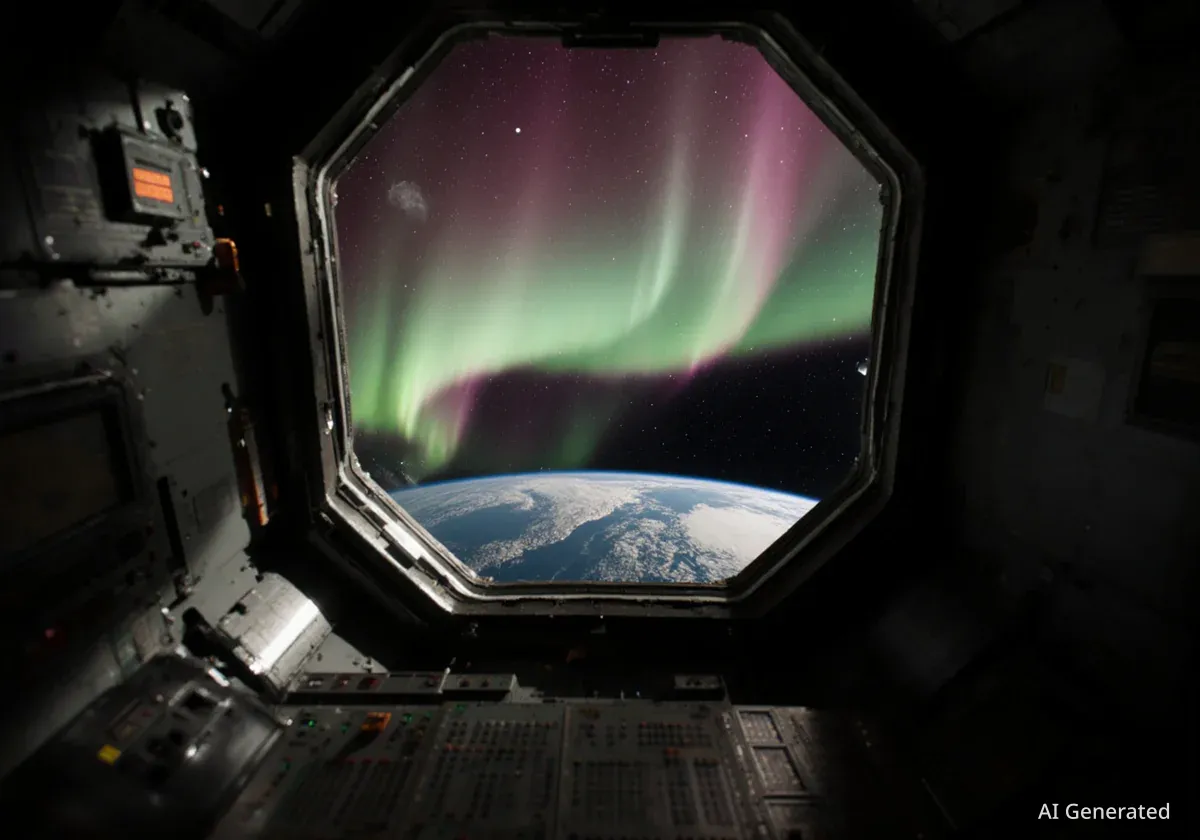

A Russian cosmonaut aboard the International Space Station (ISS) has captured breathtaking images of the aurora blanketing Earth during the most powerful solar storm to hit the planet in two decades. The photographs offer a unique orbital perspective of the vibrant light display that captivated observers worldwide.
The event, a result of intense solar activity, generated stunning auroras visible at latitudes far lower than usual, while also highlighting the importance of studying space weather from platforms like the ISS.
Key Takeaways
- A Roscosmos cosmonaut on the International Space Station photographed the aurora during a major geomagnetic storm.
- The solar storm was the most intense recorded in over 20 years, causing widespread and vibrant auroral displays.
- The images provide a rare orbital view of the interaction between solar particles and Earth's atmosphere.
- The ISS serves as a crucial platform for observing and studying space weather phenomena and their effects on Earth.
A Unique Vantage Point from Orbit
From approximately 250 miles (400 kilometers) above the planet, astronauts and cosmonauts aboard the International Space Station have a front-row seat to Earth's most dynamic atmospheric events. The recent images, released by the Russian space agency Roscosmos, show ethereal green and magenta curtains of light dancing over the limb of the Earth.
This perspective is vastly different from the one on the ground. While terrestrial observers see vertical pillars and arcs of light in the sky, the crew on the ISS can see the vast, horizontal expanse of the aurora stretching for thousands of miles. They witness the full scale of the interaction between the sun's energy and our planet's magnetic shield.
The ISS orbits Earth every 90 minutes, allowing its crew to pass through the auroral oval multiple times a day during such events. This provides an unparalleled opportunity to document the phenomenon's evolution and geographic spread in real-time.
The Science Behind the Spectacle
The stunning light show was triggered by a series of powerful solar flares and coronal mass ejections (CMEs) originating from a massive sunspot cluster. These eruptions sent a torrent of charged particles hurtling through space toward Earth.
When these particles reached our planet, they were channeled by Earth's magnetic field toward the polar regions. There, they collided with oxygen and nitrogen atoms in the upper atmosphere. These collisions excite the atoms, causing them to release energy in the form of light, which we see as the aurora.
What Causes the Different Colors?
The colors of the aurora depend on which gas is being excited and at what altitude. The most common color, a pale green, is produced by oxygen atoms at altitudes of about 60 to 150 miles (100 to 240 km). The rarer, all-red auroras are created by high-altitude oxygen, sometimes above 180 miles (300 km). Pinks and deep reds are often seen at the lower edges of the display, caused by nitrogen molecules.
This particular event was classified as an "extreme" G5 geomagnetic storm, the highest level on the scale. The last storm of this magnitude occurred in October 2003. The intensity of this storm is what pushed the auroral displays to be visible in places that rarely, if ever, see them.
A Global Light Show
While the view from space was extraordinary, the recent solar storm also created a celestial spectacle for millions on the ground. Reports of visible auroras came from across the globe, including unusual locations like northern India, Mexico, and the Canary Islands.
In Europe, the northern lights were seen as far south as Italy and Greece. Across the United States, observers from Florida to Southern California shared remarkable photos of the sky glowing with vibrant colors. This widespread visibility was a direct result of the storm's intensity, which caused Earth's magnetic field to be temporarily compressed, allowing the charged particles to penetrate deeper into the atmosphere and at lower latitudes.
Did You Know?
The term "aurora borealis" means "dawn of the north," named by astronomer Galileo Galilei in 1619. Its southern counterpart, the "aurora australis" or "southern lights," was named by explorer James Cook on his voyages in the 18th century. From space, both can sometimes be seen simultaneously.
Social media platforms were flooded with images from both professional photographers and casual observers, making this one of the most widely documented auroral events in history. The shared experience connected people from different continents, all looking up at the same cosmic display.
The ISS as a Scientific Outpost
Beyond capturing beautiful images, the International Space Station plays a vital role in the study of space weather. Its position above the distorting effects of the atmosphere makes it an ideal laboratory for observing solar phenomena and their impact on our planet.
Astronauts and cosmonauts on board conduct various experiments to understand:
- The effects of solar radiation on equipment and living organisms.
- The dynamics of Earth's magnetic field.
- The composition and behavior of the upper atmosphere during geomagnetic storms.
Data collected from the ISS helps scientists improve space weather forecasting models. Accurate predictions are crucial for protecting satellites, power grids, and communication systems on Earth from the potentially damaging effects of severe solar storms. The station itself is heavily shielded to protect its crew and critical systems from radiation during such events.
Understanding space weather is not just an academic pursuit; it is essential for safeguarding the technological infrastructure that underpins modern society.
The latest images serve as a powerful reminder of the dynamic and sometimes volatile relationship between the Sun and Earth. They showcase the beauty of natural phenomena while underscoring the scientific importance of our continued presence in low-Earth orbit.