

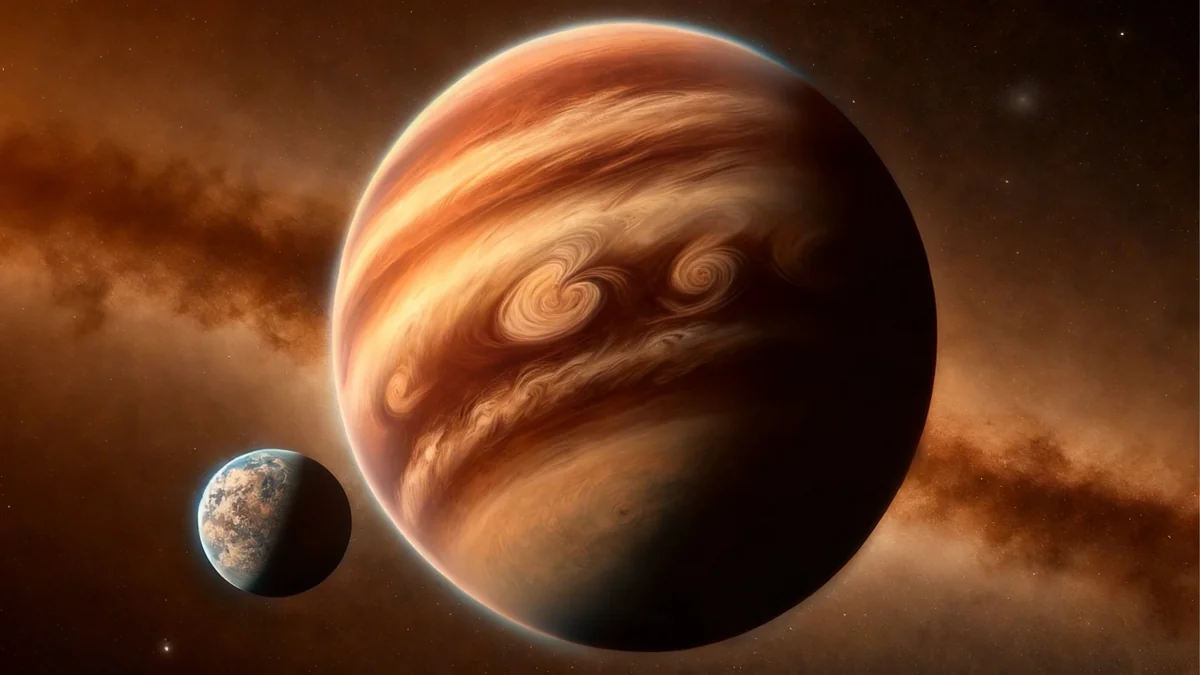


Scientists have confirmed the existence of a hidden companion star orbiting the red supergiant Betelgeuse, solving a long-standing mystery about its strange dimming behavior. A new study presents the first direct evidence of the companion, named Siwarha, by detecting the wake it creates as it moves through Betelgeuse's massive atmosphere.
This discovery provides a clear explanation for the star's periodic fluctuations in brightness, which have puzzled astronomers for years and fueled speculation about its impending supernova explosion. The findings suggest that the dramatic dimming events are not necessarily signs of the star's imminent collapse, but rather the effect of its orbiting partner.
Key Takeaways
- Astronomers have found direct evidence of a companion star, Siwarha, orbiting the red supergiant Betelgeuse.
- The discovery was made by observing a wake, or trail of gas, left by Siwarha as it moves through Betelgeuse's atmosphere.
- This companion star is the likely cause of Betelgeuse's periodic dimming, which occurs roughly every 2,100 days.
- The finding helps resolve the mystery of the "Great Dimming" of 2019-2020 and provides new insights into the evolution of massive stars.
A Cosmic Mystery Solved
For years, the red supergiant Betelgeuse has captured the attention of both scientists and the public. Located in the constellation of Orion, it is one of the brightest stars in the night sky and is destined to end its life in a spectacular supernova explosion. Its behavior, however, has been unpredictable. The star has been observed to dim and brighten in cycles, most notably during the "Great Dimming" event of 2019 and 2020.
These fluctuations led to theories that the star was on the verge of collapsing. While a supernova is still in Betelgeuse's future, a new study provides a more immediate explanation for its behavior. Researchers now believe these variations are caused by a much smaller companion star orbiting within Betelgeuse's outer layers.
A team of astronomers, using data from NASA's Hubble Space Telescope and several ground-based observatories, has identified what they describe as a "wake" in the star's atmosphere. This disturbance is caused by the gravitational pull of the companion star, named Siwarha, as it plows through the gas and dust surrounding Betelgeuse.
"It’s a bit like a boat moving through water. The companion star creates a ripple effect in Betelgeuse’s atmosphere that we can actually see in the data," explained Andrea Dupree, an astronomer at the Center for Astrophysics | Harvard & Smithsonian and the study's lead author. "For the first time, we’re seeing direct signs of this wake, or trail of gas, confirming that Betelgeuse really does have a hidden companion shaping its appearance and behavior."
The Evidence for Siwarha
The theory of a companion star explaining Betelgeuse's long secondary dimming period of approximately 2,100 days has been gaining traction. However, direct proof has been elusive until now. Previous observations were often obscured by the vast clouds of dust and gas that Betelgeuse constantly expels.
The research team analyzed eight years of observational data, tracking the movement and speed of gas in Betelgeuse's atmosphere. They found that the material was being disturbed in a pattern consistent with an object moving through it. The data showed denser, shocked gas accumulating behind a passing shockwave, creating a trail that follows an orbital path.
Betelgeuse by the Numbers
- Type: Red Supergiant
- Location: Constellation of Orion
- Dimming Cycle: Approximately every 2,100 Earth days
- Companion Wake Speed: The wake expands at about 6 km/s
- Future Supernova: When it explodes, it will be as bright as the Moon and visible during the day for 6-12 months.
The companion star itself, Siwarha, remains hidden from direct view, currently obscured by the bright disk of Betelgeuse. However, its gravitational influence is now undeniable.
What This Means for Supernova Predictions
This discovery significantly changes how astronomers interpret Betelgeuse's activity. The periodic dimming is no longer seen as a primary indicator of an impending supernova. Instead, it is understood as a predictable interaction within a binary star system.
"The idea that Betelgeuse had an undetected companion has been gaining in popularity for the past several years, but without direct evidence, it was an unproven theory," Dupree stated. This new evidence allows for a more accurate model of the star's life cycle.
While the supernova event is still expected, predicting its timing remains a challenge. The confirmation of Siwarha helps scientists separate the effects of the companion from the internal processes that signal the end of the star's life. It provides a clearer picture of how massive stars evolve and shed material before they explode.
A Tale of Two Stars
The names of the two stars are rooted in ancient Arabian astronomy. "Betelgeuse" is derived from "Yad al-Jawzā’," meaning "Hand of al-Jawzā’," a central female figure in old Arabian sky lore. Following this tradition, the discovery team named the companion "Siwarha," an Arabic name meaning "Her Bracelet."
What is a Red Supergiant?
A red supergiant is a star in a late stage of its evolution. Having exhausted the hydrogen fuel in its core, it expands to an enormous size, becoming hundreds or even thousands of times larger than our Sun. These stars are relatively cool on the surface, which gives them their reddish-orange color. Betelgeuse is one of the most famous examples of a red supergiant and is expected to end its life as a Type II supernova.
The relationship between these two celestial bodies offers a unique laboratory for studying stellar dynamics. Betelgeuse provides a "front-row seat" to observe how a giant star evolves and interacts with a smaller companion, a process that influences its structure, material loss, and eventual fate.
What's Next for Betelgeuse?
Astronomers are eagerly awaiting the next chapter in this story. According to orbital calculations, Siwarha is expected to emerge from behind Betelgeuse's disk in August 2027. This event will provide the first opportunity for direct observation of the companion star, allowing scientists to confirm its properties and refine their models of the binary system.
Further observations will help determine the mass, size, and orbit of Siwarha with greater precision. This information is crucial for understanding the full extent of its influence on Betelgeuse and for learning more about the final stages of life for massive stars across the universe.
The study, which details these findings, has been accepted for publication in The Astrophysical Journal and is currently available on the preprint server arXiv.