
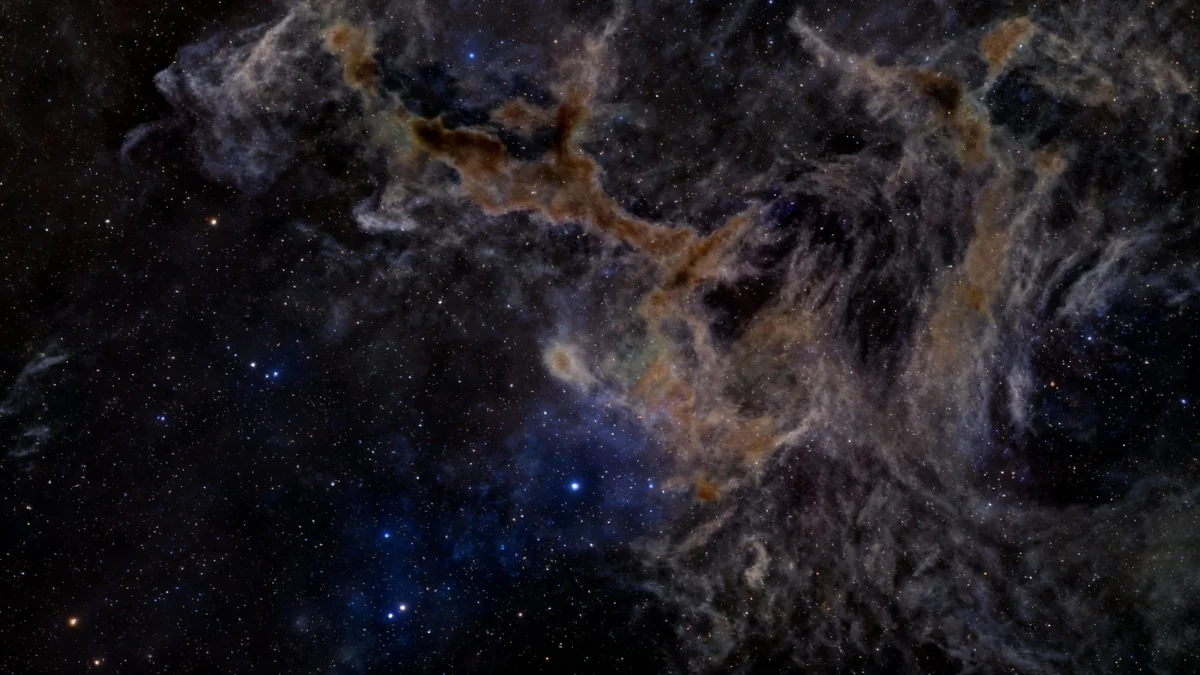

A new, detailed image captured from a Texas observatory reveals a celestial object known as the Giraffe Nebula, a vast cloud of interstellar dust that takes on the uncanny shape of a running giraffe against a backdrop of distant stars. The photograph, taken by astrophotographer Greg Meyer, showcases the dark nebula LDN 1245 in the constellation Cassiopeia.
The image is the result of 25 hours of exposure time, meticulously gathered between October 2025 and January 2026. It highlights the challenges and rewards of capturing dark nebulas, which emit no light of their own and are only visible as silhouettes against the brighter Milky Way.
Key Takeaways
- Astrophotographer Greg Meyer captured a detailed image of the dark nebula LDN 1245, nicknamed the 'Giraffe Nebula'.
- The nebula is located in the constellation Cassiopeia and appears as a silhouette against the stars of the Milky Way.
- The final image required 25 hours of total exposure time, collected over several months from the Starfront Observatory in Texas.
- Dark nebulas are dense clouds of interstellar dust that absorb and scatter light from background stars, making them difficult to photograph.
The Challenge of Photographing Darkness
Capturing an image of an object that emits almost no light is one of the greatest challenges in astrophotography. Dark nebulas like LDN 1245 are composed of cold, dense clouds of interstellar dust and gas. These clouds are so thick that they block the light from stars located behind them, creating a dark patch in the sky.
To reveal the intricate structure of the Giraffe Nebula, Greg Meyer employed a long-exposure technique. Over a period of four months, he used his Sky Watcher Esprit 120mm telescope to collect faint light particles, accumulating a total of 25 hours of data. This process allows the camera's sensor to gather enough information to distinguish the nebula's subtle outlines from the blackness of space.
What is a Dark Nebula?
Unlike emission nebulas (like the Orion Nebula) that glow from the energy of nearby stars, or reflection nebulas that scatter starlight, dark nebulas are opaque clouds. They are essentially the raw material for future star and planet formation. Their dense nature makes them appear as starless voids to the naked eye, but powerful telescopes can reveal their complex, filamentary structures.
The equipment used for this project included a specialized astronomy camera fitted with red, green, and blue filters. By capturing separate images through each filter and later combining them, astrophotographers can create a full-color composite that reveals details the human eye cannot see.
A Celestial Menagerie
The nickname 'Giraffe Nebula' comes from the object's striking resemblance to the long-necked animal. In Meyer's image, the nebula's shape is clearly defined, showing a form that looks like a giraffe in full sprint. Its 'head' appears to be reaching toward a cluster of bright, blue-white stars in the upper left of the frame.
This phenomenon, where humans see familiar shapes in random patterns, is known as pareidolia. It is the same psychological effect that causes people to see faces in clouds or on the surface of the Moon. In the vastness of space, many nebulas have earned nicknames based on their perceived shapes.
Famous Nebulas Named After Shapes
- Horsehead Nebula: A dark nebula in the constellation Orion that resembles a horse's head.
- Eagle Nebula: Contains the famous 'Pillars of Creation' and resembles a soaring eagle.
- Crab Nebula: A supernova remnant whose filamentary structure was thought to resemble a crab.
- Cone Nebula: A dark, cone-shaped nebula in the constellation Monoceros.
The naming of these objects by the astrophotography community helps make the cosmos more accessible and relatable to the public, transforming abstract clouds of gas and dust into a celestial zoo.
The Science Behind the Image
While the shape is captivating, the image also provides scientific insight. The dark, smoky mass of LDN 1245 is the most prominent feature, but the edges of the nebula tell a different story. Here, the dust is less dense, allowing it to scatter light from nearby stars.
"Along the edges the scene shifts into faint reflection nebulosity," Meyer explained in a post on the astrophotography website Astrobin. "Here the dust becomes visible because it scatters light from nearby stars which often gives a gentle blue tone."
This subtle blue glow is characteristic of reflection nebulas. The fine dust particles scatter blue light more efficiently than red light, for the same reason that Earth's sky appears blue. This detail adds another layer of complexity and beauty to the image, showing two types of nebulosity in one frame.
From Raw Data to Final Image
Creating the final photograph was a multi-step process. After collecting the 25 hours of raw data, Meyer used specialized software like PixInsight, Photoshop, and Lightroom for post-processing. This stage is crucial for balancing colors, reducing noise, and enhancing the fine details of the nebula's structure.
The work highlights the dedication required in modern astrophotography, which is a blend of astronomy, technology, and artistry. Each final image represents dozens, if not hundreds, of hours of planning, data acquisition, and careful processing to bring a hidden cosmic wonder to light.