

Astronomers have identified a faint, thread-like structure of galaxies stretching nearly four light-years, providing a direct look at the universe's underlying architecture. This discovery, made using China's FAST telescope, reveals a previously unseen filament of the cosmic web, the vast network of matter that dictates where galaxies are born and how they evolve.
The finding offers new evidence for how these immense, often invisible structures, dominated by dark matter, serve as cosmic highways that channel gas and material to form new stars and galaxies. It marks a significant step in mapping the skeleton of the cosmos.
Key Takeaways
- A new, thin filament of galaxies has been identified in the Ursa Major Supergroup.
- The structure is a nearly linear arrangement of galaxies spanning almost four light-years.
- The discovery was made possible by the high sensitivity of the Five-hundred-meter Aperture Spherical radio Telescope (FAST).
- This finding provides direct observational evidence of the cosmic web's more subtle components, which are primarily composed of dark matter.
Mapping the Universe's Grand Design
For decades, cosmologists have understood that the universe is not a random scattering of stars and planets. Instead, it is organized into a colossal, web-like structure. This network, known as the cosmic web, consists of dense clusters of galaxies, long strands connecting them, and vast, nearly empty voids in between.
This intricate architecture was sculpted by gravity over billions of years. The force pulled matter together, forming the dense regions and leaving others sparse. However, much of the material that makes up this web is invisible to us.
What is the Cosmic Web?
The cosmic web is the largest-known structure in the universe. It's a network of filaments, sheets, and voids. Galaxies are not distributed randomly but are found in clusters and superclusters located at the intersections of these filaments. These filaments act as bridges, guiding matter toward these denser regions.
The majority of this structure is composed of dark matter, a mysterious substance that does not interact with light but exerts a powerful gravitational pull. This unseen scaffolding is what shapes the visible universe, dictating the location and growth of galaxies.
A New View with a Powerful Eye
Identifying the fainter parts of this cosmic web, particularly the thin filaments, has been a significant challenge for astronomers. These structures are diffuse and difficult to detect. However, advances in telescope technology are beginning to pull back the curtain on these hidden cosmic pathways.
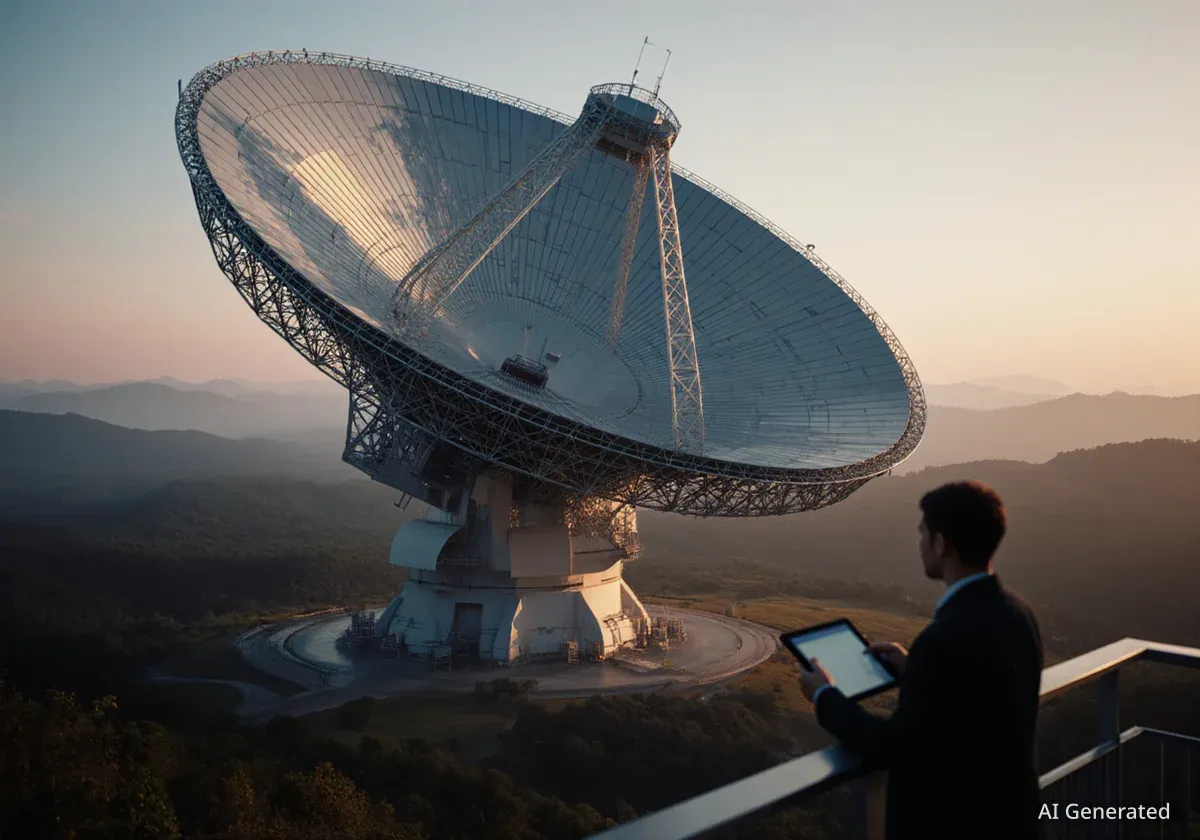
A team of scientists recently leveraged the capabilities of the Five-hundred-meter Aperture Spherical radio Telescope (FAST) in China. Its incredible sensitivity allowed them to observe faint hydrogen gas emissions in regions of space that were previously difficult to study.
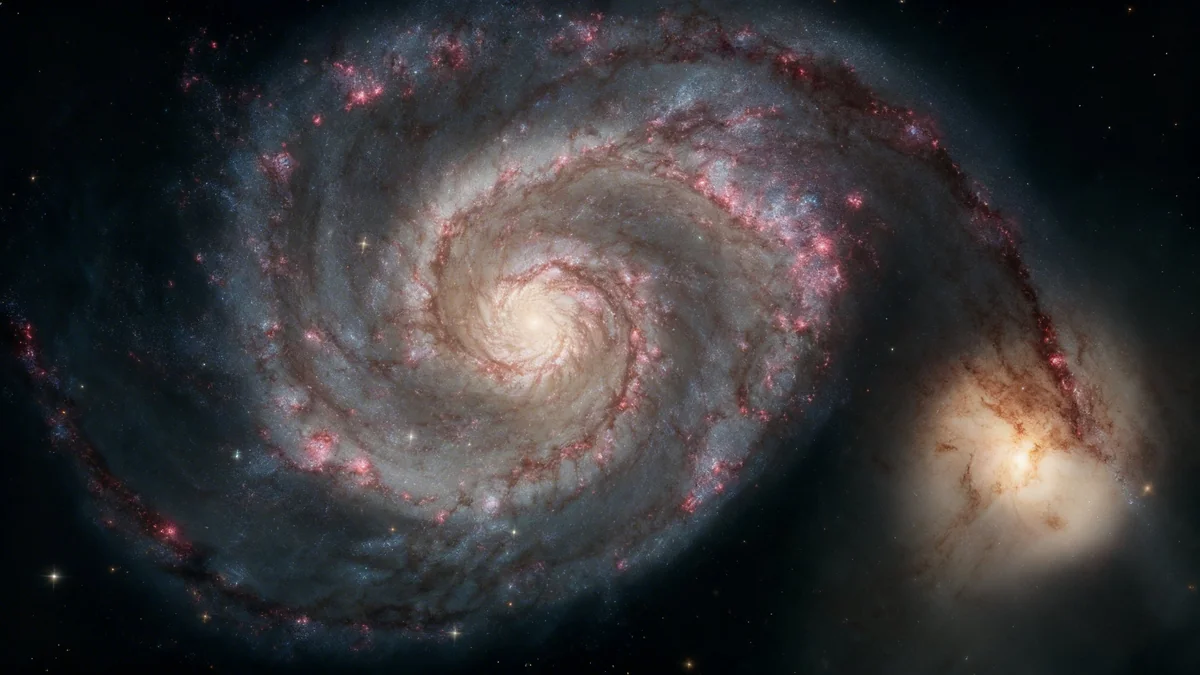
Through these observations, the team pinpointed a group of galaxies in the Ursa Major Supergroup arranged in a distinct line. This linear distribution, extending from northeast to southwest, is not a coincidence. It represents a coherent structure—a single, delicate thread woven into the cosmic tapestry.
The Significance of a Straight Line
Finding galaxies lined up in space provides direct, tangible proof of the cosmic web's underlying filaments. While computer simulations have long predicted these structures, observing them directly has been notoriously difficult. This discovery confirms that even the most subtle strands of the web play a crucial role in the universe's structure.
The alignment of these galaxies suggests they are embedded within a larger, unseen filament of dark matter. This filament acts like a cosmic river, guiding the flow of gas and dust that fuels star formation and galaxy growth within it.
Dark Matter's Role as a Cosmic Architect
The discovery of this filament reinforces the central role of dark matter in cosmology. While we cannot see it, its gravitational influence is the primary force shaping the large-scale structure of the universe.
"We are learning how the universe truly puts itself together, one subtle thread at a time," a researcher involved in the study explained. This sentiment captures the essence of the discovery—each new filament found adds another piece to the puzzle of cosmic evolution.
Within these filaments, the gravitational pull of dark matter creates a funneling effect. It draws in primordial gas and dust, providing the raw materials needed for galaxies to form and evolve. These filaments are essentially galactic nurseries, creating the ideal conditions for new stars and stellar systems to coalesce.
A Synchronized Dance of Galaxies
One of the most intriguing aspects of this finding is what it implies about galaxy evolution. Galaxies located within the same filament are not isolated; they are part of a connected system. They may evolve in similar ways, influenced by the shared environment and flow of matter along the filament.
The research, published as a preprint paper on the arXiv repository, suggests that the galaxies within this newly identified structure may even rotate in a synchronized manner, influenced by the filament's gravitational field. This observation provides a unique laboratory for studying how large-scale environmental factors orchestrate the development of individual galaxies over cosmic time.
The Future of Cosmic Cartography
This discovery is more than just finding a line of galaxies; it's about refining our map of the universe. With each new filament identified, our understanding of the cosmic web becomes more detailed and complete. It shows that the universe is an interconnected system, where even the emptiest-looking regions of space are part of a grand, underlying structure.
Powerful new instruments like the FAST telescope are essential for this work. They allow astronomers to peer into the faint, diffuse universe and uncover the secrets that have been hidden in plain sight. Future observations will likely reveal more of these subtle threads, helping scientists build a comprehensive model of how the cosmos is assembled.
By tracing these cosmic pathways, we can better understand not only where galaxies come from but also where they are going. Each filament is a clue to the past and a guide to the future, revealing the intricate and elegant ballet of creation that has been unfolding for billions of years.