



A sophisticated scientific instrument, carried by a massive NASA balloon, has successfully landed back on the Antarctic ice after spending 23 days at the edge of space. The mission, known as the Payload for Ultrahigh Energy Observations (PUEO), was designed to detect some of the most elusive and powerful particles in the universe.
The instrument touched down approximately 200 miles north of the South Pole, and a recovery team has already secured its data recorder. This device holds between 50 and 60 terabytes of information that scientists will now analyze for signs of ultra-high-energy neutrinos, particles that could unlock secrets about the universe's most violent events.
Key Takeaways
- NASA's PUEO mission completed a 23-day flight at 120,000 feet above Antarctica.
- The goal was to detect ultra-high-energy neutrinos, which are extremely rare and powerful cosmic particles.
- The instrument used the entire Antarctic ice sheet as a natural particle detector.
- Researchers have recovered 50-60 terabytes of data, with initial results expected in about a year.
Hunting for Cosmic Messengers
Scientists are searching for a special type of particle called a neutrino. These particles are incredibly common, constantly streaming from space and passing through the Earth—and even our bodies—without interacting with anything. They are often called "ghost particles" because they are so difficult to detect.
However, the PUEO mission is looking for a much rarer and more powerful version: ultra-high-energy neutrinos. These particles are believed to carry more energy than anything created in the Large Hadron Collider, the world's most powerful particle accelerator. Locating them would provide a new way to observe the cosmos.
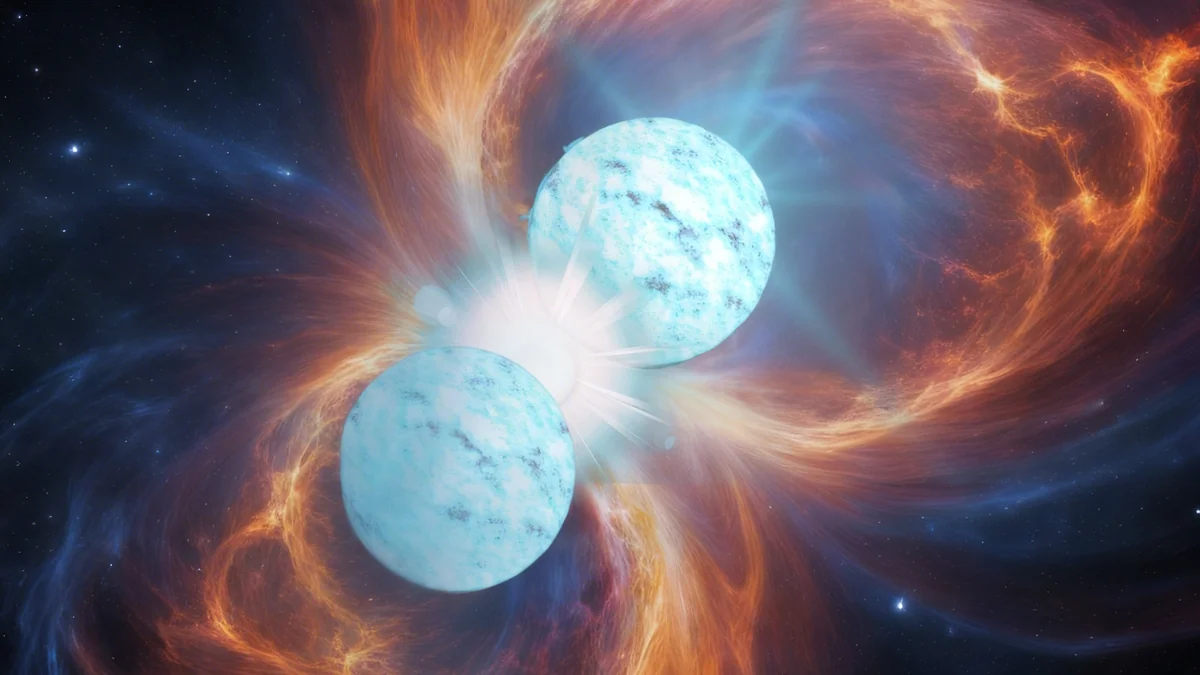
Scientists believe these high-energy particles are produced by extreme cosmic events, such as matter being consumed by supermassive black holes or the collision of dense neutron stars. By tracing these neutrinos back to their source, researchers hope to gain a clearer picture of these violent and distant phenomena.
The challenge has always been how to catch one. Because they interact so rarely with matter, a massive detector is needed to increase the chances of a collision. The PUEO team's solution was to use a detector the size of a continent.
A Continent-Sized Detector
The PUEO mission uses an innovative method that turns the vast Antarctic ice sheet into a giant scientific instrument. The theory is straightforward: if a high-energy neutrino strikes an atom within the ice, the collision will produce a brief, faint burst of radio waves.
Ice is an excellent medium for conducting these radio signals. The waves can travel through the frozen water and escape into the atmosphere above. Floating at an altitude of 120,000 feet, PUEO was perfectly positioned to listen for these specific signals rising from the ice below.
The PUEO instrument features 96 highly sensitive radio antennas arranged in circles. This design allows it to constantly scan a massive area of the ice sheet for the tell-tale radio signature of a neutrino interaction.
This instrument is a significant upgrade from its predecessor, ANITA. Thanks to advances in electronics and a design that combines signals from multiple antennas, PUEO is far more sensitive, increasing the odds of making a first-of-its-kind detection.
A Five-Year Journey to Launch
The creation of the PUEO payload was a global effort that spanned five years. Laboratories from around the world contributed components that were eventually assembled at the University of Chicago. Once built, the instrument underwent rigorous testing to ensure it could survive the harsh conditions at the edge of space.
One critical test took place in Texas, where the electronics were placed in a near-vacuum chamber to simulate the stratospheric environment. Without air, traditional cooling fans are useless, so engineers had to be certain the systems wouldn't overheat.
"The big challenge is that without air, you can’t use fans to cool down the electronics if they get too hot," explained Cosmin Deaconu, a research professor at the University of Chicago who developed the flight software.
After passing its tests, PUEO began a complex journey. It was disassembled and transported by road, ship, and finally military aircraft to NASA's Long Duration Balloon Camp in Antarctica. There, a team of scientists worked against the clock to reassemble and prepare it for launch.
Ready for Flight
Launching a 700-foot-long balloon assembly requires perfect weather conditions, not just on the ground but through all layers of the atmosphere. The team had to be on standby, ready to go at any moment.
On December 20, 2024, the conditions were ideal. PUEO launched on its first attempt in the early morning hours, ascending to its operational altitude where its solar panels and secondary antennas successfully deployed.
Mission in the Sky
For the next 23 days, the science team monitored the instrument around the clock from the ground. While PUEO was designed to operate autonomously, occasional adjustments were necessary. At one point, operators had to correct the payload's rotation speed to prevent one side from overheating in the constant sunlight of the Antarctic summer.
When weather forecasts indicated that changing wind patterns would carry the balloon away from the continent, the team decided to end the mission. Mission controllers at NASA sent a command to sever the line connecting the instrument to the balloon, and a parachute deployed for a gentle landing on the ice.
Now, the most critical phase of the project begins. The recovered data will be flown to Chicago for processing. Scientists estimate it will take a month just to process the raw information, with the first analysis and potential results becoming available in about a year.
Whether PUEO detected the cosmic ghosts it was searching for or not, the data will be invaluable. A confirmed detection would open a new window into astrophysics, while a lack of signals will help scientists refine their models of the high-energy universe.