

A long-standing cosmic puzzle has been solved, as astronomers announced they have successfully accounted for all the “normal” matter in the universe. A groundbreaking study published in June 2025 utilized powerful cosmic signals to find this matter, not in stars or galaxies, but hidden in the vast, seemingly empty spaces between them.
This discovery provides strong confirmation for the Big Bang theory, which has long predicted the total amount of matter created in the universe's first moments. While this census completes our understanding of familiar atomic matter, it also highlights the larger, more profound mysteries of dark matter and dark energy that continue to challenge scientists.
Key Takeaways
- A new study has located all the predicted normal matter in the universe, solving a decades-old astronomical problem.
- The vast majority of this matter, 76%, exists in the hot, diffuse gas of the intergalactic medium, the space between galaxies.
- Researchers used signals from Fast Radio Bursts (FRBs) as cosmic probes to measure the density of this previously hard-to-detect gas.
- The findings strongly support the Big Bang theory's prediction that normal matter constitutes about 5% of the universe's total mass-energy content.
The Case of the Missing Matter
For decades, astronomers faced a significant discrepancy. Our best model of the universe's origin, the Big Bang theory, predicts that about 5% of the cosmos should be made of normal, or baryonic, matter. This is the familiar matter composed of protons, neutrons, and electrons that makes up everything we can see and touch, from stars and planets to ourselves.
However, when scientists tallied up all the visible objects—counting the hundreds of billions of stars in the hundreds of billions of galaxies—the numbers didn't add up. The total mass from these luminous structures was far less than the predicted 5%.
A Cosmic Inventory Shortfall
Previous calculations showed that stars contain only about 0.5% of the universe's matter. Even when including cold gas within galaxies, the total only reached about 9% of all normal matter. This left a huge portion of the universe's ordinary material completely unaccounted for.
This gap, known as the “missing baryon problem,” suggested that most of the universe's atoms were not gathered into the bright, dense structures we typically associate with space. The most logical hiding place was the intergalactic medium—the near-perfect vacuum that fills the immense voids between galaxies.
Probing the Void with Cosmic Flashes
Detecting matter in the intergalactic medium is incredibly challenging. The gas there is extremely sparse, with a density of roughly one atom per cubic meter, which is a billionth of a billionth of the density of air on Earth. It is also heated to millions of degrees, causing it to emit faint X-rays that are difficult for telescopes to capture with high sensitivity.
A New Astronomical Tool
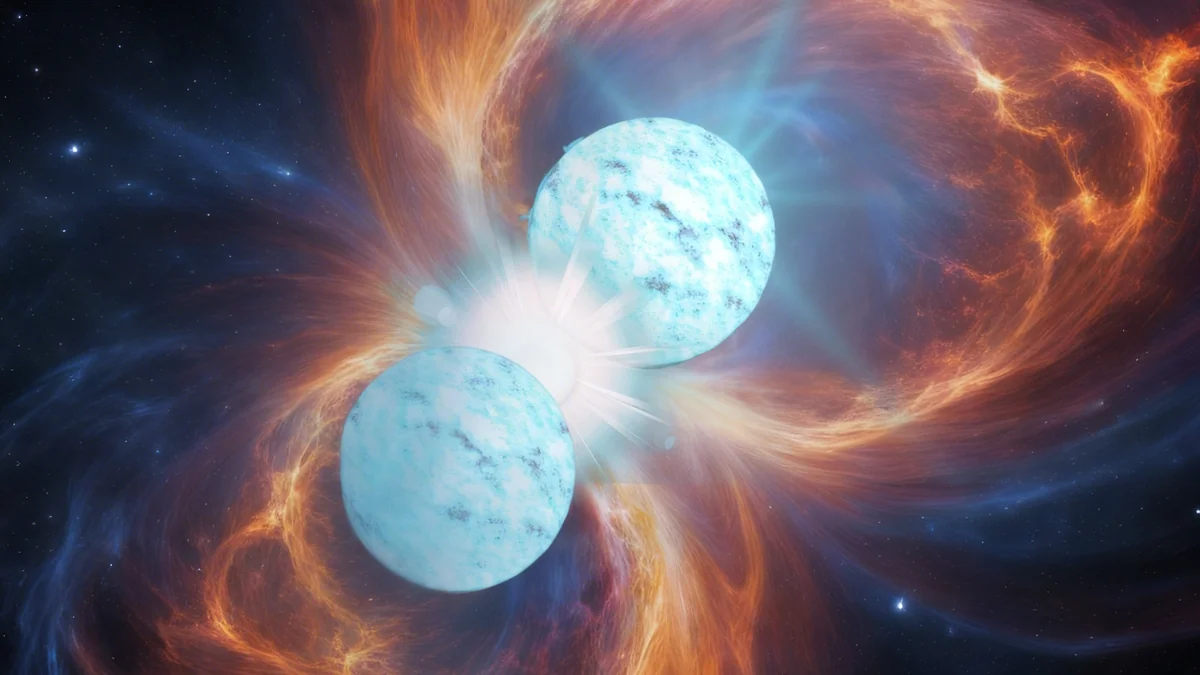
The breakthrough came from an unexpected source: Fast Radio Bursts (FRBs). These are incredibly intense, millisecond-long blasts of radio waves originating from distant galaxies. Though their exact cause is still under investigation, they are thought to be produced by highly magnetic, compact stellar remnants known as magnetars.
"Even though astronomers don't fully understand fast radio bursts, they can use them to probe the spaces between galaxies."
As an FRB travels across billions of light-years to reach Earth, its radio waves interact with the electrons in the intergalactic gas. This interaction causes longer wavelengths of the radio signal to be slowed down slightly more than shorter wavelengths. The result is that the signal gets spread out, or “dispersed.” By measuring the degree of this dispersion, astronomers can calculate the total amount of matter the burst has passed through on its journey.
The Universe's Matter Budget Solved
In the new study, a team from Caltech and the Harvard Center for Astrophysics analyzed 69 different Fast Radio Bursts using an array of 110 radio telescopes in California. By correlating the dispersion of each burst with the distance to its host galaxy, they could build a map of the matter density along each line of sight.
The results provided a complete and precise accounting of the universe's normal matter. The team found that:
- 76% of normal matter resides in the hot, diffuse gas of the intergalactic medium.
- 15% is located in the halos of galaxies—the extended, less dense regions surrounding the visible stars.
- 9% is contained within the galaxies themselves, in the form of stars and cold gas.
This complete census finally aligns with the 5% total predicted by the Big Bang theory, providing a powerful validation of our cosmological model. The theory's predictions about the formation of elements in the first few minutes after the Big Bang have passed a critical test.
The Cosmic Web
The matter in the intergalactic medium is not uniformly distributed. It is believed to form a vast, filamentary network known as the "cosmic web." Galaxies and galaxy clusters are located at the dense intersections of these filaments. With thousands of FRBs already detected and future telescope arrays expected to find up to 10,000 per year, scientists will soon be able to use these signals not just to count atoms, but to map the three-dimensional structure of this web in unprecedented detail.
The Larger Mystery Remains
While one cosmic mystery has been solved, it serves to emphasize the scale of what we still do not understand. Normal matter, now fully accounted for, makes up only a small fraction of the universe's total composition.
The complete picture of the cosmos is far stranger. Current models indicate the universe's mass-energy budget is divided as follows:
- Dark Energy (approx. 68%): A mysterious force causing the expansion of the universe to accelerate.
- Dark Matter (approx. 27%): An invisible substance that provides the gravitational glue holding galaxies and galaxy clusters together.
- Normal Matter (approx. 5%): All the atoms that make up everything we can see.
Dark matter outweighs all the normal matter in the universe by more than five to one. We know it exists because of its gravitational effects, such as the bending of light from distant galaxies—a phenomenon called gravitational lensing. However, it does not interact with light or any other form of electromagnetic radiation, making it completely invisible and its true nature one of the biggest unsolved problems in physics.
The successful search for normal matter, powered by a novel astronomical technique, is a major achievement. It closes a chapter in our understanding of the cosmos while simultaneously setting the stage for the next great hunt: to finally uncover the identities of dark matter and dark energy.