
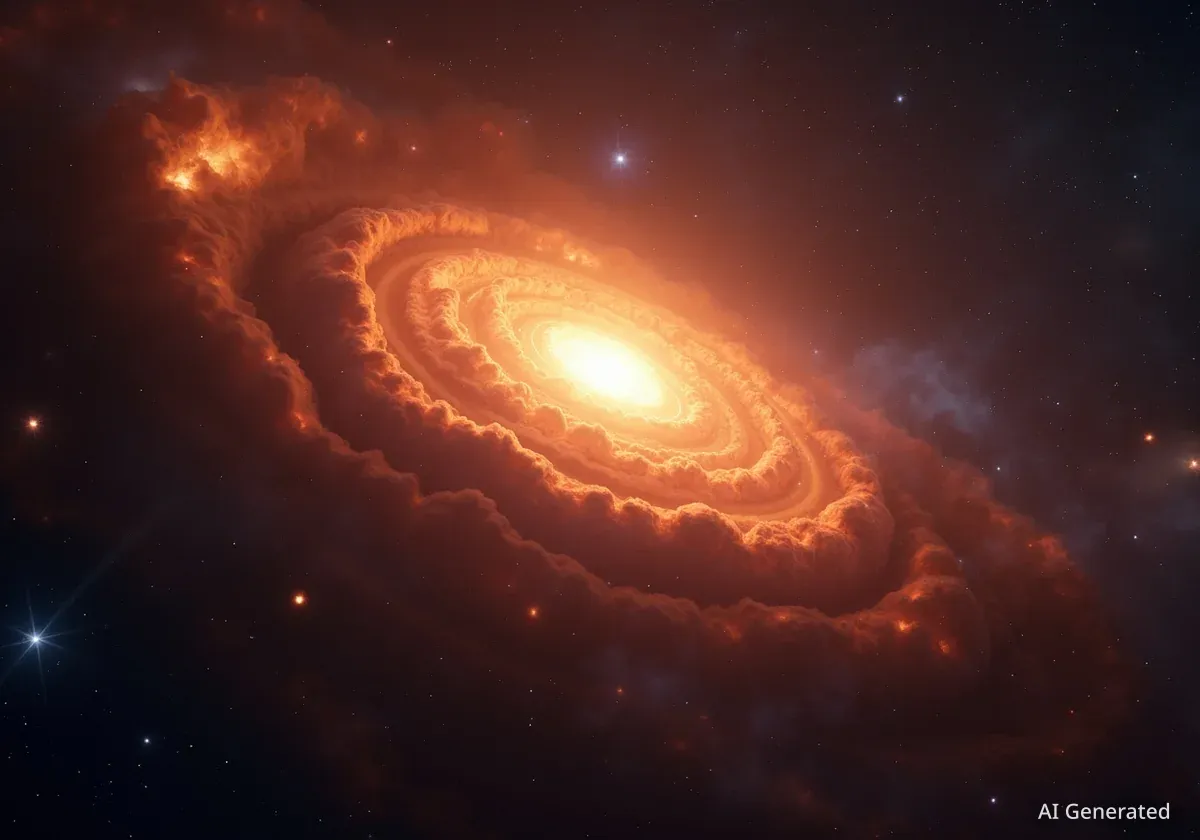

Astronomers may have witnessed a cosmic event that has only existed in theory until now: a "superkilonova." The candidate event, named AT2025ulz, appears to be a rare sequence where a massive star's supernova explosion immediately leads to a secondary, more powerful kilonova blast from the collision of two newly-formed neutron stars.
This complex and unusual observation, involving a global network of telescopes including the W. M. Keck Observatory, challenges current understanding of stellar explosions and the creation of the universe's heaviest elements.
Key Takeaways
- Astronomers have identified a potential "superkilonova," a theorized event where a supernova is followed by a kilonova.
- The event, AT2025ulz, was first detected through gravitational waves by LIGO and Virgo, followed by light observations.
- Initially, the event resembled a kilonova but later showed characteristics of a supernova, confusing scientists.
- The new theory suggests a massive, rapidly spinning star collapsed, forming two neutron stars that quickly merged, creating both explosions.
A Cosmic Mystery Unfolds
The investigation into AT2025ulz began in August 2025 when the Laser Interferometer Gravitational-Wave Observatory (LIGO) and its European partner, Virgo, detected ripples in spacetime. An alert was sent to the global astronomy community, indicating a merger between two cosmic objects, with at least one being unusually small.
Minutes later, the Zwicky Transient Facility at Palomar Observatory spotted a flash of light from the same region of the sky. Initially, the data pointed toward a kilonova, a powerful explosion that occurs when two super-dense neutron stars collide. For the first three days, its behavior mirrored the only confirmed kilonova ever seen, GW170817, which was detected in 2017.
"At first, for about 3 days, the eruption looked just like the first kilonova in 2017," said Mansi Kasliwal, a professor at the California Institute of Technology and Director of Palomar Observatory. "Everybody was intensely trying to observe and analyze it."
This initial similarity was compelling. The light from AT2025ulz faded quickly and glowed in red wavelengths, a signature trait of a kilonova caused by the formation of heavy elements like gold and platinum.
An Unexpected Transformation
Just as astronomers thought they had identified the event, AT2025ulz began to behave strangely. Days after the initial blast, it started to brighten again, this time turning blue and showing traces of hydrogen in its spectrum. These are classic signs of a supernova, not a kilonova.
This sudden shift caused confusion and led some researchers to dismiss the event as a standard supernova, unrelated to the gravitational wave signal. Supernovae from distant galaxies are not typically powerful enough to generate gravitational waves detectable by LIGO and Virgo, whereas kilonovae are.
Supernova vs. Kilonova
Understanding the difference between these two cosmic explosions is key to grasping the significance of AT2025ulz.
- Supernova: The explosive death of a massive star. It forges and scatters lighter heavy elements like carbon and iron across the universe.
- Kilonova: The result of two neutron stars (the dense remnants of dead stars) spiraling into each other and merging. This process creates the heaviest elements in the universe, such as gold, platinum, and uranium.
Despite the conflicting signals, Kasliwal's team remained intrigued. Several clues suggested something far more unusual had occurred. The event didn't perfectly match a typical supernova, and the gravitational wave data from LIGO-Virgo held a critical piece of information: at least one of the merging neutron stars was less massive than our sun.
The Superkilonova Hypothesis
The presence of a sub-solar mass neutron star is significant because current theories suggest they can only form under very specific conditions. This led to a new and compelling hypothesis, proposed by co-author Brian Metzger of Columbia University, that explains all the observed phenomena.
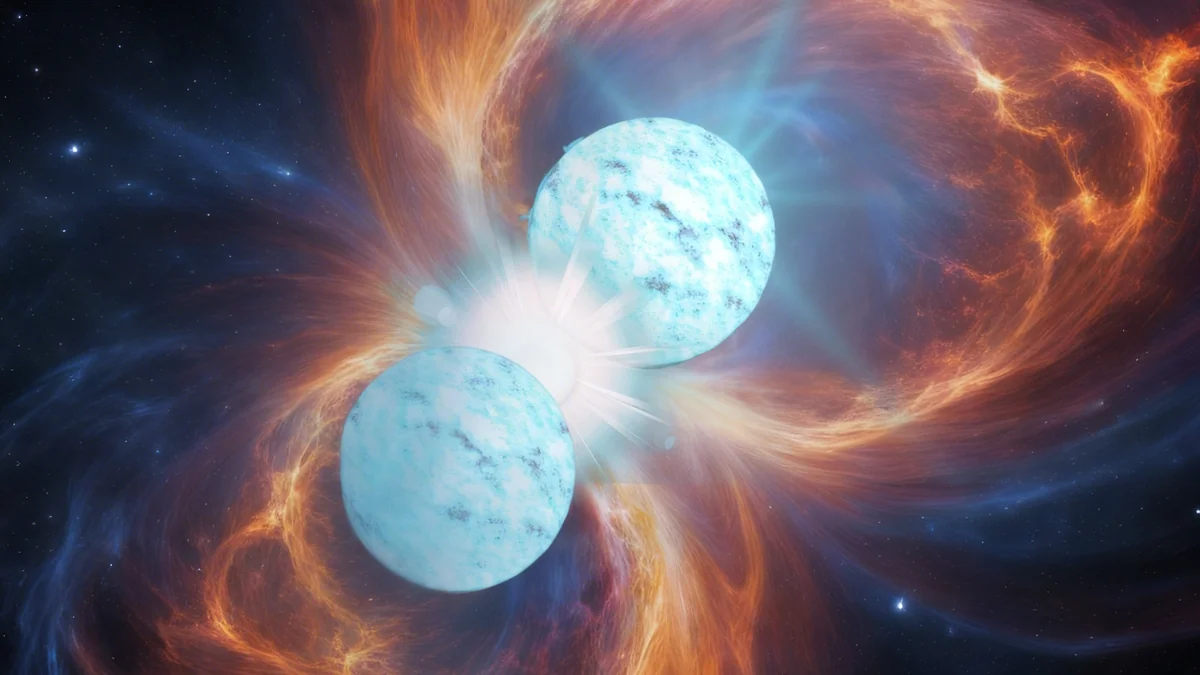
The theory posits that a single, very rapidly spinning massive star reached the end of its life and collapsed. This initial explosion was the supernova detected by telescopes. However, instead of leaving behind a single neutron star or black hole, the collapse created two smaller, newly-born neutron stars.
A Star That Explodes Twice
The superkilonova theory suggests a rapid, two-stage explosion:
- A massive star dies in a supernova, creating two infant neutron stars.
- These two neutron stars, born in close proximity, immediately spiral into each other and merge, causing a second, more powerful kilonova explosion.
According to this model, the two "baby" neutron stars then crashed into each other almost immediately, erupting as a kilonova. This secondary merger is what generated the powerful gravitational waves picked up by LIGO and Virgo.
"The only way theorists have come up with to birth sub-solar neutron stars is during the collapse of a very rapidly spinning star," Metzger explained. "If these ‘forbidden’ stars pair up and merge by emitting gravitational waves, it is possible that such an event would be accompanied by a supernova rather than be seen as a bare kilonova."
Explaining the Confusing Light Signals
This two-in-one explosion model also explains the confusing light signals. The kilonova would have happened first, creating heavy elements and glowing with red light. However, the expanding debris from the initial supernova would have acted like a curtain, temporarily obscuring the view. As this debris cleared, astronomers saw the underlying light from the supernova itself, which was brighter, bluer, and contained hydrogen.
The W. M. Keck Observatory on Mauna Kea played a crucial role in gathering the data needed to piece this puzzle together. Michael Lundquist, a staff astronomer at Keck, noted the observatory's ability to respond quickly to transient alerts was essential. "Keck Observatory provided the imagery and spectroscopy... to measure the host extinction and redshift of the galaxy, as well as looking at the spectroscopic evolution," he said.
A New Window into the Cosmos
While the superkilonova theory is a strong candidate for explaining AT2025ulz, the research team emphasizes that more evidence is needed for confirmation. The discovery, detailed in The Astrophysical Journal Letters, is considered eye-opening and suggests that astronomers may need to rethink how they classify cosmic explosions.
If confirmed, the existence of superkilonovae would provide a new pathway for the creation of heavy elements and offer a deeper understanding of the final moments of the most massive stars in the universe.
"Future kilonovae events may not look like GW170817 and may be mistaken for supernovae," Kasliwal warned. "We can look for new possibilities in data like this, but we do not know with certainty that we found a superkilonova."
The search is now on for more of these cosmic oddballs, which could be hiding in plain sight within existing and future astronomical data, waiting to be correctly identified.