


The U.S. Air Force Research Laboratory has awarded an $8.2 million contract extension to Intuitive Machines, a space technology company, to accelerate the development of compact nuclear power systems. This funding is aimed at creating reliable energy sources for future spacecraft and lunar infrastructure, moving beyond the limitations of solar power.
The initiative seeks to build and prepare flight-ready hardware for a new generation of power systems that can operate in the harsh conditions of deep space and during the extended darkness of the lunar night. This marks a significant step toward making long-duration space missions more feasible.
Key Takeaways
- Intuitive Machines received an $8.2 million contract extension from the U.S. Air Force Research Laboratory.
- The funding is for developing compact nuclear power systems for space missions.
- The technology aims to solve the energy challenges posed by extreme environments where solar power is not viable.
- A key goal is to test the system on the International Space Station to prove its flight-readiness.
A New Phase in Space Energy Development
The new funding builds upon a previous $9.5 million award, bringing the total investment in this specific project to $17.7 million. The initial phase focused on the design of a power conversion system based on Stirling engine technology. Following a successful preliminary design review, the project is now advancing from theoretical design to the production of physical hardware intended for spaceflight.
This transition is a critical milestone. While designing systems for space is complex, building and testing hardware that can withstand the rigors of launch and operation in orbit is a far greater challenge. The contract extension provides the necessary resources for Intuitive Machines to begin this next phase.
"This award moves us from design to flight hardware, which is a critical step toward proving that compact nuclear power systems can survive and perform in space," said Tim Crain, co-founder and chief growth officer for Intuitive Machines.
Overcoming the Limits of Solar Power
For decades, solar panels have been the primary energy source for satellites and space missions. However, they have significant limitations, particularly for missions venturing far from the sun or operating on planetary surfaces with long periods of darkness.
The Challenge of the Lunar Night
The Moon experiences a night that lasts for approximately two Earth weeks. During this time, temperatures can plummet to below minus 129 degrees Celsius (-200 degrees Fahrenheit). Solar-powered equipment cannot function, and keeping essential systems warm and operational requires a continuous power source. Current solutions like heavy batteries or radioisotope thermoelectric generators add significant weight and complexity to missions.
Compact nuclear power systems offer a solution. By using the heat from a radioisotope source, they can generate a steady supply of electricity and warmth, regardless of sunlight. This capability is essential for establishing permanent bases on the Moon or for missions to the outer solar system where sunlight is faint.
How the Stirling Technology Works
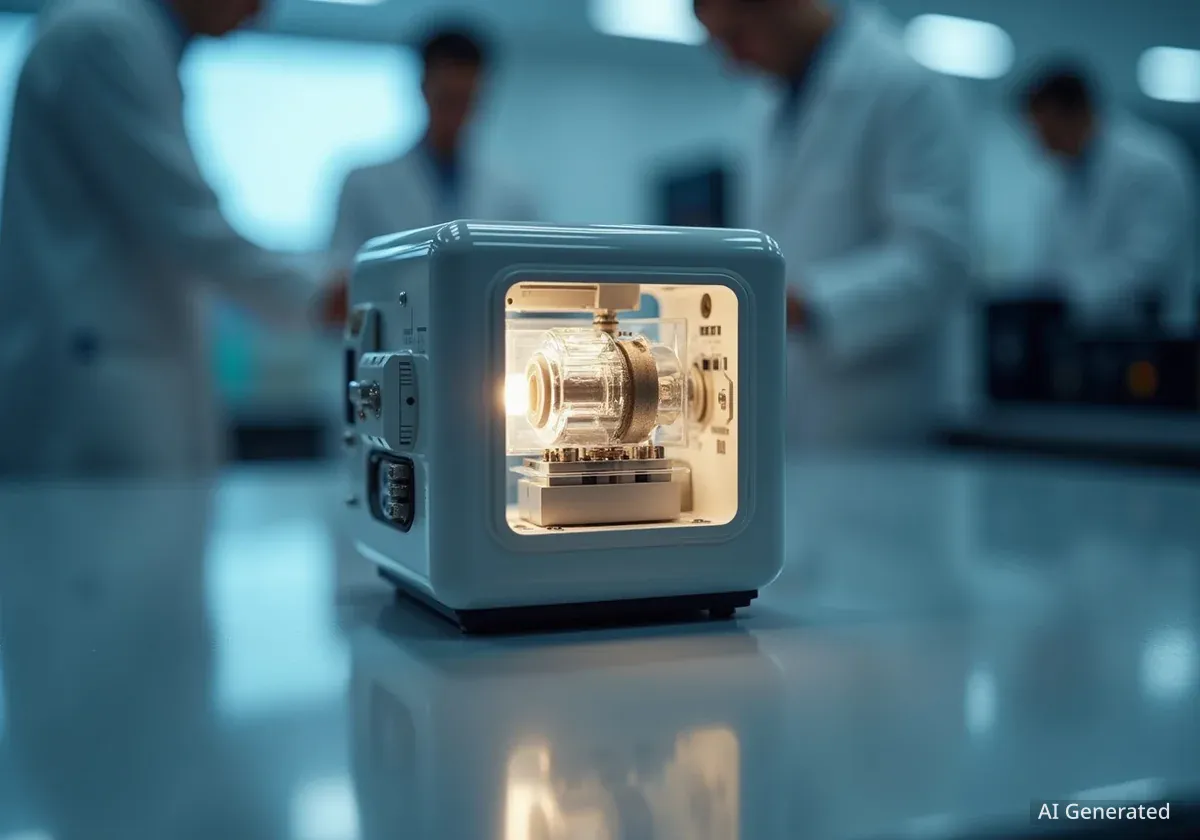
The system under development utilizes a Stirling-based power conversion process. This technology is not new, but its application in a compact, space-ready format is a key innovation. The process works by transforming heat generated by a radioisotope source into electricity with high efficiency.
The main advantages of this system include:
- Continuous Power: It can operate 24/7, unaffected by light conditions.
- Compact and Lightweight: It offers a higher power-to-mass ratio compared to batteries and solar panels needed for dark environments.
- Reliability: Stirling engines have few moving parts and are known for their long operational lifespan.
These features make the technology ideal for powering both robotic landers and future human habitats on the Moon and beyond. Intuitive Machines, which has already landed two solar-powered spacecraft on the lunar surface, is leveraging its experience to develop these next-generation energy systems.
Did You Know?
Intuitive Machines is a sister company to X-energy, a developer of advanced small modular nuclear reactors and nuclear thermal propulsion technologies. This connection provides a deep well of expertise in nuclear applications for both terrestrial and space-based needs.
Next Stop: The International Space Station
Before a new technology can be trusted for critical deep-space missions, it must be proven to work in the actual environment of space. The plan for this nuclear power system is to conduct a flight experiment aboard the International Space Station (ISS) National Laboratory.
Testing on the ISS will expose the hardware to microgravity, radiation, and extreme temperature swings. This will allow engineers to observe how the system performs and degrades over time—conditions that are difficult to replicate perfectly on Earth. The goal of the experiment, named the Stirling Technology Space Research Experiment, is to elevate the system's readiness level from a prototype to a space-flown, flight-ready technology.
Successfully demonstrating the technology in orbit is the final step needed to gain acceptance from commercial, civil, and national security space programs. This would unlock the potential for more ambitious and lengthy missions across the solar system, powered by reliable and continuous nuclear energy.