


A new partnership between Texas A&M University's Space Institute and Intuitive Machines is set to create a large-scale lunar simulation facility. The project, backed by a significant state investment, aims to provide a realistic environment for testing technologies essential for future Moon missions, including NASA's Artemis campaign.
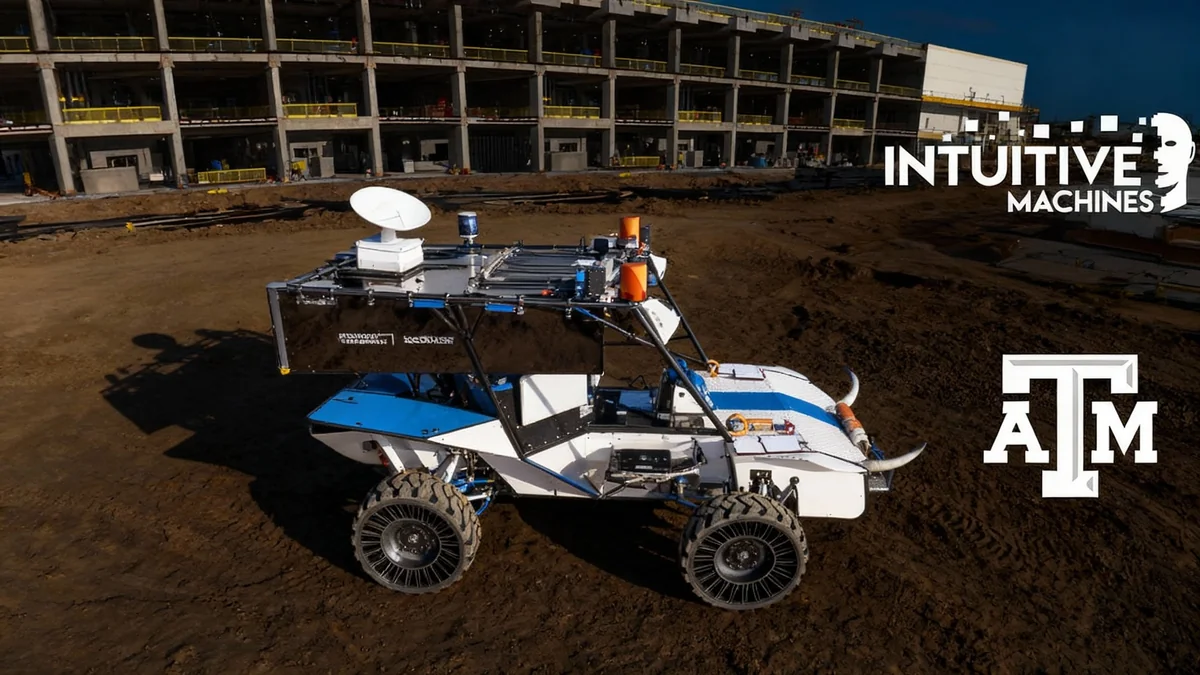
The facility, currently under construction near NASA's Johnson Space Center, will allow engineers to test vehicles and equipment in simulated lunar gravity and lighting conditions. Intuitive Machines has signed a lease agreement for a dedicated bay to refine its Moon RACER rover, marking a significant step in preparing for crewed exploration of the lunar surface.
Key Takeaways
- Texas A&M University Space Institute is building a 400,000-square-foot facility to simulate lunar and Martian environments.
- The project is funded by a $200 million state investment and is scheduled to open in the second half of 2026.
- Intuitive Machines will lease a dedicated bay to test its Moon RACER lunar terrain vehicle for the Artemis program.
- The facility features reconfigurable terrain using synthetic regolith and advanced lighting to mimic lunar conditions.
A New Frontier for Lunar Preparation
Testing equipment for the Moon has long been a challenge for space agencies and private companies. Traditional methods, such as using desert landscapes or small test beds with synthetic soil, fail to replicate the complex and harsh lunar environment accurately.
Factors like low gravity, extreme light and shadow contrasts, and the abrasive nature of lunar dust are difficult to simulate on Earth. This new facility at Texas A&M aims to overcome these limitations. Spanning 400,000 square feet, it will house the world's only indoor, large-scale recreations of the lunar and Martian surfaces, each covering an area of 2.5 acres.
Facility by the Numbers
- Total Area: 400,000 square feet
- Simulation Scapes: 2.5 acres for the Moon, 2.5 acres for Mars
- State Funding: $200 million
- Projected Opening: Second half of 2026
The core of the facility is its ability to dynamically reconfigure its terrain. Using a system that can move hundreds of tons of synthetic regolith, researchers can create craters, slopes, and other features on demand. This allows for repeatable and varied testing scenarios that were previously impossible to achieve at this scale.
Intuitive Machines Moves In
Intuitive Machines, a key player in commercial lunar exploration, has formalized its role in the project by signing a lease agreement for a dedicated bay within the institute. This space will be used to test, operate, and refine its Moon RACER (Reusable Autonomous Crewed Exploration Rover).
The Moon RACER is being developed to support NASA's Artemis missions, providing mobility for astronauts and transporting cargo across the challenging lunar landscape. Testing the vehicle in the institute's controlled environment will allow engineers to optimize its performance, durability, and navigation systems before it is deployed to the Moon.
The Importance of High-Fidelity Data
A crucial element of the simulation's accuracy comes from Intuitive Machines' extensive work with NASA's Lunar Reconnaissance Orbiter Camera (LROC). Over the past 16 years, the LROC team has captured more than 2.3 million high-resolution images, mapping over 98% of the Moon's surface. This vast dataset provides the topographical and visual information needed to create highly realistic models for the simulation facility, ensuring that vehicle tests are based on actual lunar conditions.
Dr. Tim Crain, Chief Growth Officer at Intuitive Machines, signed the agreement alongside Dr. Robert Ambrose, Associate Director of the Texas A&M Space Institute. This partnership solidifies the collaboration between the commercial space sector and academia, creating a pipeline for both technological development and workforce training.
Simulating the Lunar Environment
Beyond its sheer size, the facility's advanced technology sets it apart. An innovative lighting system will replicate the unique conditions of the lunar surface, where the lack of an atmosphere creates sharp, dark shadows and intense, direct sunlight. This is critical for testing optical navigation systems and ensuring equipment can operate in extreme light and dark.
The ability to simulate one-sixth of Earth's gravity will also be a key feature, allowing for accurate assessment of how vehicles move, grip the surface, and manage power consumption. The facility will also include research garages dedicated to the development of next-generation space suits, rovers, and medical technologies for astronauts.
"The Texas A&M University Space Institute is a proving ground for lunar operations, where we can simulate terrain, rehearse missions, and refine our vehicles before they ever leave Earth, which ultimately contributes to longer and more successful Moon missions," said Jack Fischer, Senior Vice President of Operations at Intuitive Machines and a retired U.S. astronaut.
Fischer emphasized the facility's unique capabilities, stating, "there’s truly nothing like it anywhere in the world." He also highlighted the role of Texas State Representative Greg Bonnen in championing the state support that made the project possible.
Building a Workforce for the Future
The institute is led by prominent figures in the space community, including Dr. Nancy Currie-Gregg, a former NASA astronaut, and Dr. Robert Ambrose, an expert in space robotics. Their vision extends beyond hardware testing to include mission concept development and comprehensive workforce training.
By integrating research, development, and education, the institute aims to cultivate a new generation of engineers, scientists, and technicians. This initiative is designed to create a center of excellence that not only supports the immediate needs of the Artemis program but also strengthens the broader space industry in the Houston area and globally.
The collaboration ensures that students and researchers at Texas A&M have direct access to cutting-edge projects and industry partners. In turn, companies like Intuitive Machines gain access to top talent and a world-class facility to accelerate their mission readiness. This synergistic relationship is poised to play a pivotal role as humanity prepares for a sustained presence on the Moon and future missions to Mars.