
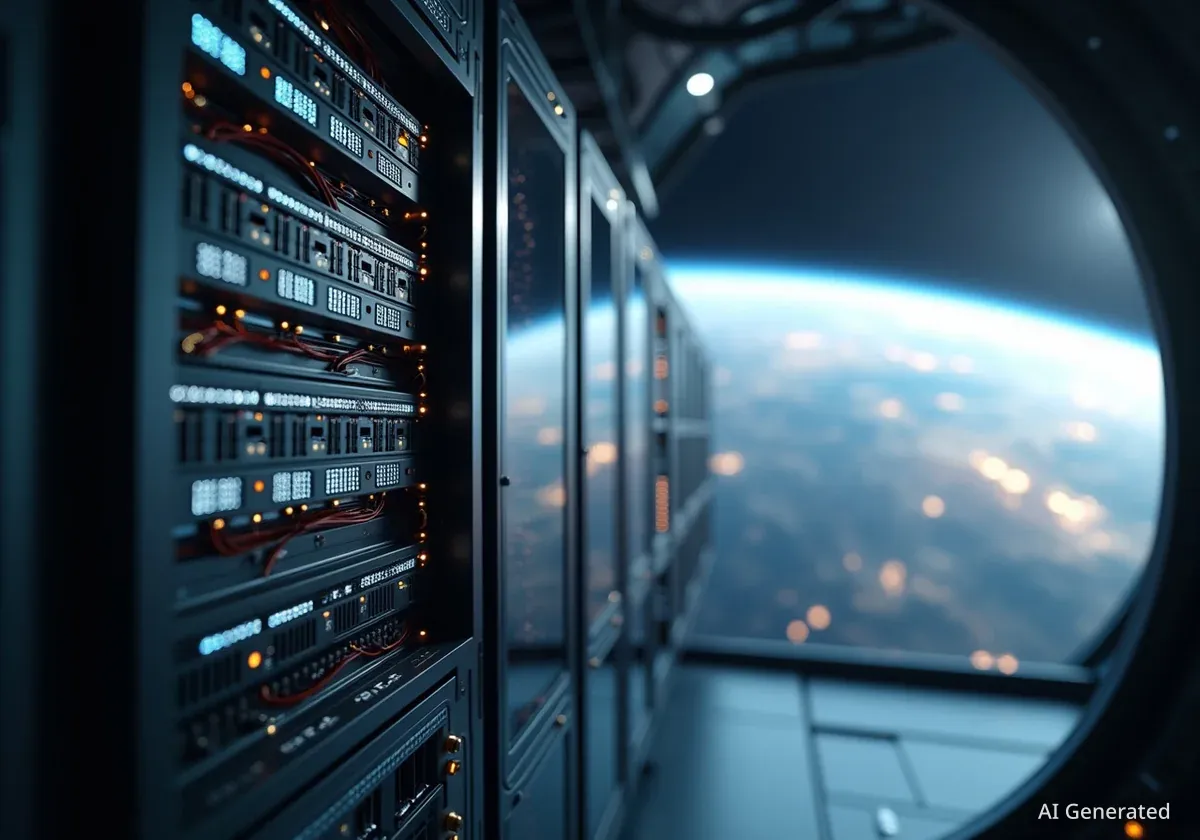


As the demand for artificial intelligence skyrockets, so does its enormous appetite for electricity. Faced with strained power grids and local opposition on Earth, major tech companies and startups are now exploring a radical new frontier for their power-hungry servers: outer space.
The concept involves launching data centers into orbit where they can be powered by continuous, unfiltered sunlight. While the idea promises a solution to Earth-based energy constraints, it also raises significant questions about cost, environmental impact, and the future of our night sky.
Key Takeaways
- The global power requirements for data centers are projected to double by the end of this decade, largely driven by AI development.
- Companies like Google and the startup Starcloud are actively developing plans for solar-powered data centers in orbit.
- Major obstacles include immense rocket launch costs, the need to protect hardware from space radiation, and managing heat in a vacuum.
- Despite using solar power, studies suggest orbital data centers could have a larger carbon footprint than terrestrial ones due to emissions from rocket launches and atmospheric reentry.
- Astronomers raise concerns about increased light pollution and the growing problem of space debris.
AI's Growing Energy Crisis on the Ground
The rapid advancement of artificial intelligence is creating an unprecedented demand for computational power. Training larger and more complex AI models requires massive server farms, known as data centers, which consume vast amounts of electricity and water for cooling.
By 2030, data centers are expected to account for nearly half of all electricity demand growth in the United States. This surge is putting immense pressure on national power grids and local resources. As a result, communities are increasingly hesitant to approve the construction of new server farms that consume land, strain utilities, and require significant water resources.
This terrestrial bottleneck has forced some of the biggest names in technology to look upward for a solution, proposing a shift of their most power-intensive operations from the ground to low-Earth orbit.
The Promise of Unlimited Solar Power in Space
The primary appeal of orbital data centers is access to a near-constant source of energy: the sun. Unlike ground-based solar farms, which are limited by weather and the day-night cycle, solar panels in space can generate electricity almost continuously.
Most proposals envision placing these facilities in a sun-synchronous orbit. This specific path keeps the satellite aligned with the boundary between day and night on Earth, ensuring its solar arrays are bathed in perpetual sunlight.
Who is exploring this technology?
Several major players are investing in the concept of off-planet computing:
- Google's Project Suncatcher: An initiative to launch satellite constellations equipped with specialized AI chips, with a demonstration mission planned for 2027.
- Starcloud: A startup that recently launched a prototype satellite carrying an NVIDIA H100 GPU. The company aims to operate a five-gigawatt orbital data center by 2035.
- International Efforts: China has already begun launching spacecraft for its Xingshidai "space data center" project, and the European Union is studying similar concepts under its ASCEND program.
"Orbital data centers would benefit from continuous solar energy, generated by arrays of photovoltaic cells," explains Benjamin Lee, a computer architect and engineer at the University of Pennsylvania. He notes this could address long-standing challenges in powering computation in a carbon-efficient way.
The High Cost of Leaving Earth
Despite the promise of clean energy, the practical and financial hurdles of building data centers in space are immense. The single greatest barrier is the cost of launching hardware into orbit.
According to estimates from Google's Suncatcher team, launch costs would need to drop to less than $200 per kilogram by 2035 for their vision to become economically viable. While reusable rockets are lowering prices, current costs are still far from this target.
Engineering Challenges in a Vacuum
Beyond launch costs, operating sensitive electronics in space presents unique difficulties. Hardware must be hardened or shielded to protect it from high levels of cosmic radiation. Furthermore, with no air to dissipate heat, these orbital platforms would require massive, heavy radiators to dump waste heat into the vacuum of space, adding significant weight and launch expense.
Another factor is the limited lifespan of computing hardware. The specialized chips used for AI processing typically need to be replaced every five to six years, requiring a constant and costly cycle of new launches to maintain and upgrade the orbital facilities.
An Unexpected Environmental Price
While a solar-powered space data center seems inherently green, a closer look reveals a more complicated environmental picture. A study by researchers at Saarland University in Germany calculated the total emissions impact, including manufacturing, rocket launches, and eventual reentry.
"Our research calculated that an orbital data center powered by solar energy could still create an order of magnitude greater emissions than a data center on Earth," stated Andreas Schmidt, a computer scientist and co-author of the paper titled "Dirty Bits in Low-Earth Orbit."
The majority of these emissions come from the process of de-orbiting. When rocket stages and old satellite components reenter the atmosphere, they burn up and release pollutants. These particles can damage the Earth's protective ozone layer, potentially creating a larger long-term environmental problem than the one they were designed to solve.
Astronomers have also voiced concerns. Samantha Lawler, an astronomer at the University of Regina, worries that massive solar arrays, potentially kilometers in size, would create significant light pollution. This could interfere with critical scientific work, such as the search for near-Earth asteroids that are often spotted during twilight hours.
The projects would also contribute to the growing crisis of space junk, increasing the risk of collisions and adding to the cloud of debris already orbiting our planet. "There’s so much pollution from reentries already and pieces hitting the ground," Lawler notes.
For now, orbital data centers remain an ambitious concept. While the physics of space-based solar power are sound, the economic, environmental, and logistical challenges are formidable. The world must now decide if sending our data into orbit is a brilliant leap forward or simply a way of pushing its consequences out of sight.