
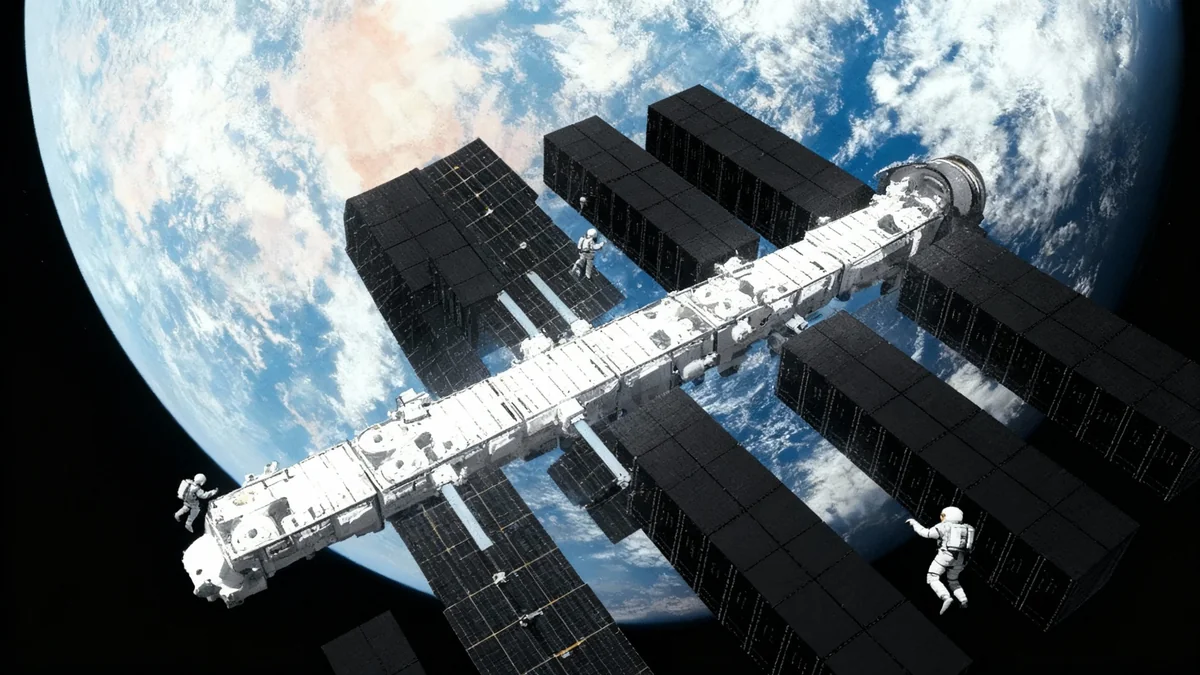


A new technological race is taking shape not on Earth, but in the orbit above it. Some of the most prominent figures in the tech and space industries are now seriously planning to move the energy-intensive infrastructure of artificial intelligence—data centers—into space. This ambitious plan aims to solve one of AI's biggest problems: its massive and growing demand for electricity and cooling.
The vision, once confined to science fiction, is being driven by billionaires like Elon Musk, Jeff Bezos, and former Google CEO Eric Schmidt. They see space as a viable solution for housing the powerful computers that drive modern AI, effectively outsourcing the industry's enormous environmental footprint to the final frontier.
Key Takeaways
- Prominent tech leaders are actively pursuing plans to build and operate AI data centers in Earth's orbit.
- The primary motivation is to address the immense energy consumption and cooling requirements of AI systems.
- Elon Musk's SpaceX is reportedly considering a multi-billion dollar IPO in 2026 to help fund this ambitious project.
- Jeff Bezos's Blue Origin and a startup acquired by Eric Schmidt are also involved in this emerging space race.
- Despite the vision, the project faces extraordinary engineering, logistical, and financial challenges.
The Driving Force: AI's Insatiable Energy Appetite
The rapid advancement of artificial intelligence has created a significant challenge on Earth. The complex computations required by AI models, from language processing to image generation, consume vast amounts of electricity. This energy is needed not only to power the servers but also to cool them, as they generate immense heat.
As AI becomes more integrated into daily life and business, the demand on global power grids is expected to surge. Building more data centers on the ground raises concerns about resource consumption, carbon emissions, and land use. This growing problem has prompted industry leaders to look for radical solutions beyond our planet.
A Growing Problem
Some estimates suggest that the electricity consumption of the AI industry could soon rival that of entire countries. Moving this demand off-planet is seen by some as a necessary step for sustainable technological growth.
A New Space Race for Data Dominance
Several key players are positioning themselves to lead this futuristic industry. Their parallel efforts signal a serious, competitive push toward making orbital computing a reality.
Elon Musk and SpaceX's Grand Vision
Elon Musk's SpaceX is at the forefront of this movement. Reports indicate the company is planning a substantial initial public offering (IPO) in 2026, potentially valued at over $30 billion. A significant portion of this capital would be allocated to developing and launching a vast network of data centers in space.
This initiative aligns with Musk's long-term goals of leveraging space infrastructure for Earth-based needs, similar to the Starlink internet satellite constellation. By placing data centers in orbit, SpaceX could tap into the unlimited solar energy available in space and use the vacuum of space for cooling.
Jeff Bezos and Eric Schmidt Join the Fray
Musk is not alone in this ambition. Jeff Bezos, founder of the aerospace company Blue Origin, has also publicly discussed the potential of moving heavy industry and data processing off-world. His vision involves creating an industrial ecosystem in space to preserve Earth's environment.
Adding to the competition, former Google CEO Eric Schmidt has entered the field by acquiring Relativity Space, a rocket manufacturing startup. While the specific plans are not public, the move is widely interpreted as a strategic step toward building the launch capability required for deploying space-based infrastructure like data centers.
Why Space? The Orbital Advantage
Operating data centers in space offers several theoretical benefits:
- Unlimited Solar Power: Solar panels in orbit can collect energy continuously without atmospheric interference or nighttime interruptions.
- Natural Cooling: The cold vacuum of space provides an efficient, passive cooling system, eliminating the need for the massive water and energy resources used for cooling on Earth.
- Reduced Earthly Footprint: It would free up land and reduce the strain on terrestrial power grids and water supplies.
The Monumental Engineering Hurdles Ahead
While the concept is compelling, the path to establishing orbital data centers is filled with immense challenges. The engineering required to build, launch, and maintain such facilities is on a scale never attempted before.
Experts point to several major obstacles that must be overcome:
- Launch Costs and Mass: Data centers are heavy and composed of thousands of sensitive components. Launching the required mass into orbit would be extraordinarily expensive, even with reusable rockets.
- In-Space Maintenance: Repairing and upgrading hardware in space is a complex and costly task. A failed component on Earth is a simple swap; in orbit, it could require a robotic or even a human mission.
- Radiation Shielding: Electronics in space are vulnerable to cosmic radiation, which can corrupt data and damage hardware. Extensive and heavy shielding would be necessary, adding to the launch weight.
- Data Transmission: Sending massive amounts of data between orbit and Earth introduces latency, or delay. While this might be acceptable for some AI training tasks, it would be problematic for real-time applications.
"The engineering hurdles are enormous. We are talking about creating a completely new class of space infrastructure that must operate with near-perfect reliability for years without direct human intervention."
A Future Built in Orbit?
Despite the difficulties, the financial and strategic momentum behind the idea is undeniable. The involvement of industry titans like Musk, Bezos, and Schmidt suggests that the question is not if humanity will attempt to build orbital data centers, but when.
If successful, this initiative could fundamentally reshape both the technology and space industries. It would represent a major step in moving industrial activity off-planet and could provide the necessary infrastructure for a future space-based economy.
For now, the project remains a grand vision. But with billions in potential funding and the competitive drive of the world's leading innovators, the dream of AI computing among the stars is slowly moving closer to reality.