


A Virginia-based startup has successfully demonstrated a key technology for transmitting solar power from the sky to the ground, a major step toward the long-held goal of harvesting clean energy from space. Overview Space confirmed it beamed thousands of watts of power from an aircraft to a ground station using a laser, validating a concept that could one day provide continuous, carbon-free electricity to the planet.
The test, which involved sending a near-infrared laser beam from an altitude of 5,000 meters, proves the viability of the company's unique approach to space-based solar power. This method aims to supplement existing terrestrial solar farms, allowing them to generate electricity even at night or on cloudy days.
Key Takeaways
- Overview Space successfully transmitted thousands of watts of power from a high-altitude aircraft to a ground receiver using a near-infrared laser.
- The company's strategy involves beaming energy to existing solar facilities, allowing them to operate 24/7.
- A demonstration satellite is scheduled to launch in early 2028, with plans for operational spacecraft in geosynchronous orbit by 2030.
- The technology is described as "passively safe," with a low-intensity beam that poses no harm.
A New Approach to an Old Idea
The concept of collecting solar energy in space and sending it to Earth has been explored for over 50 years. Space offers an unfiltered, constant source of sunlight, free from weather or nighttime interruptions. However, previous concepts often relied on massive satellites using microwaves to transmit power, raising concerns about cost, safety, and complexity.
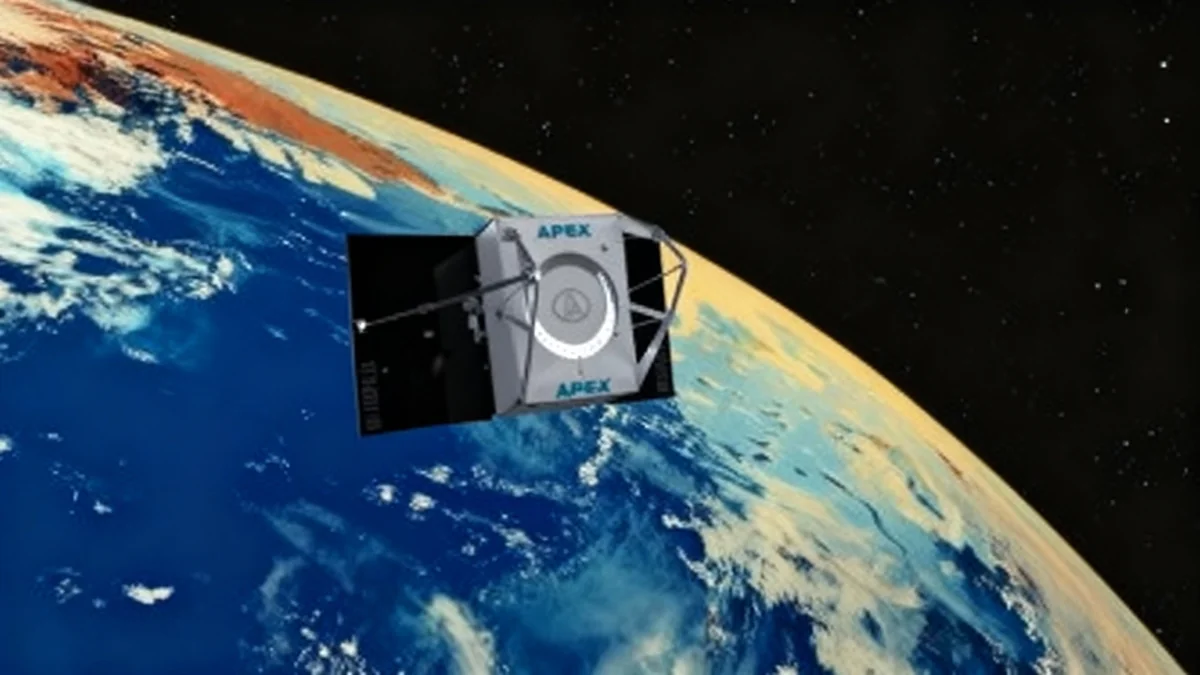
Overview Space is pursuing a different path. Instead of microwaves, the company uses near-infrared lasers. This choice has significant advantages, allowing the transmission antenna on a satellite to be about half a meter across, compared to the hundreds of meters required for microwave systems.
"This is an approach that uses all of the tracking and guidance methodology that we would take to space," said Marc Berte, founder and chief executive of Overview Space. "This is an integrated system test of all the elements of the piece in a way that is economically scalable into the future."
Safety and Efficiency
A key benefit of the laser-based system is its inherent safety. The beam's intensity is low, eliminating the risks associated with high-power microwaves. Berte explained that the beam is "passively safe," meaning a person could stand in it without harm. He compared the experience during the day to being on a white sand beach on a sunny afternoon.
This approach also leverages existing infrastructure. By targeting terrestrial solar farms, Overview Space avoids the need to build large, dedicated receiving stations on the ground. The laser energy would simply allow the solar panels to continue generating electricity when the sun is not available.
By the Numbers
- Altitude of Test: 5,000 meters
- Power Transmitted: Multiple thousands of watts
- Planned Satellite Power: At least 1 megawatt per spacecraft
- First LEO Demo: Early 2028
- First GEO Operational Satellite: As soon as 2030
Overcoming Atmospheric Hurdles
One notable challenge for a near-infrared laser system is that it cannot penetrate clouds. While microwaves can pass through cloud cover, lasers are blocked. Overview Space has developed a practical solution for this limitation.
The company plans to operate a global network of ground receivers. This network ensures that at any given moment, a satellite can beam power to a location with clear skies. By dynamically switching between ground stations, the system can maximize the satellite's uptime and deliver a consistent energy supply.
Endorsement from a NASA Veteran
The project has attracted high-profile support, including from former NASA Administrator Mike Griffin, who now serves as an advisor to the company. His endorsement lends significant credibility to the venture.
"I’ve been looking at concepts for space solar energy for 48 years, and this is the first one I’ve seen that I think might work," Griffin stated.
The Path to Orbit
With the successful aircraft demonstration complete, Overview Space is now focused on taking its technology into orbit. The company has already booked a launch with SpaceX for its first low Earth orbit (LEO) demonstration satellite.
This mission, scheduled for the Bandwagon-7 rideshare in early 2028, will test the same laser and optics systems used in the aerial test, transmitting kilowatts of power from space. Most of the satellite will be constructed in-house by the company's growing team.
Scaling Up for Global Impact
The LEO mission is a stepping stone. The ultimate goal is to deploy a constellation of more powerful spacecraft in geosynchronous orbit (GEO) starting around 2030. These satellites, designed to be about 90% deployable solar arrays, will each deliver at least one megawatt of electricity to the grid.
The company's production strategy is inspired by the success of satellite megaconstellations like Starlink. Rather than building a few gigantic satellites, Overview Space plans to mass-produce a larger number of standardized spacecraft.
"Starlink and the other megaconstellations have shown the economy of mass production wins over economy of scale for the most part," Berte noted. This approach simplifies launch logistics and reduces manufacturing costs.
While Berte did not provide a specific price point for the electricity, he affirmed it will be competitive with other carbon-neutral energy sources. The company's ambition is to add megawatts, and eventually gigawatts, of clean power to the global grid throughout the 2030s.
From Concept to Company
Marc Berte began developing the concept in 2017, driven by the belief that space solar power was a viable but underfunded solution to the world's energy needs. He started with a clean-sheet design, prioritizing passive safety and minimal initial investment.
The company was incubated in 2021 within Vast, a commercial space station company founded by billionaire Jed McCaleb. When Vast shifted its focus, Overview Space was spun out as an independent entity, retaining Vast as a stakeholder. Since then, the company has raised nearly $20 million in two seed funding rounds.
Based in Ashburn, Virginia, the team of approximately 25 employees is expanding rapidly to develop its satellite systems and production facilities. "This is an industry now. This isn’t science fiction," Berte concluded. "The technology works, and now it’s scaling up."