
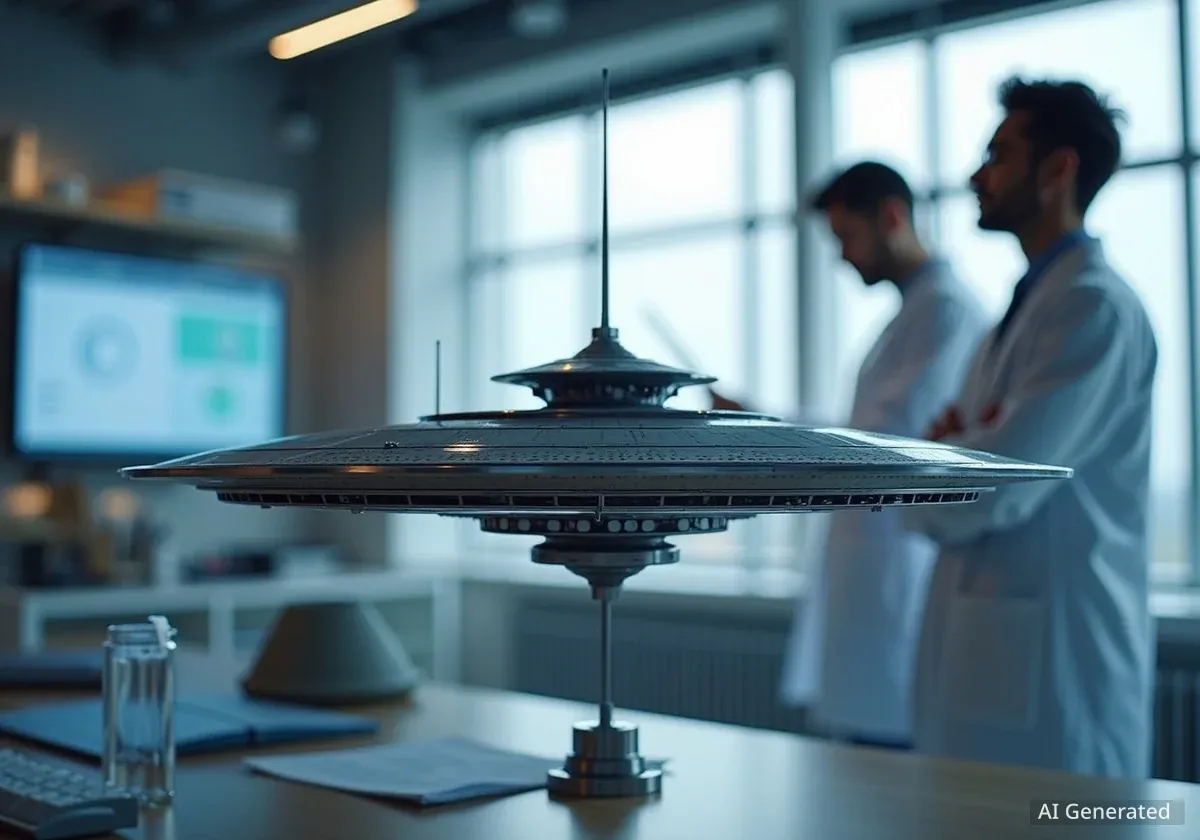


Russia's state rocket company has secured a patent for a new type of orbital space station designed to generate artificial gravity. The concept aims to counteract the harmful effects of long-term weightlessness on astronauts by creating an environment where they can live and work without constantly floating.
The design draws on principles long imagined in science fiction, most famously depicted in the film 2001: A Space Odyssey, signaling a potential shift in how humanity approaches long-duration missions in space.
Key Takeaways
- Russia has officially patented a design for an orbital station that can create artificial gravity through rotation.
- The primary goal is to mitigate severe health problems astronauts face during extended missions in zero-gravity environments.
- This technology could be crucial for future long-haul journeys, such as missions to Mars or the establishment of lunar bases.
- The concept relies on centrifugal force, a principle that has been a staple of theoretical space architecture for decades but has not yet been implemented on a large scale.
A New Spin on Space Habitation
The patent outlines a space station that would use rotation to produce centrifugal force, simulating the pull of gravity. In this design, astronauts would experience a constant force pushing them toward the station's outer wall, allowing them to walk and perform tasks in a manner similar to Earth.
This approach moves away from the microgravity environment of current habitats like the International Space Station (ISS), where every object, including the crew, is in a state of continuous freefall. While weightlessness is useful for certain scientific experiments, it poses significant challenges for the human body over long periods.
The successful implementation of such a system would represent a major engineering milestone. It would not only improve the quality of life for astronauts but also fundamentally change the requirements for equipment and daily operations in orbit.
The Challenge of Long-Term Weightlessness
Living in space takes a heavy toll on the human body. Without the constant pull of gravity, astronauts experience a range of physiological issues that can have lasting consequences. The current regimen to combat these effects involves several hours of rigorous daily exercise.
Health Risks in Microgravity
Astronauts can lose an average of 1% to 2% of their bone mineral density for every month they spend in space. This condition, known as space-induced osteoporosis, makes bones more brittle and increases the risk of fractures upon returning to a gravity environment.
Other significant health concerns include:
- Muscle Atrophy: Without the need to support body weight, muscles, particularly in the legs and back, begin to weaken and shrink.
- Cardiovascular Deconditioning: The heart does not have to work as hard to pump blood, causing it to decrease in size and strength.
- Fluid Shifts: Bodily fluids move towards the head, causing facial puffiness, nasal congestion, and increased intracranial pressure, which can lead to vision problems.
- Neurovestibular Issues: The body's sense of balance and orientation is disrupted, leading to space adaptation syndrome, or space sickness, in the initial days of a mission.
An artificial gravity station is proposed as a comprehensive solution to these problems, potentially reducing the need for intensive exercise countermeasures and making deep space travel more viable.
From Science Fiction to Engineering Blueprint
The idea of a rotating wheel-shaped space station to create gravity is not new. It was first proposed by scientists like Konstantin Tsiolkovsky in the early 20th century and was later popularized by Wernher von Braun. However, it is most widely recognized from its iconic depiction in Stanley Kubrick's 1968 film, 2001: A Space Odyssey.
"For decades, the rotating space station has been a symbol of humanity's future in space. Moving this from a theoretical concept to a patented engineering plan is a significant step, even if construction remains a distant goal."
While the concept is straightforward, the engineering challenges are immense. Building a large, rotating structure in orbit, ensuring its stability, and managing the complexities of docking and operations present formidable hurdles. The Coriolis effect, a force that can cause disorientation and nausea in a rotating environment, would also need to be carefully managed through design and astronaut training.
The Legacy of the International Space Station
The International Space Station (ISS) has been continuously inhabited since November 2000, providing a wealth of data on the effects of microgravity. This research has been instrumental in understanding the very problems that an artificial gravity station aims to solve. The ISS is expected to be deorbited around 2030, prompting space agencies worldwide to plan for the next generation of orbital habitats.
Implications for the Future of Space Exploration
The development of an artificial gravity station could be a game-changer for humanity's ambitions in space. For missions to Mars, which would involve travel times of six to nine months each way, mitigating the health effects of weightlessness is a top priority.
A station with artificial gravity would allow astronauts to arrive at their destination in better physical condition, ready to perform demanding tasks on the Martian surface. It would also make the prospect of permanent off-world settlements, whether on the Moon or in orbit, far more practical.
While this patent is an initial step and does not guarantee construction, it reflects a strategic focus on solving one of the core biological barriers to deep space exploration. As nations look beyond low-Earth orbit, technologies that can sustain human health for years at a time will become increasingly critical.