
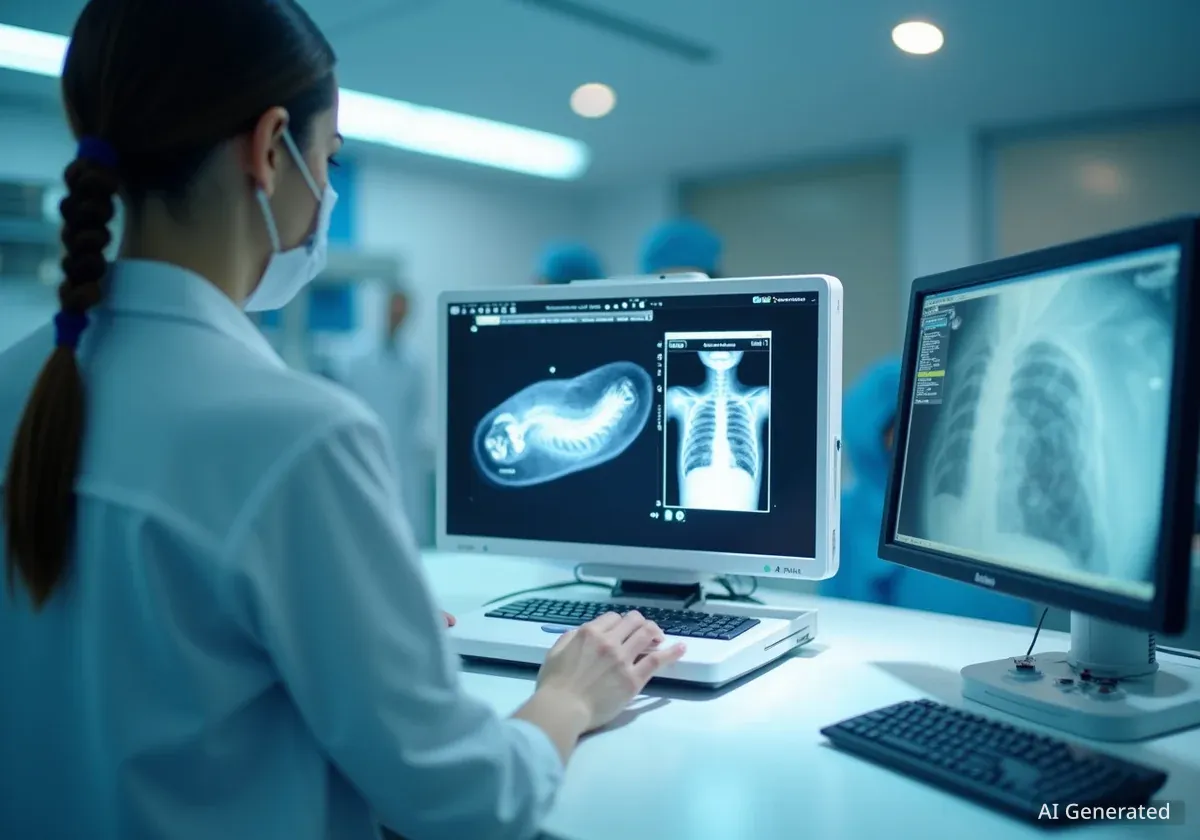


NASA's Glenn Research Center is collaborating with two Ohio-based institutions to test portable, handheld X-ray devices for use on the International Space Station and future long-duration missions. The project aims to provide astronauts with crucial diagnostic capabilities for medical emergencies and equipment maintenance far from Earth.
The initiative, a partnership with University Hospitals and Cuyahoga Community College, involves evaluating three commercial X-ray systems to determine the most suitable option for the unique challenges of spaceflight. The selected device is scheduled for deployment on the ISS between 2027 and 2028.
Key Takeaways
- NASA Glenn is leading a project to select a portable X-ray machine for space missions.
- The project is a collaboration with University Hospitals and Cuyahoga Community College in Ohio.
- The device will have dual uses: diagnosing astronaut medical issues and inspecting spacecraft components.
- Three devices from MinXray, Remedi, and Fujifilm are being tested.
- The final selection is expected next year, with deployment on the ISS planned for 2027 or 2028.
Addressing a Critical Gap in Space Medicine
For astronauts on the International Space Station, a medical emergency like a fractured bone presents a significant challenge. With the nearest hospital over 200 miles below on Earth, immediate access to advanced diagnostic imaging is not possible. Currently, the ISS is equipped with an ultrasound machine, which provides real-time images but has limitations in its ability to penetrate dense materials and provide the clarity needed for certain diagnoses.
To solve this problem, NASA's Glenn Research Center in Cleveland is spearheading an effort to identify a compact, low-power X-ray system that can operate effectively in microgravity. According to Cy Peverill, the project task lead at NASA Glenn, having the right tools is essential for crew survival on long missions.
“Having the right tools on hand is crucial to ensure the survival of the crew,” Peverill stated. “It costs a lot of money to send anything into space, so we need to show that these X-ray machines are worth the amount of room they would take in the crew module.”
The chosen device must be user-friendly for astronauts who are not trained radiology technicians, durable enough for spaceflight, and versatile enough for multiple applications.
A Multifaceted Tool for Deep Space Exploration
The applications for a portable X-ray machine in space extend beyond medical emergencies. Researchers envision using the device for a wide range of diagnostic tasks that are crucial for the safety and success of missions to the Moon and Mars.
Non-Medical Applications
One key use is non-destructive inspection of spacecraft hardware. During testing at NASA Glenn, researchers used the devices to examine intentionally damaged rover tires.
“We were able to see inside (the tires) where some of the springs had bent, which could support a decision to switch out that tire before you go on a five-mile trip on the moon,” explained Chase Haddix, a senior biomedical engineering research contractor at NASA Glenn. The devices have also shown promise in imaging through spacesuits, metal objects, and electronic components to identify internal damage without disassembly.
Versatile Imaging Capabilities
Beyond hardware, the X-ray devices could be used for scientific research, such as examining the root systems of plants grown in space without uprooting them. This capability could provide valuable data on plant biology in microgravity.
A Three-Way Collaboration in Ohio
NASA leveraged local expertise in Northeast Ohio, forming a partnership with Cuyahoga Community College (Tri-C) and University Hospitals (UH) to conduct comprehensive testing. This multi-disciplinary approach allowed for a thorough evaluation of the candidate devices in simulated and real-world scenarios.
“This has been a very multi-disciplinary project, and it was really cool that we were able to leverage all the expertise nearby,” said Haddix.
Training and Simulation at Tri-C
At Tri-C's advanced radiography labs, the NASA team spent a month learning proper X-ray techniques. They practiced on anatomical phantoms—human bones encased in clear plastic—to master positioning and image quality.
Elizabeth Gildone, program director for radiology at Tri-C, noted the mutual benefits of the collaboration. “There were all kinds of technical considerations they were learning from us, and we were learning what their needs were in the space environment,” she said. The college's dental hygiene department also provided training, using specialized manikins with human bone and teeth to teach dental radiography.
Hands-On Learning for Students
Students in Tri-C's radiography program were able to observe the testing, offering them a unique insight into the real-world application of their studies in a space exploration context. In return for the college's assistance, NASA hosted Tri-C faculty and students for a tour of the Glenn Research Center.
Clinical Validation at University Hospitals
The final phase of testing involves comparing the images from the portable devices with those from traditional, hospital-grade equipment. At University Hospitals, up to 40 patients have the opportunity to participate in the study. Each volunteer receives a standard clinical X-ray and a second one using one of the portable NASA devices.
David Jordan, chief medical physicist in radiology at UH, explained the importance of this comparison. “If they find, for example, that this equipment works well for wrists, ankles and forearms, but it’s not so useful for shoulders or chests, that’ll factor into their decisions for when and how they would pull it out during a mission,” he said.
The Three Contenders for Spaceflight
The evaluation process, which began in June 2024, initially reviewed over 200 different X-ray systems. NASA narrowed the field to three finalists based on criteria such as size, weight, power consumption, ease of use, and image quality.
The three companies whose devices are being tested are:
- MinXray: An Illinois-based company known for portable digital imaging equipment. Its device, the largest of the three, is roughly the size of a coffee machine and recently took the first X-ray of a human hand in space during a SpaceX mission.
- Remedi: A South Korean medical technology firm. One of its X-ray machines is already scheduled for a flight on a SpaceX mission in 2026.
- Fujifilm: A global imaging and healthcare company headquartered in Japan, offering a wide range of technology products.
The collaboration has generated excitement among the local partners. “There’s a certain amount of bragging rights to it all,” Jordan commented. “We’re helping support the crew that’s going out there.” The final decision on which device will be certified for spaceflight is expected by next year, marking a significant step forward in ensuring astronaut health and safety on long journeys into the solar system.