
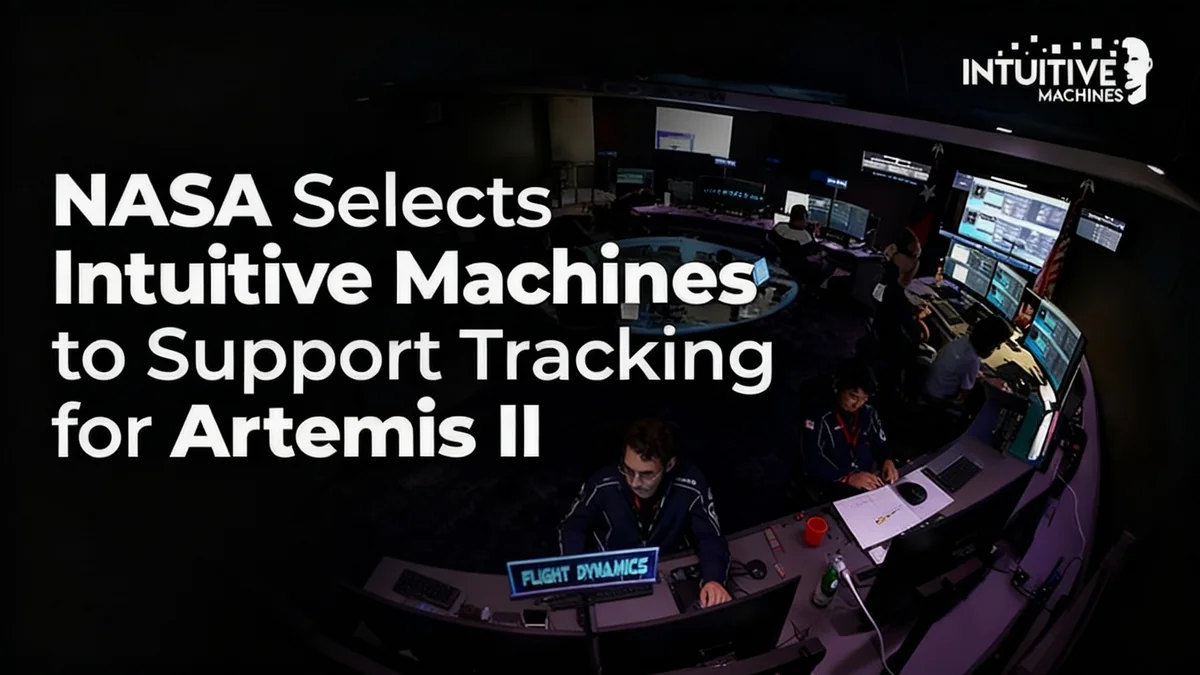


NASA has selected private space firm Intuitive Machines as one of 34 global partners to provide tracking support for the upcoming Artemis II mission. The company will utilize its proprietary Space Data Network to monitor the Orion spacecraft as it carries four astronauts on a historic 10-day journey around the Moon.
This collaboration, which involves no exchange of funds, highlights a growing trend of public-private partnerships in space exploration. Intuitive Machines will provide crucial data to help ensure the safety and success of the crewed lunar flyby, a critical step toward establishing a sustainable human presence on the Moon.
Key Takeaways
- Intuitive Machines will join a global volunteer group to track NASA's Artemis II mission.
- The company will use its Space Data Network (SDN) to provide one-way Doppler measurements of the Orion spacecraft.
- This data helps determine the spacecraft's precise position and velocity during its 10-day lunar journey.
- The collaboration is part of NASA's effort to integrate commercial capabilities into its deep-space missions.
- Intuitive Machines previously provided successful tracking for the uncrewed Artemis I mission in 2022.
A Crucial Role in Humanity's Return to the Moon
The Artemis II mission represents a significant milestone in human spaceflight, marking the first time in over 50 years that astronauts will travel to the vicinity of the Moon. The mission will test the capabilities of the Orion spacecraft and its life-support systems in a deep-space environment before future missions attempt a lunar landing.
To ensure the mission's success, precise and constant tracking is essential. While NASA's own Deep Space Network and Near Space Network will provide primary communications, the agency has enlisted a diverse group of partners to augment its capabilities. This group includes commercial providers, academic institutions, and even amateur radio enthusiasts.
Intuitive Machines, a Houston-based company, stands out as a key commercial partner. The firm will leverage its ground station infrastructure and its advanced Space Data Network to monitor radio signals transmitted by Orion throughout its flight.
The Science of Doppler Tracking
Intuitive Machines will employ a technique known as one-way Doppler measurement to track Orion. This method involves analyzing tiny shifts in the frequency of the radio waves emitted by the spacecraft. These shifts, caused by the Doppler effect, reveal critical information about the spacecraft's movement.
By monitoring these frequency changes in real-time, engineers can calculate Orion's velocity relative to Earth with incredible accuracy. This tells them whether the spacecraft is accelerating, slowing down, or maintaining a steady speed on its trajectory to and from the Moon. The data is fundamental for navigation and for verifying that the mission is proceeding as planned.
Building on Past Success
This is not the first time Intuitive Machines has supported an Artemis mission. In 2022, the company successfully tracked the uncrewed Artemis I mission, providing NASA with valuable Doppler data as the Orion spacecraft traveled to a record-breaking distance of over 270,000 miles from Earth.
Strengthening a Growing Space Network
The collaboration serves a dual purpose. For NASA, it's an opportunity to test and validate the tracking capabilities of the broader space community. The data submitted by Intuitive Machines and other volunteers will help the agency identify new ways to support future, more complex missions to the Moon and eventually Mars.
For Intuitive Machines, it is a chance to prove and expand its own network. The company's Space Data Network, formerly known as the Lunar Data Network, is designed to provide persistent communication and navigation services for missions operating throughout the Earth-Moon system and beyond.
"In partnership with NASA, tracking Artemis II is another opportunity to strengthen and expand our Space Data Network, while we continue our work under the agency’s Near Space Network services contract. We look forward to providing resilient, persistent networking for future Artemis campaign missions and our commercial partners."
The experience gained from tracking Artemis I proved invaluable, informing improvements that were applied to the company's own successful lunar landing missions, IM-1 and IM-2. Participating in Artemis II continues this cycle of innovation and refinement.
The Artemis Program Goals
The Artemis campaign is NASA's multi-mission initiative to return humans to the lunar surface. Its long-term objectives include:
- Establishing a sustainable, long-term human presence on and around the Moon.
- Confirming systems needed for future deep-space exploration.
- Using the Moon as a stepping stone for the first crewed missions to Mars.
A New Era of Collaborative Space Exploration
The selection of Intuitive Machines underscores a strategic shift in how deep-space missions are conducted. By integrating commercial assets, NASA can build a more robust, resilient, and cost-effective communications and tracking infrastructure.
This model allows the agency to focus its primary resources while leveraging the innovation and agility of the private sector. The volunteer nature of this specific agreement further demonstrates the shared commitment within the global space community to advance human exploration.
As the four astronauts of Artemis II prepare for their historic flight, a network of partners on the ground, including the team at Intuitive Machines, will be watching the data, ensuring their safe journey to the Moon and back.