
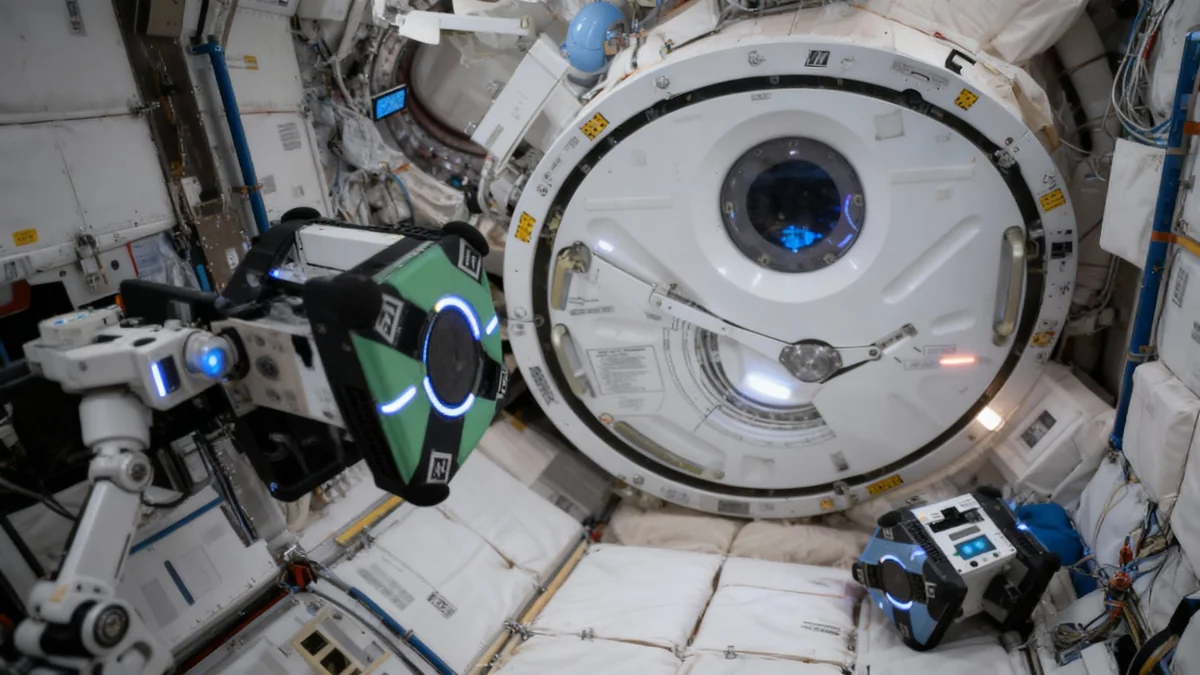


Free-flying robots aboard the International Space Station (ISS) can now navigate with unprecedented accuracy, thanks to a new system developed in collaboration with NASA. The technology uses a virtual replica of the station to help the robots understand their position, solving a persistent problem that required astronauts to intervene.
The solution significantly reduces orientation errors for NASA's Astrobee robots, allowing them to perform long-term missions autonomously and freeing up crew members for critical scientific research.
Key Takeaways
- NASA's Astrobee robots on the ISS frequently lost their orientation in microgravity, requiring manual resets by astronauts.
- A new algorithm, developed with Professor Pyojin Kim of GIST, uses a 'digital twin' of the ISS to provide a stable reference map.
- The system reduces rotational errors to an average of 1.43 degrees, enabling 'drift-free' autonomous navigation.
- This technology has potential applications on Earth for indoor drones and robots in GPS-denied environments.
The Challenge of Direction in Zero Gravity
On Earth, even the simplest machines rely on gravity to function. A ballpoint pen uses it to pull ink to its tip. Similarly, terrestrial robots use sensors called Inertial Measurement Units (IMUs) to determine their orientation relative to the pull of gravity.
In the microgravity environment of the International Space Station, this fundamental reference point is missing. Without a clear sense of 'up' or 'down', even sophisticated autonomous robots like NASA's Astrobee can become disoriented.
These free-flying assistants are designed to handle routine chores, such as inventory checks and monitoring experiments, to save astronaut time. However, their navigation systems would accumulate small errors over time, causing them to drift and lose their position. This forced astronauts to pause their own work to manually recalibrate the machines.
What is Astrobee?
Astrobee is a system of three free-flying, cube-shaped robots designed to operate inside the ISS. They serve as research platforms and assistants for the crew, equipped with cameras and sensors to perform tasks that would otherwise require an astronaut's attention.
A Virtual Solution to a Physical Problem
To solve this navigational drift, NASA collaborated with a team led by Professor Pyojin Kim at the Gwangju Institute of Science and Technology (GIST). The team developed a groundbreaking algorithm centered on the concept of a digital twin.
They created a precise, clean 3D virtual model of the ISS interior using NASA's own blueprints. This digital version is free of the temporary clutter that exists in the real station, such as cables, floating personal items, or experimental equipment that can block a robot's view.
The Astrobee robot uses its cameras to see its real, often messy, surroundings. The new software then compares this live footage with pristine, predictable images generated from the digital twin. This cross-referencing allows the robot to filter out the 'visual noise' and accurately determine its true position and orientation.
"The digital twin serves as a ground truth, enabling the robot to filter out visual noise and recalibrate its position," Professor Kim explained.
Leveraging Geometry as a Compass
The system relies on a principle known as the 'Manhattan World Assumption,' which posits that human-made environments are primarily composed of straight lines and right angles. The boxy, modular structure of the ISS is an ideal environment for this approach.
By identifying the major lines and planes of the station's walls and modules, the robot can use these geometric features as a fixed 'visual compass' to triangulate its location with high precision.
Precision Achieved
The implementation of this new technology has reduced the average rotational error for the Astrobee robots to just 1.43 degrees. Crucially, this error figure does not increase over time, achieving what the team calls a 'drift-free' navigation capability.
From Orbit to Earth
While designed for the unique challenges of space, this navigation technology holds significant promise for applications on Earth. The system's ability to operate using only visual data from cameras makes it ideal for indoor environments where GPS signals are unreliable or unavailable.
Potential uses include:
- Warehouse Automation: Guiding robots and drones through complex storage facilities.
- Indoor Drones: Enabling drones to navigate inside large buildings for inspections or deliveries.
- Urban Robotics: Assisting robots in navigating complex cityscapes filled with orthogonal structures.
"Orientation techniques based on these structural features are applicable not only to space stations but also to typical urban settings," Professor Kim noted, highlighting the technology's versatility.
The Value of a Collaborative Ecosystem
Professor Kim's involvement with NASA began during his doctoral studies with an internship at the agency's Ames Research Center, where Astrobee was being developed. This long-standing relationship underscores the importance of NASA's role in fostering innovation that extends beyond its own missions.
He observed that NASA's culture encourages bold experimentation, even if it leads to setbacks. This willingness to endure failures in pursuit of a single major breakthrough is a key driver of its success.
"Because only successful projects are publicized, it appears as though they never fail," Professor Kim said. "But behind every public triumph lie dozens of quiet failures."
This sustained investment in talent and technology has created a robust ecosystem that fuels the private space industry. For those aspiring to work in this field, Professor Kim's advice is direct: focus on fundamentals. "You must excel at mathematics and your studies in general... If you work hard to build your skills, the opportunity will surely follow."