
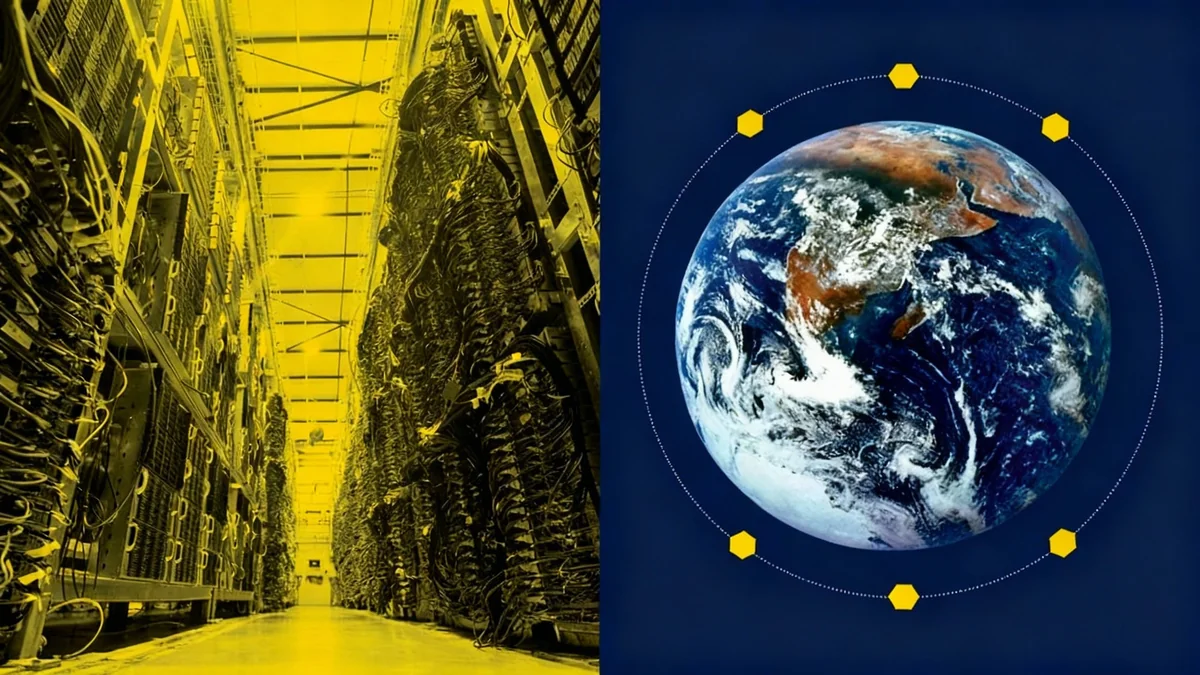


The rapid expansion of artificial intelligence is creating an unprecedented demand for data centers, the powerful computing facilities that form the backbone of the digital world. However, these centers consume vast amounts of land and energy, prompting some companies to explore a radical new frontier: outer space.
By moving data processing and storage into orbit, proponents believe they can tap into a limitless supply of solar energy and bypass the physical constraints of building on Earth. While the concept faces significant technical and financial hurdles, a growing number of startups and established aerospace firms are now investing in the idea.
Key Takeaways
- Surging AI development is driving a massive increase in demand for data centers and their energy consumption.
- Companies are exploring placing data centers in orbit to utilize constant solar power and save land on Earth.
- Major challenges include high launch costs, rocket emissions, heat dissipation in a vacuum, and space radiation.
- Despite skepticism, several firms have already launched or plan to launch small-scale demonstration missions.
The Growing Problem on Earth
The global demand for data processing is expanding at an exponential rate, largely fueled by advancements in artificial intelligence. Applications like OpenAI's ChatGPT and Sora require immense computational power, which is housed in sprawling, warehouse-like data centers.
These terrestrial facilities have a significant environmental footprint. They occupy large tracts of land and require enormous amounts of electricity for operation and cooling. According to analysis from Goldman Sachs, the power demand from data centers is projected to increase by 165% by 2030, putting further strain on global energy grids.
While some modern data centers incorporate renewable energy sources, solar and wind farms also require substantial physical space, creating a direct conflict for land resources.
This escalating need for power and space has led innovators to look upward for a potential solution, proposing to move the infrastructure itself off-planet.
A Solution Beyond the Atmosphere
The primary appeal of placing data centers in space is access to uninterrupted solar energy. In orbit, solar panels can generate power 24 hours a day, without interference from clouds, nighttime, or seasonal changes that affect terrestrial solar farms.
A European Commission-funded study called the ASCEND project, led by the France-based company Thales Alenia Space, explored this very concept. The study concluded last year that space-based data centers could offer a more environmentally friendly solution for data hosting, provided certain technological advancements are made.
Xavier Roser of Thales Alenia Space noted that for the idea to be truly sustainable, significant progress is needed in multiple areas. One of the most critical is the development of cleaner launch vehicles.
The Launch Paradox
While total emissions from rocket launches are currently a small fraction of the aviation industry's, they release pollutants high in the atmosphere where they can persist for longer. The ASCEND study estimated that for space data centers to be a net positive for carbon emissions, a new type of rocket that emits 10 times less carbon over its lifecycle than current models would be required.
It remains unclear when, or if, such a rocket will be developed. Major launch providers like SpaceX have not publicly announced plans for a more environmentally friendly rocket design.
The Pioneers of Orbital Computing
Despite the challenges, a number of companies are pushing forward with small-scale projects to prove the technology's viability. These early missions are designed to test components and demonstrate that data can be stored and processed effectively in the harsh environment of space.
Early Demonstrations
Abu Dhabi-based startup Madari Space is preparing its first mission for 2026. The company, founded by Etihad Airways pilot Shareef Al Romaithi, will send a payload roughly the size of a toaster oven into orbit. This package will contain data storage and processing components to test their performance.
Al Romaithi believes processing data in space is essential for customers like Earth observation satellite operators, as it can reduce delays and "allow them to make informed decisions in a timely manner."
Others are already in orbit. In May, China launched 12 satellites as part of a planned 2,800-satellite constellation for in-space data processing. Al Romaithi sees this as a clear signal that the concept is becoming a reality.
Several American firms are also active in the field:
- Lonestar Data Holdings: The Florida-based company reported a successful test of a small data center on the moon in March. It has since signed a $120 million deal to build six data-storage satellites, with the first scheduled to launch in 2027.
- Starcloud: This Washington-based startup plans to launch a satellite equipped with a powerful Nvidia H100 graphics processing unit (GPU) in November, which it claims will set a record for in-orbit computing power.
Philip Johnston, CEO of Starcloud, is optimistic about the future. "My view is that in 10 years’ time, almost all new data centers will be being built in space, purely because of the constraints we are facing on building new energy projects terrestrially," he stated.
Astronomical Hurdles Remain
While the vision is ambitious, experts urge caution, pointing to a host of significant obstacles that must be overcome before orbital data centers can compete with their terrestrial counterparts.
Quentin A. Parker, director of the Laboratory for Space Research at the University of Hong Kong, is skeptical about the financial viability. "To do a cost effective, true, objective analysis of it, it doesn’t really stand up to scrutiny," he said, adding, "The terrestrial solutions are still there, and they’re still probably a lot cheaper."
Key challenges include:
- Cost: Launching heavy payloads into space is extremely expensive. Lonestar's initial satellite launch could cost around $10 million while offering only a fraction of the storage capacity of a typical data center on Earth.
- Technical Issues: Engineers must solve the problem of dissipating large amounts of heat from computer chips in the vacuum of space. They also need to harden the electronics against constant high-energy radiation.
- Maintenance and Security: Repairing hardware in orbit is a complex and costly endeavor. Furthermore, space assets are vulnerable to space debris, solar flares, and potential jamming from counterspace technologies being developed by several nations.
Proponents argue that these challenges are worth tackling. For Madari's Al Romaithi, the push into space is a necessity. "It is worth overcoming these challenges because the alternative is technological stagnation," he said. "We will reach a point where we are exhausting our resources just to run data centers."