


A tiny crack discovered on a spacecraft window has triggered an unprecedented emergency response for China's Tiangong space station, forcing the nation to deploy its backup rescue vehicle and creating a temporary but significant gap in its human spaceflight safety protocols. The incident highlights the growing threat of space debris and has prompted an urgent acceleration in the production of the next Shenzhou spacecraft.
Key Takeaways
- A crack on the Shenzhou-20 spacecraft, likely caused by space debris, was deemed a safety risk for astronaut return.
- China launched its backup spacecraft, Shenzhou-22, in an uncrewed emergency mission to serve as a new lifeboat.
- The use of the backup vehicle has left Tiangong without an immediate on-ground rescue option for the first time.
- Production of the next spacecraft, Shenzhou-23, is being accelerated to re-establish emergency readiness, potentially by early 2026.
An Unexpected Discovery in Orbit
The sequence of events began on November 5 during routine pre-departure checks on the Shenzhou-20 spacecraft docked at the Tiangong station. Astronauts discovered a crack exceeding 10 millimeters in size on a portview window. Initial assessments suggested the damage had penetrated the outermost of the window's three glass layers, rendering the vehicle unsafe for the high-stress conditions of atmospheric reentry.
The discovery left the three outgoing Shenzhou-20 astronauts without a secure ride home. In response, China's Manned Space Engineering Office (CMSEO) made a critical decision: the crew would return to Earth using the Shenzhou-21 vehicle, which had just arrived at the station on October 31 with their replacements.
The Threat of Space Debris
Even minuscule objects traveling at orbital velocities of thousands of miles per hour can cause catastrophic damage. Experts believe the crack on Shenzhou-20 was likely caused by a piece of space debris smaller than one millimeter, illustrating the pervasive and serious risk posed by orbital clutter to all space missions.
On November 14, the Shenzhou-20 crew safely landed back on Earth aboard Shenzhou-21. While this solved one problem, it created another: the newly arrived Shenzhou-21 crew was now stranded in orbit without a dedicated lifeboat.
First-Ever Emergency Launch Protocol Activated
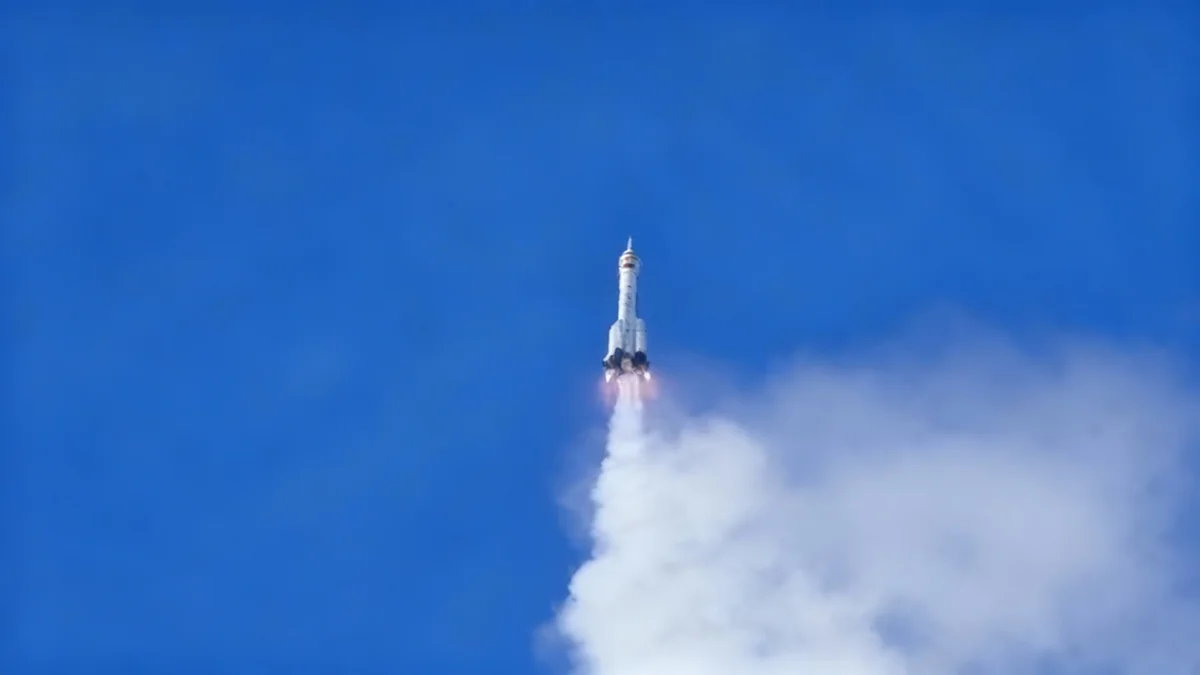
For the first time, China activated its "one launch, one on standby" emergency protocol. A fully prepared Long March 2F rocket with the Shenzhou-22 spacecraft, originally slated for a crewed mission in mid-2026, was readied for an uncrewed launch from the Jiuquan Satellite Launch Center.
The launch campaign, which typically takes about 30 days, was compressed into approximately 16 days. On November 25, Shenzhou-22 lifted off, carrying no crew but filled with essential supplies and a special "device," potentially a patch for the damaged window. It successfully docked with Tiangong, re-establishing a safe return vehicle for the orbiting crew and ending the immediate crisis.
"From one corner, it looks like it has been pierced through. But as the spaceship is still in orbit, we can’t see it with our own eyes. We may be able to observe it more closely after the Shenzhou-20 spacecraft returns," a CMSEO official stated in a media report.
The successful mission resolved the emergency, but the knock-on effects are now becoming clear.
A Critical Gap in Readiness
With its designated backup now in orbit, China's space program faces a period of vulnerability. There is currently no spacecraft on the ground ready for a rapid emergency launch should another crisis arise aboard Tiangong. This situation will persist until the next vehicle in the production line, Shenzhou-23, is completed and delivered to the launch site.
The manufacturing timeline for Shenzhou-23 is now being significantly accelerated. Originally scheduled for completion in March 2026, officials have indicated it could be finished two months ahead of schedule, potentially in January. Once delivered to Jiuquan, it will still need to be assembled, integrated with its Long March 2F rocket, and thoroughly tested before it can assume its role on standby.
The Shenzhou Spacecraft
- Crew Capacity: 3 astronauts
- Life Support: Can function as an independent lifeboat for up to 6 months docked at Tiangong.
- Launch Vehicle: Long March 2F rocket
- Safety Protocol: China maintains a backup spacecraft and rocket in a near-launch-ready state for emergencies.
This process could take weeks, even on an accelerated schedule, meaning the crucial backup capability may not be fully restored until well into the first quarter of 2026.
Next Steps for Tiangong
The crew currently aboard Tiangong—commander Zhang Lu and crewmates Zhang Hongzhang and Wu Fei—are preparing for their mission's first extravehicular activity (EVA), or spacewalk. This will provide a critical opportunity for the astronauts to inspect the damage to Shenzhou-20's window from the outside, supplementing data gathered by the station's robotic arm.
During the spacewalk, the crew may attempt to apply the patch delivered by Shenzhou-22. This would help secure the window ahead of the damaged spacecraft's planned uncrewed return to Earth. Engineers are eager to study the vehicle upon its return to better understand the impact dynamics and improve designs for future spacecraft.
The Shenzhou-20 incident has served as a stark, real-world test of China's emergency procedures and a powerful reminder of the ever-present dangers of operating in low Earth orbit. The race is now on to close the readiness gap and ensure the long-term safety of the astronauts aboard the Tiangong space station.