

A recent SpaceX Starlink satellite launch from California created a stunning visual phenomenon known as a "space jellyfish," which was visible for hundreds of miles across the southwestern United States. The effect occurred during twilight, when sunlight in the upper atmosphere illuminated the rocket's expanding exhaust plume against a darkening sky.
The spectacle was captured by numerous observers on the ground, including a notable photograph taken with an iPhone 15 Pro from as far away as Deming, New Mexico. This event highlights the unique atmospheric conditions that turn routine satellite deployments into widespread celestial displays.
Key Takeaways
- A SpaceX Starlink launch from Vandenberg Space Force Base produced a large, illuminated plume called a "space jellyfish."
- The phenomenon was visible at twilight and could be seen from up to 600 miles (1,000 km) away, including in New Mexico and Arizona.
- The effect is caused by sunlight catching the rocket's exhaust as it expands rapidly in the thin air of the upper atmosphere.
- The image was captured by an observer in New Mexico, demonstrating the vast range of visibility for these twilight launches.
A Twilight Spectacle Over the Southwest
On the evening of the launch, residents across several states witnessed an unusual, glowing shape moving across the sky. The event was the result of a SpaceX Falcon 9 rocket carrying the Starlink Group 11-20 batch of satellites into orbit. The launch took place at Vandenberg Space Force Base in California shortly after sunset.
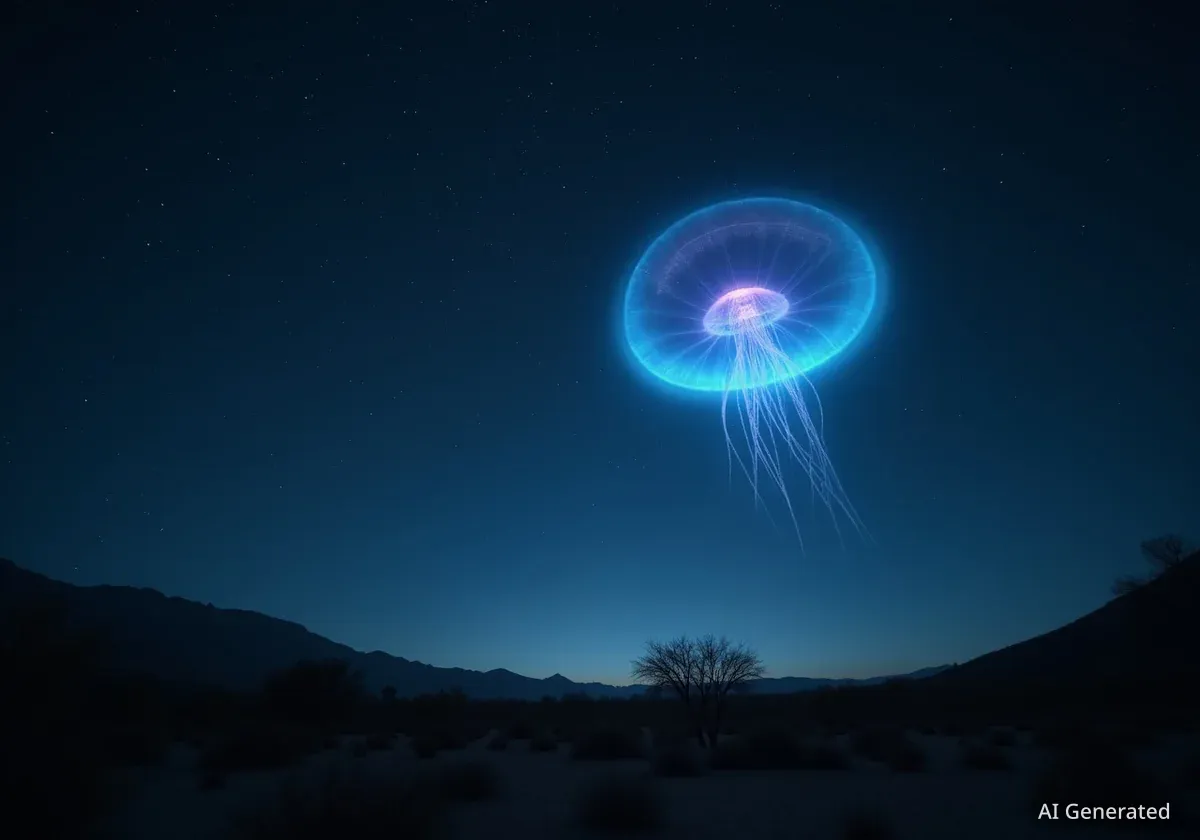
As the rocket ascended, its exhaust plume was lit by the sun, which had already set for observers on the ground but was still visible at high altitudes. This created a bright, ethereal display that is often nicknamed a "space jellyfish" due to its shape. The plume's head consisted of the bright rocket engine, while the tentacles were formed by the expanding, sunlit exhaust gases.
One of the clearest images of the event was taken by Valerie Hwang from Deming, New Mexico, a location approximately 600 miles from the launch site. Her photo, captured with a standard iPhone 15 Pro, shows the distinct jellyfish-like profile of the plume, demonstrating that advanced photographic equipment is not always necessary to document these atmospheric events.
The Science of the Space Jellyfish Effect
The "space jellyfish" is not an extraterrestrial object but a predictable atmospheric phenomenon tied to the physics of rocket launches at specific times of day. The effect requires a precise set of conditions, which is why it is only seen during twilight launches, either just before sunrise or just after sunset.
What Causes the Illuminated Plume?
For the phenomenon to occur, the sun must be below the horizon from the perspective of a person on the ground, creating a dark sky. However, the rocket must climb to an altitude where the sun is still visible. At these heights, typically above 60 miles (100 km), the atmosphere is extremely thin, almost a vacuum.
When the rocket's engines expel hot gases, this exhaust expands rapidly and dramatically in the low-pressure environment. The tiny particles within the plume, composed of water vapor and other combustion byproducts, act like a massive cloud that reflects the high-altitude sunlight. This makes the plume appear to glow brightly against the twilight sky.
The characteristic jellyfish shape is a direct result of this expansion. The "bell" or head of the jellyfish is the brightest part, where the exhaust is most concentrated near the rocket. The trailing "tentacles" are the dispersed gases that have spread out into the near-vacuum of space.
Details of the Starlink 11-20 Mission
The launch responsible for this display was part of SpaceX's ongoing mission to build out its Starlink satellite constellation. The Starlink project aims to provide high-speed, low-latency internet access to underserved areas across the globe. To achieve this, SpaceX has been launching satellites in large batches.
SpaceX has launched over 6,000 Starlink satellites into low-Earth orbit. The company has permission to deploy up to 12,000 satellites, with plans to expand to a larger megaconstellation in the future. This high launch frequency increases the chances of observing phenomena like the space jellyfish.
The Group 11-20 mission lifted off from Vandenberg Space Force Base, a key launch facility on the California coast. Launches from Vandenberg often follow a southerly or polar trajectory, which makes their ascent visible over a wide area of the western and southwestern United States.
The Falcon 9 rocket used for these missions is a two-stage vehicle. The first stage booster provides the initial thrust to leave the atmosphere before separating and returning to Earth for reuse. The second stage continues to carry the satellites to their designated orbit. The space jellyfish effect is typically created by the second stage engine as it operates at very high altitudes.
Observing Rocket Launches From Afar
The visibility of rocket launches over long distances depends heavily on the time of day and atmospheric clarity. While daytime launches are often only visible locally due to atmospheric haze and bright skies, twilight launches can be seen for hundreds of miles.
The recent Starlink launch is a prime example of this long-distance visibility. Reports and photographs of the event came from locations across California, Arizona, Nevada, and New Mexico. This broad viewing area is possible because the illuminated plume is at such a high altitude that it is not obscured by the curvature of the Earth for distant observers.
With the increasing number of rocket launches from private companies like SpaceX and government agencies, opportunities to witness these spectacles are becoming more common. Observers interested in seeing a space jellyfish should pay attention to launch schedules from coastal sites like Vandenberg or Cape Canaveral, particularly for missions scheduled just before dawn or after dusk.