
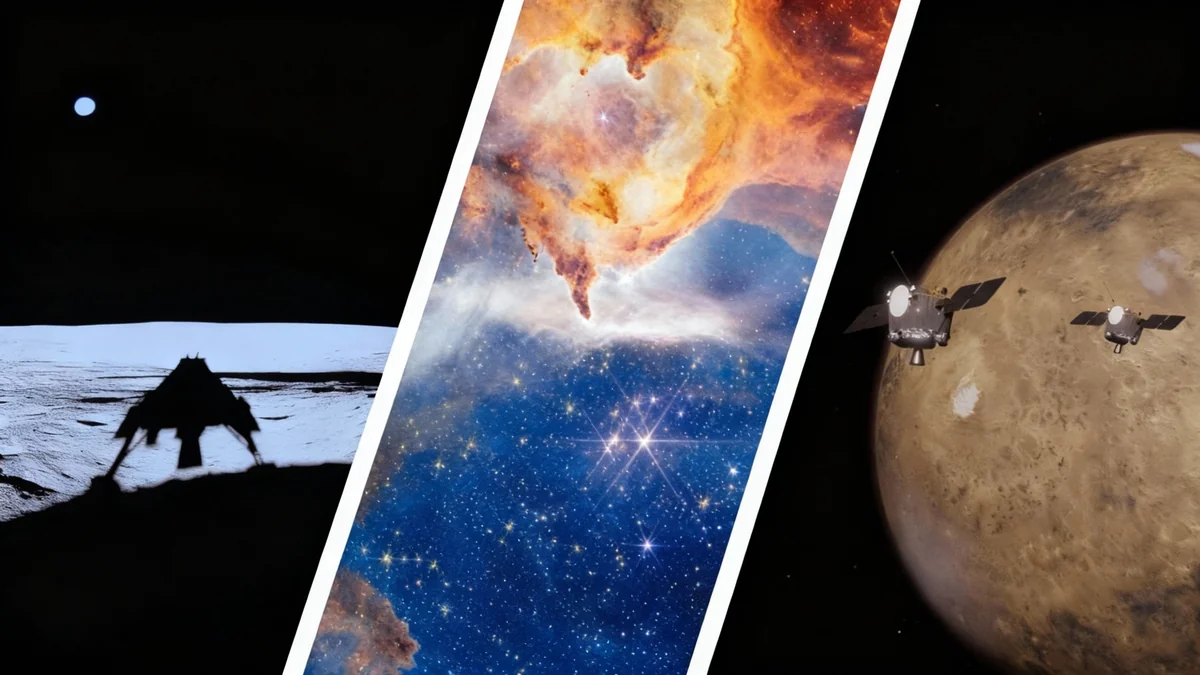


The year 2026 is shaping up to be a pivotal period for space science, with an ambitious schedule of missions targeting the Moon, Mars, and the wider solar system. Following a year of both triumphs and setbacks, international space agencies and commercial companies are preparing for a new wave of exploration that includes multiple lunar landings, the launch of advanced space telescopes, and the arrival of spacecraft at distant worlds.
Key activities include an increased cadence of commercial lunar missions, new robotic explorers heading to Mars, and the long-awaited launch of NASA's Nancy Grace Roman Space Telescope. These efforts are expected to build on recent discoveries, such as the identification of life's building blocks in asteroid samples, and further humanity's understanding of the cosmos.
Key Takeaways
- Multiple commercial and national missions are scheduled to land on the Moon, including attempts by Firefly Aerospace, Intuitive Machines, Blue Origin, and China.
- Two new missions, ESCAPADE and MMX, are set to journey to Mars to study its atmosphere and moons.
- Several next-generation space telescopes, including NASA's Nancy Grace Roman Space Telescope and ESA's PLATO, are slated for launch.
- ESA's Hera mission will arrive at the Didymos-Dimorphos asteroid system, while the BepiColombo mission will enter orbit around Mercury.
Renewed Focus on the Moon
Lunar exploration is set to accelerate significantly in 2026, with a packed manifest of missions from both private firms and government agencies. This follows a mixed year in 2025, where the first fully successful commercial lunar landing by Firefly Aerospace's Blue Ghost was a major milestone.
Firefly Aerospace plans to build on its success with Blue Ghost Mission 2, scheduled to launch no earlier than November. This mission is notable for carrying NASA's LuSEE-Night payload, which aims to become the first operational radio telescope on the Moon. It will also deploy the United Arab Emirates' Rashid Rover 2.
Other key players are also returning to the lunar surface. Intuitive Machines will attempt its third landing with the IM-3 mission in the second half of the year. The company hopes for a fully successful landing after its previous two missions, IM-1 and IM-2, tipped over upon touchdown.
Building a Commercial Lunar Economy
The increase in commercial lunar missions is part of NASA's Commercial Lunar Payload Services (CLPS) initiative. This program contracts private companies to deliver science and technology payloads to the Moon, aiming to foster a sustainable lunar economy and support the upcoming Artemis crewed missions.
The year will also see new entrants. Blue Origin is expected to attempt its first lunar landing with its Blue Moon Mark 1 lander. This uncrewed pathfinder mission will test critical systems ahead of future missions, including one planned to carry NASA's VIPER rover, which searches for water ice.
Astrobotic's Griffin lander is also scheduled for a July 2026 launch, carrying Astrolab’s FLEX rover prototype. Separately, China is planning its ambitious Chang’e 7 mission, which will target the lunar south pole and includes an orbiter, lander, rover, and a small hopping probe.
New Explorers Head to Mars
While the Moon receives intense focus, Mars remains a prime target for robotic exploration. In 2026, two new missions will begin their journeys to the Red Planet, even as existing rovers and orbiters continue their scientific work.
NASA's twin ESCAPADE satellites, named Blue and Gold, are already en route. Having launched in late 2025, they will use the Mars transfer window in November 2026 to begin their final approach. Upon arrival, they will orbit Mars to study how the solar wind strips away its atmosphere over time.
Later in the year, the Japan Aerospace Exploration Agency (JAXA) will launch its Martian Moons eXploration (MMX) mission. This spacecraft will not only observe Mars's two moons, Phobos and Deimos, but will also attempt the daring feat of collecting a sample from Phobos's surface for return to Earth by 2031.
Perseverance Rover Nears Driving Record
On the surface, NASA's Perseverance rover is on track to break a significant record. Having already surpassed the distance traveled by the Curiosity rover, Perseverance is expected to exceed the all-time extraterrestrial driving distance record of 45.16 km, set by the Opportunity rover, sometime in 2026.
These new missions launch as NASA engineers work to resolve an issue with the Mars Atmosphere and Volatile Evolution (MAVEN) satellite. Contact with MAVEN was lost in late 2025, and recovery efforts are ongoing. The incident highlights the challenges of operating complex robotic missions millions of kilometers from Earth.
Journeys Across the Solar System
Beyond the Moon and Mars, several other missions will reach critical milestones in 2026, providing new insights into asteroids, Mercury, and the Sun.
The European Space Agency's Hera mission is scheduled to arrive at the binary asteroid system of Didymos and Dimorphos in November. Hera will conduct a detailed investigation of the crater left by NASA's DART spacecraft, which intentionally impacted Dimorphos in 2022 to test planetary defense techniques. This follow-up study is crucial for understanding how to deflect potentially hazardous asteroids.
That same month, another joint ESA-JAXA mission, BepiColombo, will finally enter orbit around Mercury after an eight-year journey. The mission consists of two orbiters that will separate to study the planet's magnetic field, surface, and interior in unprecedented detail.
Closer to home, the Solar Orbiter spacecraft will continue to adjust its path to get a better view of the Sun's poles. A gravity-assist flyby of Venus on December 24, 2026, will increase its orbital inclination, allowing for unique observations of our star's polar regions.
A New Generation of Space Telescopes
The year 2026 will be transformative for astronomy, with several powerful new space-based observatories set to launch and begin their quests to unravel the universe's greatest mysteries.
The most anticipated launch is NASA’s Nancy Grace Roman Space Telescope, expected in October. Roman will have a field of view nearly 200 times larger than Hubble's, allowing it to create vast cosmic panoramas with similar sharpness. Its primary goals are to study dark energy, dark matter, and search for exoplanets.
"Roman will use its 288-megapixel Wide Field Instrument to perform sky surveys with a resolution similar to that of Hubble, while producing images nearly 200 times larger."
Two other significant telescopes are also on the manifest:
- SMILE (Solar wind Magnetosphere Ionosphere Link Explorer): A joint ESA-China mission launching in April to study the interaction between Earth's magnetosphere and the solar wind.
- PLATO (Planetary Transits and Oscillations of stars): An ESA exoplanet hunter launching in December. It will monitor up to one million stars to find and characterize Earth-like planets in habitable zones.
These new observatories will join the existing fleet, including the James Webb and Hubble telescopes, which continue to make groundbreaking discoveries. Data releases from missions like ESA's Euclid telescope are also planned for 2026, promising a flood of new information about the dark universe.