


A new study analyzing distant radio galaxies suggests our Solar System is traveling through the universe significantly faster than previously thought. The findings, which show a discrepancy 3.7 times greater than standard cosmological predictions, challenge fundamental assumptions about the large-scale structure of the cosmos and could force a major revision of our understanding of the universe.
The research, led by astrophysicist Lukas Böhme at Bielefeld University, utilized a vast network of radio telescopes to map the distribution of galaxies across the sky. The results revealed an unexpected lopsidedness, or anisotropy, that points to a much higher velocity for our local cosmic neighborhood.
Key Takeaways
- A comprehensive study of radio galaxies indicates the Solar System is moving through space much faster than standard cosmological models allow.
- The measured effect is 3.7 times stronger than predicted, a discrepancy with a statistical significance exceeding five sigma, meaning it is highly unlikely to be a random fluke.
- The findings were made possible by combining data from the Europe-wide LOFAR telescope network and other observatories, creating an unprecedentedly precise map of the radio sky.
- This result aligns with previous, independent studies of quasars in infrared light, strengthening the evidence for a genuine cosmic anomaly.
- Scientists are now faced with two possibilities: either our understanding of cosmic motion is wrong, or the universe is less uniform on a large scale than previously assumed.
A Cosmic Headwind Stronger Than Expected
Scientists have long sought to measure our Solar System's speed and direction as it journeys through the universe. This motion is not just the Earth orbiting the Sun, or the Sun orbiting the Milky Way's center, but the entire galaxy's movement relative to the cosmic microwave background—the faint afterglow of the Big Bang.
This overall motion should create a subtle effect: we should see slightly more galaxies in the direction we are heading, similar to how raindrops appear to come from the front when driving through a storm. This phenomenon is known as an anisotropy.
The Bielefeld University team set out to measure this effect with unparalleled precision. They focused on radio galaxies, which are distant galaxies that emit powerful radio waves from supermassive black holes at their centers. These radio signals can travel vast cosmic distances unimpeded by the dust and gas that can block visible light, providing a clearer view of the deep universe.
Why Use Radio Telescopes?
Optical telescopes see the universe in visible light, which can be absorbed or scattered by interstellar dust clouds. Radio telescopes detect much longer wavelengths that pass through this dust easily. This allows astronomers to create a more complete and unbiased map of distant objects, which is crucial for studies that rely on counting galaxies across the entire sky.
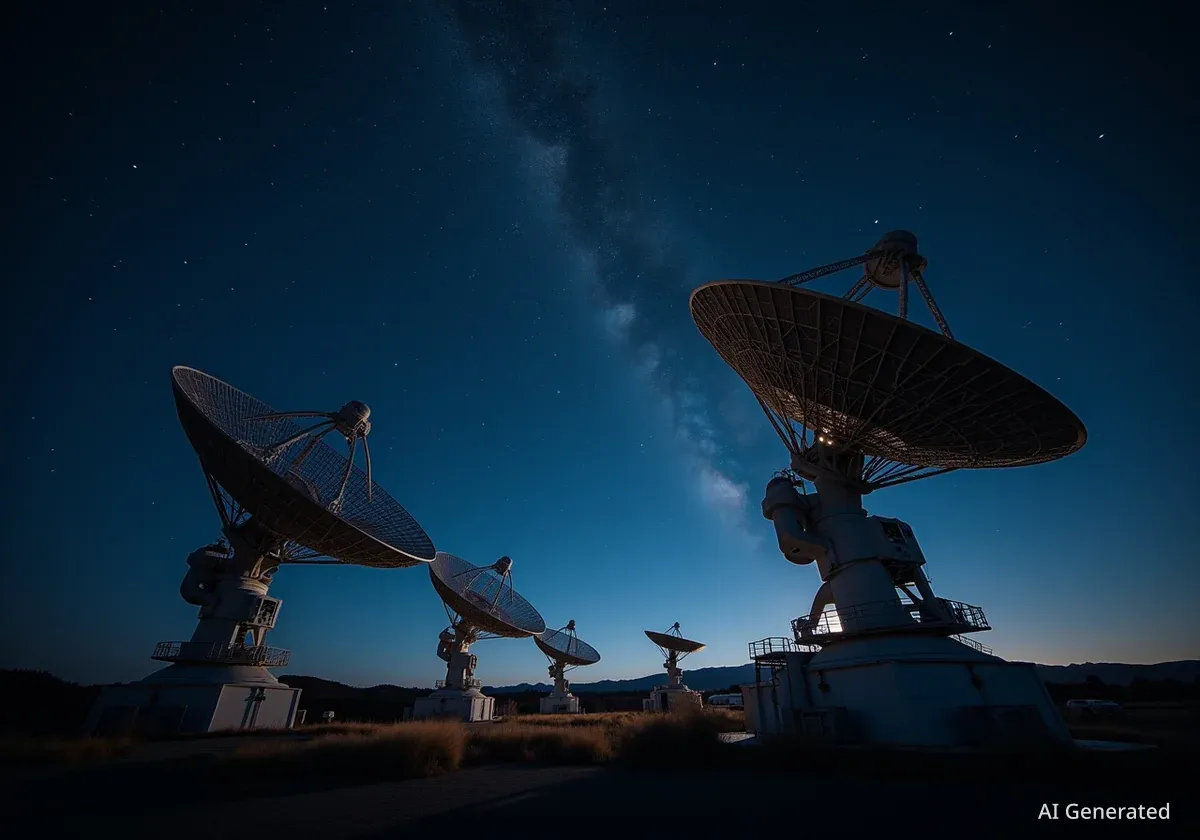
By combining data from the Low Frequency Array (LOFAR), a network of radio telescopes spread across Europe, with two other observatories, the researchers created a massive and detailed catalog of these celestial objects. This allowed them to count the density of radio galaxies in every direction.
Data Reveals a Significant Anomaly
After analyzing the data with a newly developed statistical method, the team found a clear directional imbalance. The distribution of radio galaxies was lopsided, indicating a motion-induced anisotropy. However, the strength of this effect was far greater than what the standard model of cosmology predicts.
The standard model, which has successfully described the universe's evolution since the Big Bang, is built on the assumption that matter is distributed fairly uniformly on the largest scales. This model predicts a certain velocity for our local group of galaxies, which in turn predicts a certain level of anisotropy in galaxy counts.
What is Five Sigma Significance?
In particle physics and cosmology, a "five sigma" result is the gold standard for a discovery. It means there is only a 1 in 3.5 million chance that the observed result is due to random statistical fluctuation. The finding of an anisotropy this strong provides overwhelming evidence that the effect is real and not just measurement noise.
The new study found an effect 3.7 times stronger than the prediction. This result was confirmed with a statistical confidence level exceeding five sigma, a threshold that scientists use to declare a discovery.
"If our Solar System is indeed moving this fast, we need to question fundamental assumptions about the large-scale structure of the universe," stated Professor Dominik Schwarz from Bielefeld University, a co-author of the study.
This isn't the first time such an anomaly has been observed. Previous studies looking at quasars—extremely bright galactic cores—using infrared data have shown a similar, unexplained effect in the same direction of the sky. This independent confirmation from a different method and wavelength of light makes it far less likely that the result is an error or an artifact of the instruments.
Two Uncomfortable Possibilities for Cosmology
The dramatic discrepancy leaves cosmologists with two profound and challenging possibilities, both of which would require rewriting parts of our cosmic story.
The first possibility is that the Solar System, and by extension our local cosmic neighborhood, is genuinely moving much faster than our current models permit. This would mean that the gravitational pull from large-scale structures in the universe is different from what we've calculated, suggesting there are unknown factors influencing cosmic dynamics.
The second possibility is that the universe itself is not as uniform as we believe. The cosmological principle, a foundational assumption, states that on large scales the universe is homogeneous and isotropic (the same in all locations and in all directions). If the observed lopsidedness is not due to motion but is an inherent feature of the galaxy distribution, it would mean that this fundamental principle may be incorrect.
Either scenario presents a major puzzle for modern physics.
What Comes Next?
This research highlights how advancements in observational technology continue to push the boundaries of our knowledge. The precision of modern radio telescopes like LOFAR has opened a new window into the universe's large-scale structure, revealing inconsistencies that were previously undetectable.
Scientists will now work to verify these findings with even larger datasets and different observational techniques. Future telescopes and sky surveys will be critical in determining whether our cosmic speedometer is broken or if the map of the universe we have been using needs to be redrawn.
For now, the study serves as a powerful reminder that despite all we have learned, the universe still holds deep mysteries. Our place within it, and the fundamental rules that govern it, may be stranger than we ever imagined.