
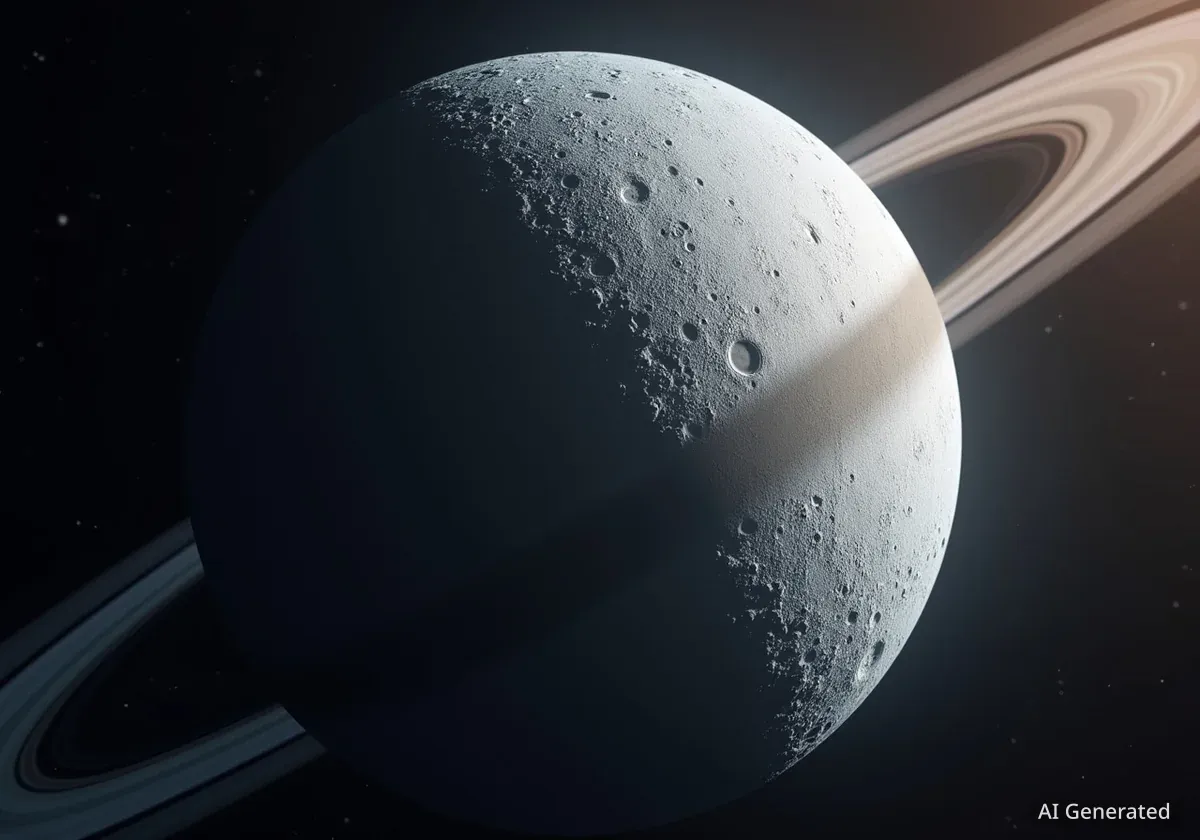

New research indicates that Saturn's smallest major moon, Mimas, may conceal a liquid water ocean beneath its thick, cratered ice shell. Scientists believe this ocean is relatively young, having formed within the last 15 million years due to gravitational forces from Saturn that heated the moon's interior.
Despite its unassuming, heavily cratered surface, which lacks the typical signs of a water world, data from NASA's Cassini spacecraft and recent computer models are building a strong case for Mimas as a new type of ocean moon.
Key Takeaways
- Scientists have found compelling evidence for a subsurface ocean on Saturn's moon Mimas.
- The ocean is believed to be young, forming 10 to 15 million years ago, and lies 20 to 30 kilometers below the ice.
- The formation is linked to changes in Mimas's orbit, which increased tidal heating from Saturn's gravity.
- Analysis of the massive Herschel Crater supports the theory, suggesting it formed when the ice was warm but not yet liquid.
An Unlikely Ocean World
For years, scientists have identified ocean worlds in our solar system by their distinct surface features. Moons like Jupiter's Europa and Saturn's Enceladus display networks of cracks and fissures, indicating the movement of a liquid ocean beneath a shifting icy crust. Mimas, however, shows none of these signs.
Its surface is dominated by craters and appears ancient and inactive. "When we look at Mimas, we don't see any of the things that we're accustomed to seeing in an ocean world," stated Alyssa Rhoden, a planetary scientist at the Southwest Research Institute (SwRI), during a recent science congress.
This lack of geological activity led many to believe Mimas was simply a solid, frozen body. However, detailed analysis of data from the Cassini mission, which studied the Saturn system for over a decade, has steadily challenged that assumption.
Cassini's Legacy
NASA's Cassini spacecraft orbited Saturn from 2004 to 2017, gathering extensive data on the planet and its many moons. Observations of Mimas's slight wobble, or libration, as it orbited Saturn provided the first hints that its interior might not be uniform and solid, opening the door to the possibility of a subsurface ocean.
The Role of Orbital Mechanics
Scientists now believe the potential ocean on Mimas is not a remnant from its formation but a much more recent development. The leading theory suggests that at some point in the last 10 to 15 million years, Mimas’s orbit around Saturn became more eccentric, or less circular.
This change in orbit intensified the gravitational tug-of-war between the moon and its giant parent planet. This process, known as tidal heating, generates friction and heat deep inside the moon. According to models developed by Rhoden and her team, this increase in heat was sufficient to melt ice and form a liquid water ocean.
A Fleeting Phenomenon
The ocean on Mimas may not be permanent. The same gravitational forces that are heating the moon are also gradually pushing its orbit back into a more circular path. Once the orbit is fully circularized, the tidal heating will cease, and the ocean will likely begin to refreeze over millions of years.
Rhoden's team applied thermal models to understand how this process would affect Mimas. They concluded that a significant shift in orbit would have melted the entire surface, erasing the ancient craters we see today. The fact that the craters remain intact suggests the orbital change was moderate, providing just enough heat to create an ocean without resurfacing the moon.
Clues from a Giant Crater
A key piece of evidence in this planetary puzzle is Herschel Crater, an enormous impact basin that dominates one side of Mimas. The crater is so large—approximately 130 kilometers (80 miles) across—that it gives the moon its distinctive "Death Star" appearance.
The Tipping Point of Melting
Adeene Denton, another planetary scientist at SwRI, has focused her research on what Herschel Crater reveals about the moon's interior at the time of its formation. By running simulations of the impact, her team found that the crater's specific shape, including its prominent central peak, could only have formed under very specific conditions.
"Water can't make a structure like that," Denton explained. If an ocean had already existed and the ice shell was thin, the impact would have punched through to liquid water, which is too fluid to support a tall central peak. Conversely, if the ice was completely solid and cold, the peak would not have formed at all.
The simulations suggest the impact occurred when Mimas was in a transitional state. The ice was warm and pliable from the initial stages of tidal heating but had not yet melted into a full-fledged ocean. Mimas "needs to be right on the tipping point," Denton said, a state it could have maintained for millions of years.
This finding helps constrain the age of both the crater and the ocean, extending the possible window for Herschel's formation from one million to ten million years. "That's still geologically short, but way better than one," Denton noted.
Future Detection and a Coherent Narrative
The combined research is painting a new picture of Saturn's small, cratered moon. "All of these things are now building a coherent narrative about Mimas as a young ocean world," Denton concluded.
Detecting this hidden ocean directly remains a significant challenge. Rhoden's simulations of heat flow suggest that the ice shell's thickness may vary across the moon. The thinnest points, likely near the poles, would be the best targets for a future mission to confirm the ocean's existence.
A future orbiter equipped with instruments to measure the moon's heat flow could potentially identify these thin spots and provide definitive proof of the liquid water below. While technologically demanding, such a mission is considered a possibility. As Rhoden stated, "It would be hard, but may be doable."