


A new study warns that the explosive growth of satellite megaconstellations in low Earth orbit poses a significant and escalating threat to space-based astronomy. Researchers predict that nearly all images from next-generation space telescopes could be contaminated by light trails from tens of thousands of planned satellites, potentially obscuring vital scientific discoveries.
Companies like SpaceX and OneWeb, along with national projects from China, are deploying vast networks of satellites for global internet coverage. While promising enhanced connectivity on Earth, the sheer number of these objects is creating unprecedented challenges for observatories both on the ground and in orbit.
Key Takeaways
- New research indicates future space telescopes like NASA's SPHEREx and ESA's ARRAKIHS will be heavily impacted by satellite light pollution.
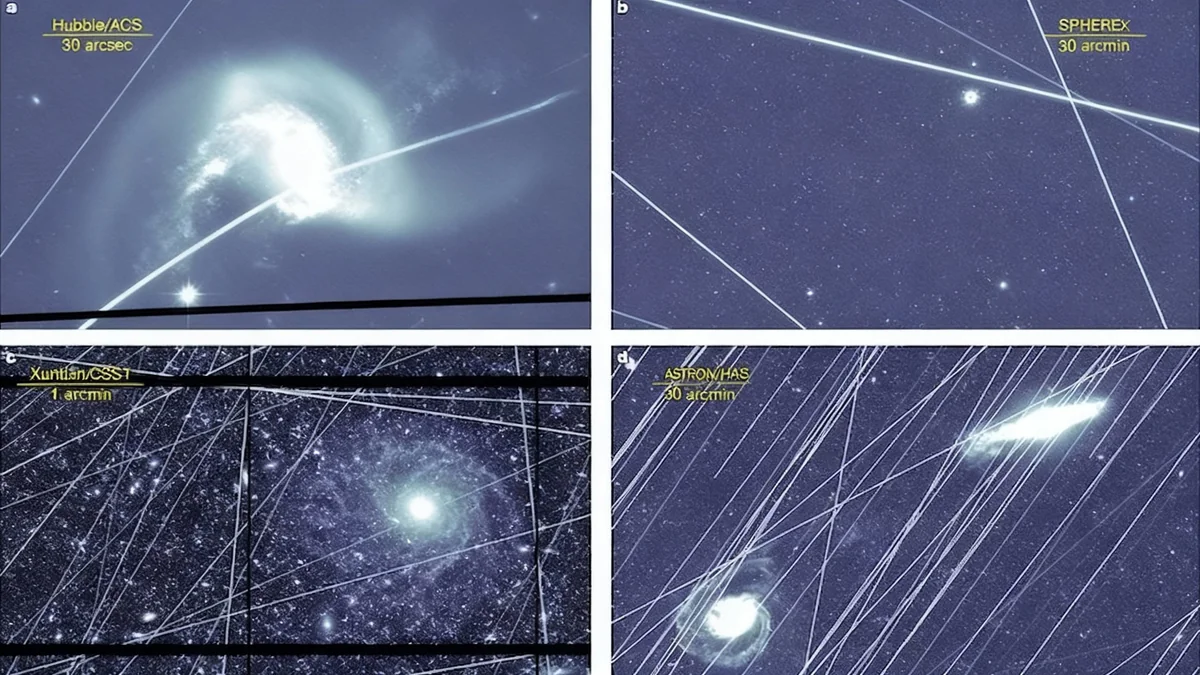
- If all proposed constellations are launched, researchers forecast that 96% of exposures from these new telescopes will contain at least one satellite trail.
- Even existing observatories are affected; a recent analysis showed 4.3% of Hubble Space Telescope images taken between 2018 and 2021 were already compromised.
- Mitigation efforts by companies, while helpful for ground-based astronomy, can sometimes worsen the problem for space-based telescopes.
A Crowded Sky Above
The region of space known as low Earth orbit (LEO) is becoming increasingly congested. The primary drivers of this traffic are megaconstellations, massive networks of interconnected satellites designed to provide services like high-speed internet.
SpaceX has been a dominant force, having launched over 3,000 of its Starlink satellites in 2025 alone. The company's ultimate goal is to operate a fleet of more than 30,000 satellites. Other major players are also expanding their presence. China is developing its Guowang network, with plans for nearly 13,000 satellites, according to filings with the International Telecommunication Union.
This rapid deployment has raised alarms within the scientific community. Astronomers rely on capturing faint light from distant stars and galaxies to understand the universe. The reflective surfaces of these satellites can create bright streaks across sensitive astronomical images, rendering them partially or entirely useless.
By the Numbers
- 30,000+: The number of Starlink satellites SpaceX aims to operate in LEO.
- 12,992: The planned size of China's Guowang satellite constellation.
- 4.3%: The percentage of Hubble Space Telescope images already showing satellite trails between 2018 and 2021.
Space Telescopes No Longer Safe
For decades, placing telescopes in space was the ultimate solution to avoid atmospheric distortion and light pollution from cities. However, a new study published in the journal Nature reveals that even orbital observatories are vulnerable to the growing swarm of LEO satellites.
The research, conducted by a team at NASA Ames Research Center, simulated the impact of planned constellations on several current and future space telescopes. The findings are stark. The team projects that crucial missions like NASA’s SPHEREx and the European Space Agency's ARRAKIHS will be severely affected.
The Most Vulnerable Missions
The study specifically modeled the effects on three key observatories:
- SPHEREx (NASA): Scheduled for a 2023 launch, this telescope is designed to survey the entire sky in near-infrared light, studying the origins of the universe and the prevalence of water ice.
- ARRAKIHS (ESA): A proposed mission to study the faint halos of galaxies, providing clues about their formation and evolution.
- Xuntian (China): A forthcoming space station telescope with a field of view similar to Hubble but with a much wider scope.
The conclusion from the modeling is concerning. According to the paper, if all currently proposed satellite constellations are completed, an estimated 96 percent of the images taken by SPHEREx, ARRAKIHS, and Xuntian will contain at least one bright trail from a sun-illuminated satellite.
"Considering that the proposed number of satellites is two orders of magnitude higher than the current count, the fraction of impacted images will increase very soon," the researchers stated in their paper.
Mitigation Efforts and Unintended Side Effects
Satellite operators, particularly SpaceX, have acknowledged the concerns of the astronomy community. The company has implemented several measures to reduce the brightness of its Starlink satellites, including using less reflective materials and adjusting their orientation in orbit.
In one such strategy, SpaceX changed the orientation of its satellites from an "open-book" configuration to one where the craft is perpendicular to the ground. This was intended to minimize reflections seen by ground-based observers. However, the study points out an unintended consequence of this change.
A Double-Edged Sword
The new orientation, while beneficial for observers on Earth, actually increases the reflective cross-section of the satellites from the perspective of a telescope also in LEO. Because the solar panels must face the Sun for power, a space telescope looking away from the Sun is now more likely to capture the bright reflection off those panels.
This highlights the complexity of finding a universal solution. A fix for one type of observation can create a new problem for another.
The End-of-Life Problem
Another significant issue raised by the researchers is the long-term management of these satellites. Mitigation strategies based on a satellite's orientation depend on the craft being fully operational and under active control.
Once a satellite reaches the end of its service life or becomes non-operational, it may lose attitude control. A defunct satellite could begin to tumble uncontrollably, creating unpredictable and complex light trails that are far more difficult to correct for in astronomical data.
The study's authors emphasize the need for "detailed de-orbit plans and enforcement policies" to manage the growing population of orbital objects. Without clear regulations for removing satellites from orbit promptly, the problem of space debris and reflective pollution will only compound over time, creating a lasting legacy that could hamper scientific progress for generations.