
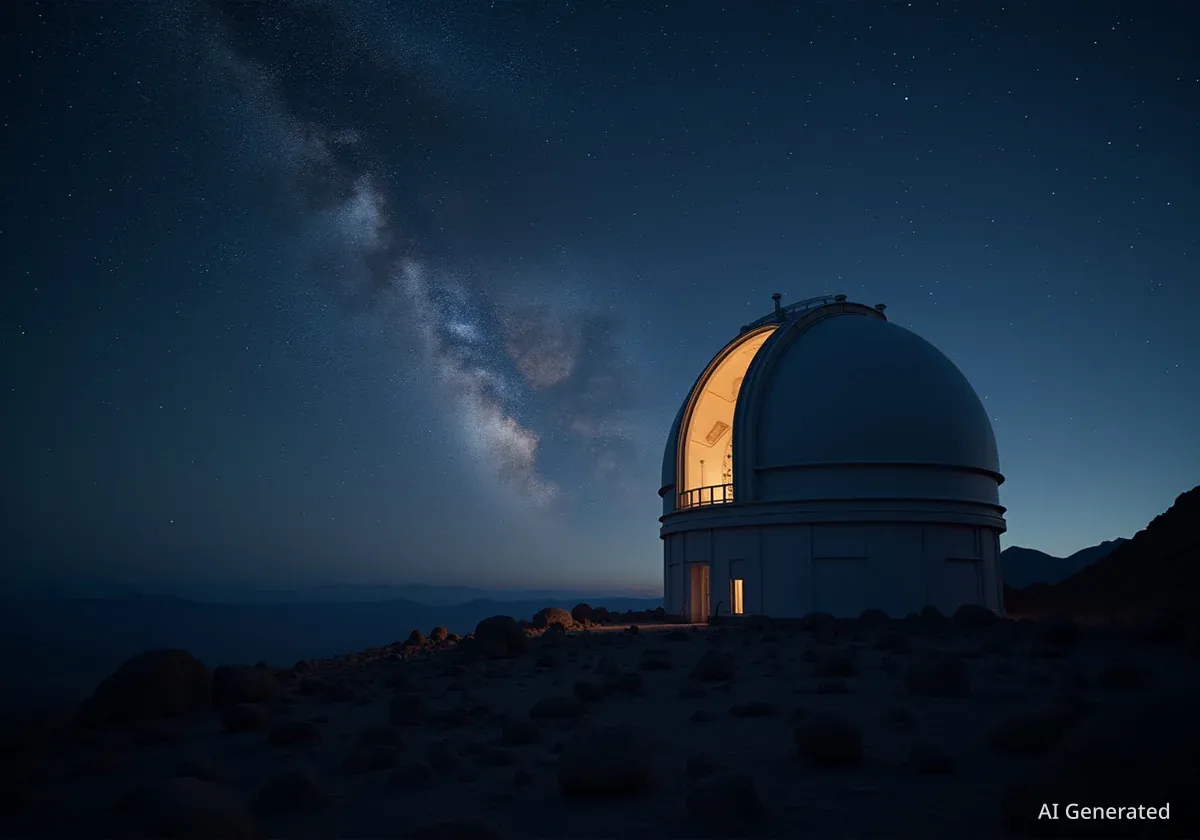



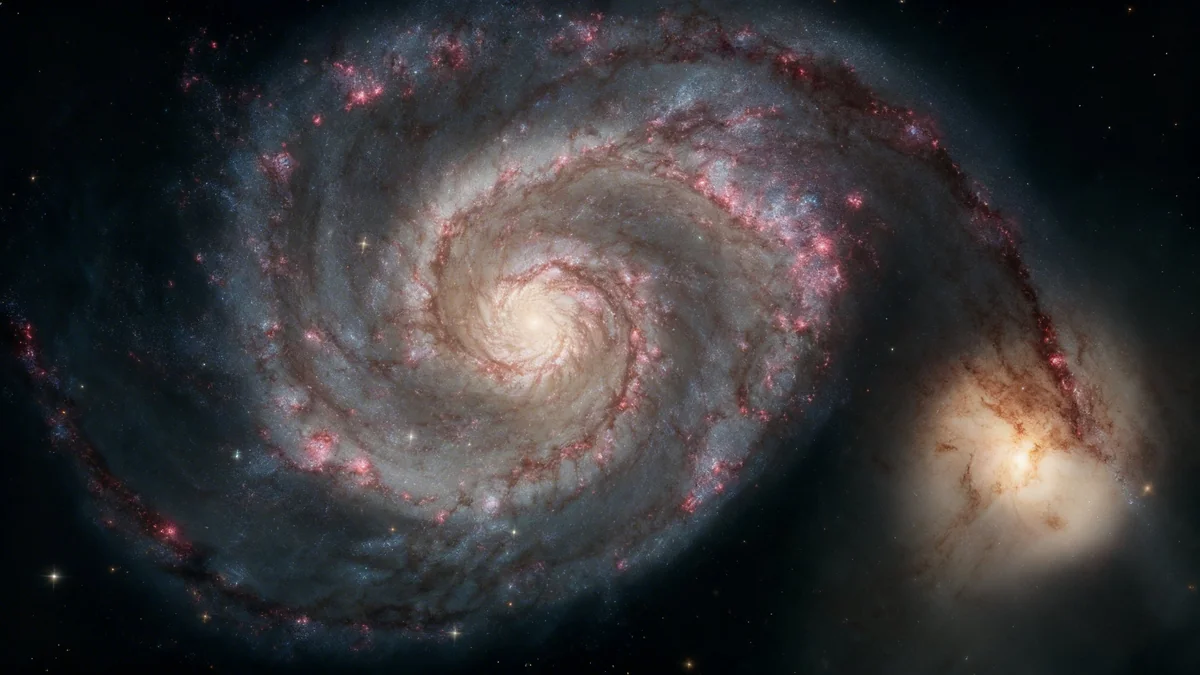
The Vera C. Rubin Observatory, located atop Cerro Pachón in Chile, has officially commenced its decade-long mission to map the southern night sky. This ambitious project, known as the Legacy Survey of Space and Time (LSST), will use the advanced Simonyi Survey Telescope and the world's largest digital camera to create the most comprehensive astronomical movie ever made, capturing the entire visible sky every three nights.
Key Takeaways
- The Vera C. Rubin Observatory has started its 10-year Legacy Survey of Space and Time (LSST).
- It will survey the entire southern sky every three nights, creating a dynamic map of the universe.
- The Simonyi Survey Telescope can move between targets in as little as five seconds, enabling unprecedented survey speed.
- The LSST Camera captures an area of the sky 45 times larger than the full moon with each exposure.
- The primary scientific goals are to investigate dark matter, dark energy, and track potentially hazardous near-Earth objects.
A New Era in Astronomical Observation
Positioned in the clear, dark skies of the Chilean Andes, the Vera C. Rubin Observatory is set to revolutionize our understanding of the cosmos. The observatory's primary mission, the LSST, is designed to observe cosmic changes on a massive scale. Over the next ten years, it will gather an immense amount of data, charting the movements and changes of billions of celestial objects.
The project is a joint initiative between the U.S. National Science Foundation (NSF) and the Department of Energy (DOE). Its goal is to produce a detailed, time-lapsed view of the universe, allowing scientists to study phenomena that change over short timescales, from exploding stars to moving asteroids.
Why Cerro Pachón?
The observatory's location in Chile is no accident. The region's high altitude, dry climate, and stable atmosphere provide some of the best conditions for astronomical observation on Earth. These factors minimize atmospheric distortion, resulting in sharper and clearer images of distant objects.
The Technology Driving the Survey
At the heart of the Rubin Observatory's capabilities are two groundbreaking pieces of technology: the Simonyi Survey Telescope and the LSST Camera. These components work together to achieve the survey's rapid pace and wide coverage.
The Simonyi Survey Telescope
Unlike traditional telescopes that focus on a single object for long periods, the Simonyi Survey Telescope is engineered for speed and efficiency. It features a unique three-mirror design that provides a wide field of view with minimal distortion. Its most remarkable feature is its advanced drive system.
This system allows the 8.4-meter telescope to move from one point in the sky to the next and settle for a new image in just five seconds. This rapid repositioning, known as "slewing," is critical for scanning the entire sky in the three-night timeframe. A recently released long-exposure photograph from the observatory vividly illustrates this rapid movement, showing glowing streaks of light that trace the telescope's path as it pivots beneath the stars.
Unprecedented Data Collection
The LSST is expected to generate approximately 20 terabytes of data every single night. Over its ten-year lifespan, the survey will accumulate over 60 petabytes of raw data, creating one of the largest scientific databases in the world.
The World's Largest Digital Camera
Paired with the telescope is the Legacy Survey of Space and Time (LSST) Camera, a device the size of a small car. It is the largest digital camera ever constructed for astronomy, boasting a focal plane with 3.2 gigapixels.
This massive sensor allows the camera to capture an enormous section of the sky in a single shot. Each exposure covers an area 45 times larger than the full moon. This wide-angle capability is essential for mapping the sky efficiently and capturing large-scale cosmic structures.
Probing the Universe's Greatest Mysteries
The data collected by the Rubin Observatory will be used to address some of the most fundamental questions in modern physics and astronomy. The survey's objectives are broad, ranging from our own solar system to the very nature of the universe.
Mapping Dark Matter and Dark Energy
Two of the most profound mysteries in science are dark matter and dark energy. Dark matter is an invisible substance that is believed to make up about 27% of the universe, while dark energy is the force thought to be driving the universe's accelerated expansion, accounting for roughly 68%.
"Rubin will probe the nature of dark matter and dark energy by measuring the subtle distortions of distant galaxy images, a phenomenon known as weak gravitational lensing, and by mapping the large-scale structure of the universe," states the official observatory mission brief.
By observing billions of galaxies, the LSST will create a detailed 3D map of the distribution of mass (including dark matter) over cosmic time. This will help scientists understand how these enigmatic components have shaped the evolution of the universe.
Protecting Our Planet
The LSST will also play a critical role in planetary defense. Its rapid and repeated scans of the sky make it an ideal tool for detecting and tracking near-Earth objects (NEOs), such as asteroids and comets, that could potentially pose a threat to Earth. The survey is expected to increase the catalog of known NEOs by a factor of 10, providing crucial data for assessing potential impact risks.
A Universe in Motion
Beyond these primary goals, the observatory will create a massive catalog of transient events. These include:
- Supernovae: The explosive deaths of massive stars.
- Variable Stars: Stars that change in brightness over time.
- Active Galactic Nuclei: The bright, energetic centers of distant galaxies.
By repeatedly imaging the same areas of the sky, scientists can create a dynamic portrait of the cosmos, observing how objects change, move, and interact over time. This will provide an unprecedented dataset for astronomers worldwide, enabling discoveries for decades to come.