
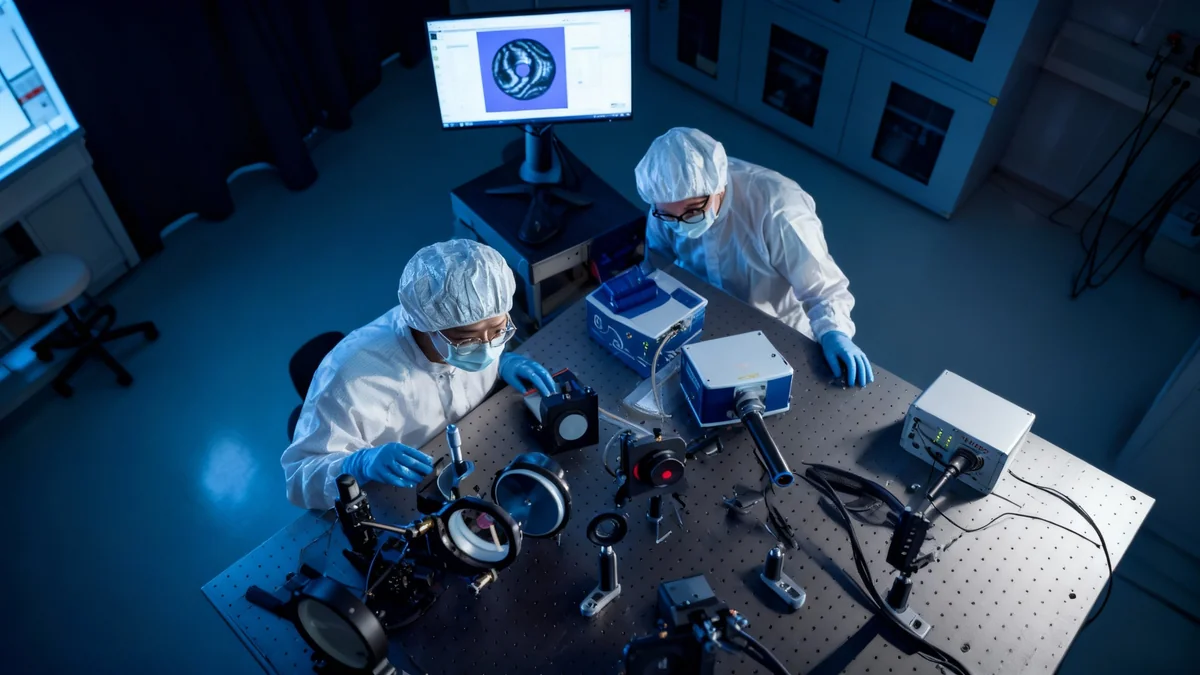




A major philanthropic initiative has announced plans to build and launch four next-generation telescopes, including what could become the first privately funded space observatory. The project, backed by Schmidt Sciences, aims to accelerate astronomical research by developing advanced instruments on a faster and more cost-effective timeline than traditional government-led efforts.
The announcement, made at the 247th meeting of the American Astronomical Society in Phoenix, details a system of three ground-based arrays and one space telescope. The entire system is designed to provide astronomers with powerful new tools to study everything from distant exoplanets to the fundamental nature of the universe.
Key Takeaways
- Schmidt Sciences, a philanthropic organization, is funding four advanced telescopes.
- The Lazuli space telescope will have 70% more light-collecting area than the Hubble Space Telescope.
- Three ground-based projects—Argus Array, DSA, and LFAST—will survey the sky in visible and radio light and provide follow-up observations.
- The projects aim for faster development and lower costs compared to traditional models, with operational dates set between 2028 and 2029.
A New Model for Astronomical Discovery
The initiative is being spearheaded by Schmidt Sciences, an organization founded by former Google CEO Eric Schmidt and Wendy Schmidt. This move into large-scale private funding for fundamental science marks a significant shift in a field historically dominated by government agencies like NASA.
Project leaders emphasize that their streamlined approach, with fewer stakeholders, can avoid the lengthy delays and budget overruns that can affect large public projects. This model has proven successful in commercial spaceflight and is now being applied to scientific instrumentation.
"This is an experiment in accelerating astrophysics discovery: What happens when we get technology into the hands of astronomers more quickly?" said Arpita Roy, lead of the Astrophysics & Space Institute at Schmidt Sciences, during the conference.
The goal is not to replace government efforts but to complement them, filling gaps and pushing technological boundaries in a more agile way. The initiative's mandate is to build an enabling layer of technology and open it to the scientific community.
Lazuli: A Private Eye in the Cosmos
The flagship of the new fleet is the Lazuli space telescope. If launched as planned by 2029, it will be the first privately funded observatory of its kind. Its design features a 3.1-meter (10.2-foot) primary mirror, giving it 70% more light-collecting power than the Hubble Space Telescope.
Lazuli Telescope Specifications
- Primary Mirror: 3.1 meters (10.2 feet)
- Launch Target: 2029
- Orbit: Lunar-resonant (a stable and cost-effective option)
- Key Instruments: Wide-field imager, integral field spectrograph, and a high-contrast coronagraph.
Scientists are particularly interested in its high-contrast coronagraph, an instrument designed to block the overwhelming glare of a star to directly image the planets orbiting it. This technology is a critical step toward finding and characterizing Earth-like planets around other stars.
"There's a lot of technology that we're going to demonstrate on Lazuli that will complement what NASA's upcoming Nancy Grace Roman Space Telescope is doing and help us find the path most quickly and efficiently to get to Earth-like planets around sun-like stars," explained Ewan Douglas of the University of Arizona.
The project's executive director, Pete Klupar, highlighted the ambitious timeline. "We're going to do it in three years, and we're going to do it for a ridiculously low price," he stated, referring to the development phase.
A Trio of Ground-Based Observatories
Supporting Lazuli is a network of three powerful ground-based telescope systems, each with a specialized purpose.
The Argus Array
Scheduled to be operational by 2028, the Argus Array will consist of 1,200 small telescopes working in unison. Together, they will have the collecting area of a single 8-meter telescope but with an enormous field of view covering 8,000 square degrees of the sky at once.
This capability is designed to monitor the sky for transient events like supernovae or the optical counterparts to gravitational wave detections. "Argus takes a different approach with an overwhelmingly large field of view that eliminates the need to tile," said Nicholas Law of the University of North Carolina. He added that in its fastest mode, it can capture images as frequently as once per second.
The Deep Synoptic Array (DSA)
To be built in Nevada, the DSA will scan the sky in radio wavelengths. Comprising 1,656 individual 1.5-meter telescopes spread over a large area, it will be exceptionally sensitive to radio sources like black holes and distant galaxies.
Why Radio Telescopes?
Radio waves can pass through cosmic dust that obscures visible light, allowing astronomers to see objects and phenomena that are otherwise hidden. This makes radio astronomy essential for studying galaxy centers, star formation, and powerful cosmic events.
Gregg Hallinan of the California Institute of Technology described its potential as "unprecedented." He noted, "To put it in context, every radio telescope ever built has detected about 10 million radio sources. We'll double that in the first 24 hours." The DSA is expected to be operational by 2029.
The Large Fiber Array Spectroscopic Telescope (LFAST)
LFAST is designed as a rapid follow-up instrument. While survey telescopes like Argus and DSA find interesting objects, LFAST will be tasked with studying them in greater detail. It is composed of 20 modules with a combined collecting area of a 3.5-meter telescope.
"LFAST is a facility that we are building to do follow-up," said Chad Bender of the University of Arizona. A key innovation is its design, which forgoes a massive, expensive dome. Instead, each individual mirror is protected by a small, cylindrical canister, significantly reducing construction costs and complexity.
This scalable and cost-effective approach embodies the project's core philosophy. As Bender concluded, "The questions that we're trying to answer are: How do we get bigger apertures, and how do we do it cheaper, and how do we do it faster?"