
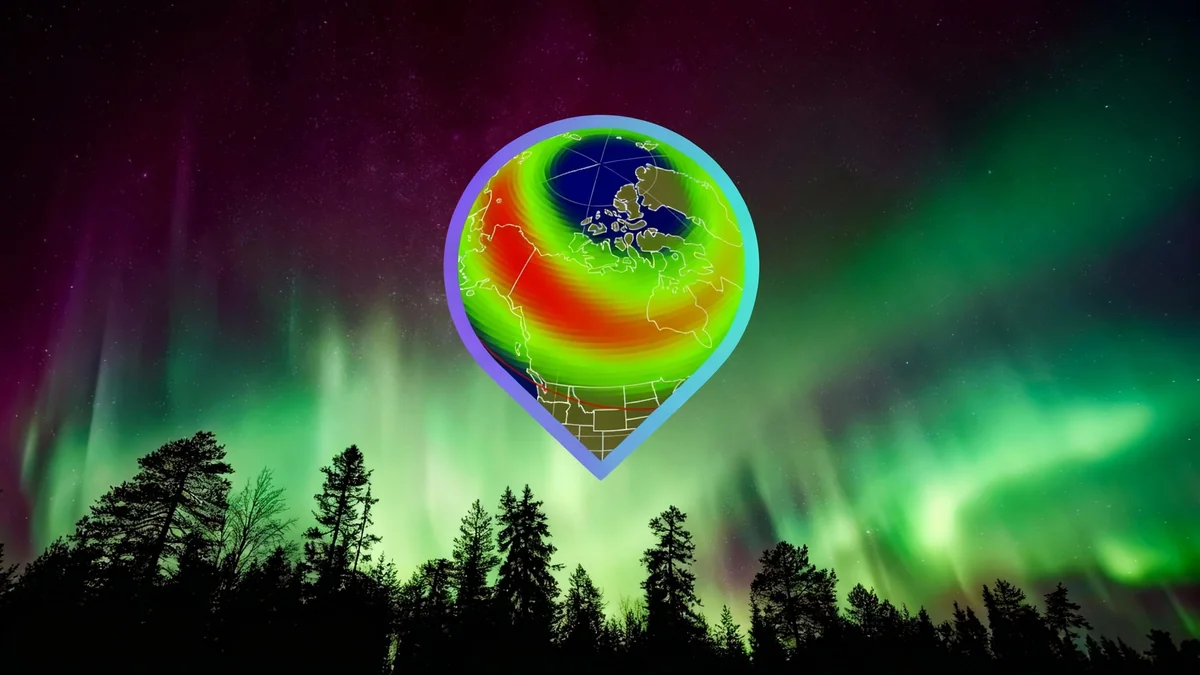

Residents across ten northern U.S. states may have a chance to witness the northern lights tonight as Earth continues to experience the effects of a recent geomagnetic storm. The National Oceanic and Atmospheric Administration (NOAA) has issued forecasts indicating that storm conditions could be strong enough to push the aurora borealis farther south than usual.
The celestial display is a result of solar eruptions sending charged particles toward Earth, which interact with our planet's magnetic field. While sightings are never guaranteed, conditions are favorable for a potential light show in specific regions.
Key Takeaways
- A G1 (Minor) to G3 (Strong) geomagnetic storm watch is in effect, creating potential for aurora sightings.
- Ten U.S. states are within the primary viewing forecast area, including states from Washington to Maine.
- The best viewing opportunities are expected in the early evening hours, beginning around 4 p.m. EST.
- Clear, dark skies away from city lights are essential for seeing the aurora.
Understanding the Geomagnetic Storm
The current opportunity to see the northern lights stems from recent activity on the sun. Solar flares and coronal mass ejections (CMEs) have sent a stream of energetic particles hurtling through space. When these particles reach Earth, they are guided by our planet's magnetic field toward the poles.
These particles then collide with atoms and molecules in the upper atmosphere, primarily oxygen and nitrogen. The collisions energize the atmospheric gases, causing them to glow in distinct colors. The most common color, a pale green, is produced by oxygen molecules at altitudes of around 60 to 150 miles.
What the Storm Ratings Mean
Geomagnetic storms are rated on a scale from G1 (Minor) to G5 (Extreme). A G3 (Strong) storm, which is possible tonight, can cause the aurora to be seen much farther from the poles than normal. It can also cause intermittent issues with satellite navigation and low-frequency radio navigation.
Forecasts from NOAA's Space Weather Prediction Center indicate that lingering effects from the solar event could produce storm conditions ranging from G1 to G3 throughout the evening. The U.K. Met Office also noted that while space weather is expected to quiet down by the end of the week, a G3 watch remains in effect for today.
Where and When to Look for the Aurora
The visibility of the aurora is highly dependent on geographic location and the intensity of the geomagnetic storm. Based on current forecast models, the aurora view line extends across a significant portion of the northern United States.
States in the Viewing Zone
Residents in the following 10 states have the highest probability of seeing the northern lights, provided local weather conditions are clear:
- Alaska
- Washington
- Idaho
- Montana
- North Dakota
- South Dakota
- Minnesota
- Wisconsin
- Michigan
- Maine
It is important to note that the view line on forecast maps represents the southernmost point where the aurora might be visible on the horizon. Observers in the northernmost parts of these states will have a much better chance of seeing the lights higher in the sky.
Peak Viewing Hours
According to NOAA's forecast, the geomagnetic activity is expected to be at its highest during the early evening. Skywatchers should be alert during these key windows:
- 4 p.m. - 7 p.m. EST (2100-0000 GMT): This period has the highest potential for Strong G3 storm levels, offering the best chance for vibrant and widespread auroras.
- 7 p.m. - 10 p.m. EST (0000-0300 GMT): Activity may decrease to Minor G1 storm levels, but sightings could still be possible.
Tips for a Successful Aurora Hunt
Seeing the northern lights requires more than just being in the right place at the right time. Preparation and patience are key to maximizing your chances of witnessing this natural wonder.
"Patience is the most important tool for an aurora chaser. The lights can be unpredictable, appearing suddenly and fading just as quickly. Finding a comfortable spot and being prepared to wait is essential."
Follow these practical steps to improve your viewing experience:
- Escape Light Pollution: The single most important factor is getting away from city lights. Even a faint aurora will be completely washed out by urban skyglow. Drive at least 20-30 miles away from any major town or city to find a truly dark location.
- Find a Clear Northern Horizon: The aurora typically appears on the northern horizon for viewers in the contiguous United States. Find a spot with an unobstructed view to the north, such as a field, a lake shore, or a hilltop.
- Let Your Eyes Adapt: It takes the human eye about 20 to 30 minutes to fully adapt to the darkness. Avoid looking at your phone screen or other bright lights during this time. Using a red flashlight can help preserve your night vision.
- Use Your Camera: Modern smartphone cameras are surprisingly sensitive to the colors of the aurora. If you think you see a faint glow, take a long-exposure photo. The camera can often pick up colors that are too subtle for the naked eye to detect.
- Dress Warmly: Aurora watching involves standing still in the cold for long periods. Dress in layers, wear insulated boots, a hat, and gloves to stay comfortable while you wait for the show to begin.
While forecasts provide a strong indication of potential activity, the behavior of the aurora remains famously unpredictable. The strength of the display can fluctuate rapidly, so it is worth monitoring the sky throughout the evening if conditions seem promising.