
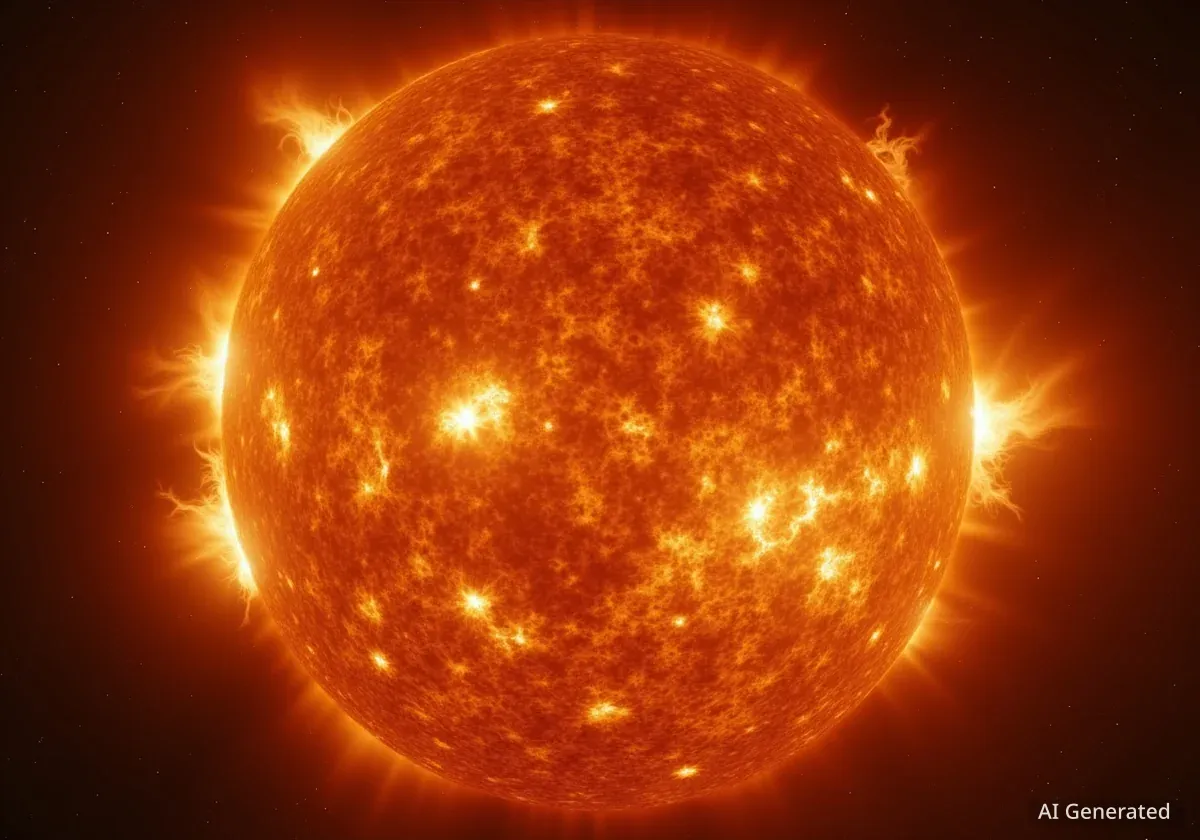

A relatively new model for predicting the sun's activity, known as the "terminator" model, is gaining significant attention for its accuracy in forecasting the current solar cycle. This approach has outperformed official predictions, prompting businesses that rely on stable space conditions to take notice and potentially reshaping how we prepare for disruptive space weather events.
The sun's temperamental nature, marked by an approximately 11-year cycle of activity, has long been a challenge for scientists. These cycles of solar storms can disrupt everything from GPS navigation and satellite communications to power grids on Earth. The new model offers a different perspective on the mechanisms driving this cycle, providing a potentially more reliable tool for long-term forecasting.
Key Takeaways
- A new forecasting method, the "terminator" model, has more accurately predicted the intensity of the current solar cycle than official consensus forecasts.
- The model links the end of one solar cycle and the beginning of the next to the collision of magnetic bands at the sun's equator.
- Industries like precision agriculture and satellite operations are beginning to adopt the terminator model's forecasts to mitigate risks from space weather.
- The success of this observational model has led to the founding of a commercial company, Hale SWx, to provide specialized forecasts to businesses.
The Challenge of Predicting Solar Activity
Forecasting the sun's behavior is a complex and vital task. Our technological infrastructure is increasingly vulnerable to space weather, the term for the disruptive conditions in space caused by solar flares and coronal mass ejections. These events release massive amounts of energy and charged particles that can have profound effects on Earth.
In May 2024, a powerful solar storm interfered with GPS systems, causing agricultural equipment from companies like John Deere to malfunction. This highlighted the real-world consequences of intense solar activity. Farmers using precision guidance systems found their tractors veering off course, a direct result of the storm's impact on satellite signals.
Traditionally, scientists at institutions like NASA and the National Oceanic and Atmospheric Administration (NOAA) convene to produce a consensus forecast for each upcoming solar cycle. However, these predictions are often imperfect. The official forecast for the current cycle, Solar Cycle 25, significantly underestimated its intensity, requiring monthly updates to align with observed reality.
Understanding the Solar Cycle
The sun follows a rhythm known as the solar cycle, which lasts about 11 years. It moves from a period of low activity (solar minimum) with few sunspots to a period of high activity (solar maximum) with many sunspots and frequent solar storms. At the peak, the sun's magnetic poles flip. Two of these cycles together form a 22-year Hale cycle, after which the magnetic field returns to its original orientation.
A New Theory: The Terminator Model
Amidst the challenges of traditional forecasting, a different approach has emerged. Led by scientist Scott McIntosh, a group of researchers has developed what they call the "terminator" model. This model proposes that the sun's activity is governed by large, doughnut-shaped magnetic bands that migrate from the sun's poles toward its equator over many years.
According to this theory, a solar cycle doesn't truly end until the magnetic bands from the previous cycle meet and annihilate each other at the equator. This event is what the researchers have named a "terminator."
The model suggests that this annihilation acts as a switch. Within days or weeks of a terminator event, the next solar cycle begins with a rapid emergence of sunspots at mid-latitudes. The key insight is that the time between two terminator events can predict the strength of the following cycle. A shorter duration between terminators suggests a more intense upcoming cycle.
This is precisely what the terminator model team predicted for the current Solar Cycle 25. Their forecast, which called for a stronger cycle than the official one, has so far proven to be closer to reality.
A Predictive Link
The core of the terminator model is the relationship between the length of a solar cycle and the intensity of the next. When the time between two "terminator" events is shorter than the average 11 years, the subsequent cycle tends to be much stronger. This was the basis for the team's successful prediction for the current cycle.
From Theory to Commercial Application
The success of the terminator model has not gone unnoticed. Industries that are highly sensitive to space weather are now looking to it for more reliable long-range planning. Satellite operators are a key example. Increased solar activity heats and expands Earth's upper atmosphere, creating more drag on satellites in low-Earth orbit.
This increased drag can shorten a satellite's operational lifespan or require it to use precious fuel to maintain its orbit. Capella Space, a satellite imaging company, reported in 2024 that atmospheric density was two to three times higher than predicted by official forecasts, directly impacting their assets. The company noted that it found the terminator forecast to be more accurate and began incorporating it into its own operational models.
"Everybody wants to know what the solar cycle looks like so that they can plan for the future," says Lisa Upton, a scientist at the Southwest Research Institute and co-chair of the official forecast panel, highlighting the critical need for accurate predictions.
Recognizing this demand, Scott McIntosh has co-founded a company called Hale SWx. The firm aims to provide tailored space weather forecasts to businesses in sectors like precision agriculture, satellite operations, and oil and gas exploration. This move signifies a shift from purely academic research to a commercial service built on the model's predictive power.
The Future of Space Weather Forecasting
While the terminator model has demonstrated impressive accuracy, it is primarily an observational model. It describes a pattern of what happens on the sun but does not yet include a complete underlying physical theory explaining *why* it happens. This has led some in the scientific community to view it with caution, emphasizing that it is based on observation rather than a simulation of the sun's complex physics.
However, its practical success is undeniable. Christian Möstl of the Austrian Space Weather Office has stated that while the model slightly overestimated the current cycle's strength, it remains a highly useful tool that his office plans to use for the next forecast.
Scientists agree that a diversity of approaches is essential for improving our understanding of the sun. Models based on physics, statistical patterns, and machine learning all contribute to a more complete picture. As our reliance on technology in space and on Earth continues to grow, the ability to accurately predict the sun's behavior will only become more critical. The terminator model, once a fringe idea, is now a serious contender in the effort to provide a reliable cosmic forecast.