
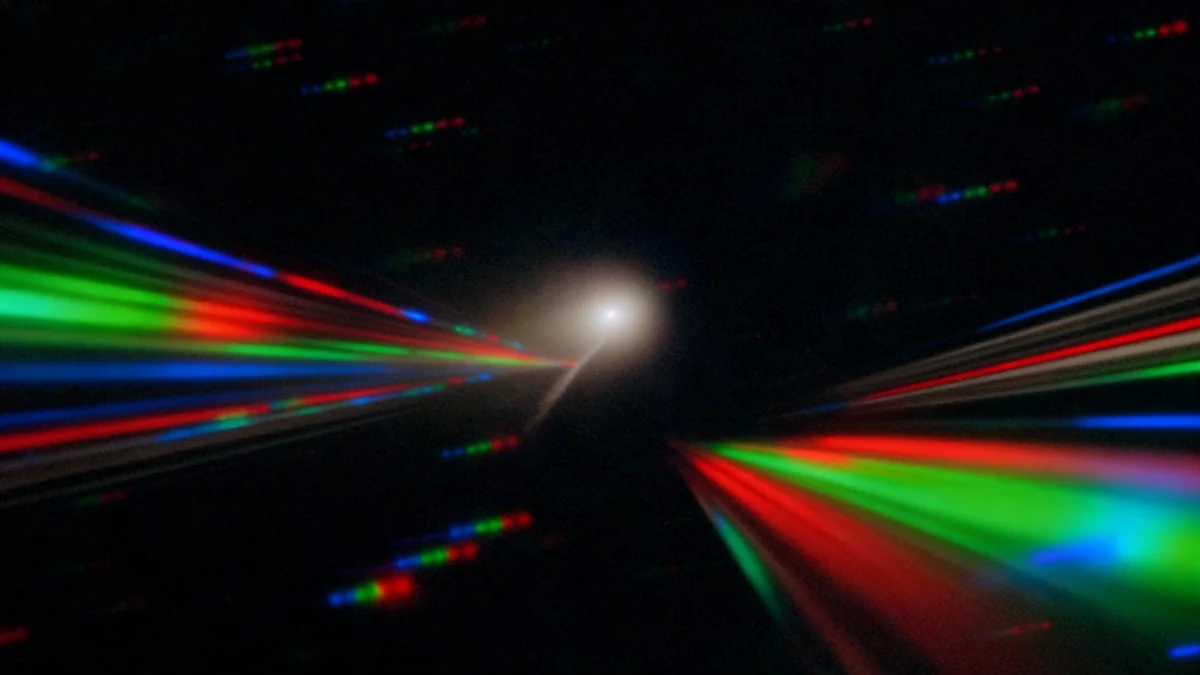

NASA's PUNCH mission has provided an extraordinary, near-continuous look at a comet's journey through the inner solar system. For nearly 40 days, the spacecraft captured images of Comet C/2025 R2 (SWAN) every four minutes, creating a detailed time-lapse that is helping scientists understand the dynamics of space weather.
This intensive observation campaign, which ran from August 25 to October 2, may represent the longest period a comet has ever been tracked with such high frequency. The data offers new insights into how comets interact with the solar wind, the constant stream of charged particles flowing from the sun.
Key Takeaways
- NASA's PUNCH mission observed Comet C/2025 R2 (SWAN) for nearly 40 days.
- Images were captured every four minutes, a record cadence for such a long duration.
- The data helps scientists study the solar wind's interaction with cometary tails.
- A separate interstellar comet, 3I/ATLAS, was also briefly captured in the footage.
- The comet was discovered by an amateur astronomer using publicly available data.
An Unprecedented Watch
While comets have been tracked for years, the frequency of observation is what sets this event apart. The PUNCH mission's ability to capture an image every few minutes provides a level of detail previously unseen over such an extended period.
According to Craig DeForest, the principal investigator for the PUNCH mission at the Southwest Research Institute, this high-cadence observation is a significant achievement.
"Other comets have been tracked at once-per-day cadence for years. What's new here is the few-minute cadence of observation."
This near-real-time view allows researchers to see subtle changes in the comet's tail as it is buffeted by the solar wind. These tails act as natural tracers, revealing the structure and speed of the solar wind as it travels through space.
Record-Breaking Observation
The PUNCH mission's observation of Comet SWAN, capturing images every four minutes for nearly 40 days, marks a new milestone in cometary science. This high-frequency data is invaluable for studying dynamic space phenomena.
The Journey of Comet SWAN
Comet C/2025 R2 (SWAN) was first identified in September by Vladimir Bezugly, a Ukrainian amateur astronomer. He spotted the object while examining public images from the Solar and Heliospheric Observatory (SOHO), a joint NASA and European Space Agency mission.
Just one day after its discovery, the comet made its perihelion, or closest approach to the sun, coming within 46.74 million miles (75.20 million km) of our star. The intense solar heat caused the comet's ices to vaporize, a process known as sublimation, which created its distinct bluish-green coma, or head.
A Peculiar Shape
As the observation continued, astronomers noted an unusual change in the comet's appearance. By mid-September, the normally round coma had developed a distorted, triangular shape that some described as a "hammerhead."
Scientists often associate such distortions with a fragmenting nucleus. If a comet's core breaks into multiple pieces, outgassing from each fragment can stretch the coma into an irregular shape, providing clues about the comet's structural integrity.
What is a Comet?
Often called "dirty snowballs," comets are cosmic bodies of frozen gases, rock, and dust left over from the formation of the solar system. As they approach the sun, the heat vaporizes their icy components, creating a glowing coma and one or more tails that can stretch for millions of miles.
- Nucleus: The solid, core part of the comet, made of ice, dust, and rock.
- Coma: The cloud of gas and dust that forms around the nucleus as it heats up.
- Tails: Comets typically have two tails—a dust tail and an ion (gas) tail—both of which are pushed away from the sun by solar radiation and solar wind.
A Cosmic Video with a Surprise Guest
NASA released a time-lapse video compiling hundreds of images from the PUNCH mission. The video shows Comet SWAN gliding across the starfield, passing between two bright celestial objects: the planet Mars and the star Spica, located in the constellation Virgo.
The comet's tail is visibly pushed by the solar wind, causing the comet to appear as if it is drifting backward. This visual effect perfectly illustrates how the sun's outflowing particles influence objects throughout the solar system.
Adding to the spectacle, the footage captured a brief appearance by another icy visitor: the interstellar comet 3I/ATLAS. Near the end of the sequence, 3I/ATLAS can be seen zipping from left to right below Comet SWAN, a chance encounter of two distinct comets from different origins.
Understanding Our Space Environment
The detailed observation of Comet SWAN is more than just a celestial novelty. It provides critical data for understanding space weather, which can have significant impacts on Earth.
Gina DiBraccio, acting director of the Solar System Exploration Division at NASA's Goddard Space Flight Center, highlighted the importance of such missions.
"Watching the sun's effects from multiple vantage points — and with different types of instruments — is what gives us a complete picture of the space environment. We use these same tools to track and analyze how space weather impacts our astronauts, our spacecraft, and our technology here on Earth."
In late October, Comet SWAN made its closest approach to Earth, passing at a distance of 25.10 million miles (40.38 million km). At that point, it became bright enough to be seen with binoculars and small telescopes, offering skywatchers a chance to view the well-studied cosmic traveler for themselves.