
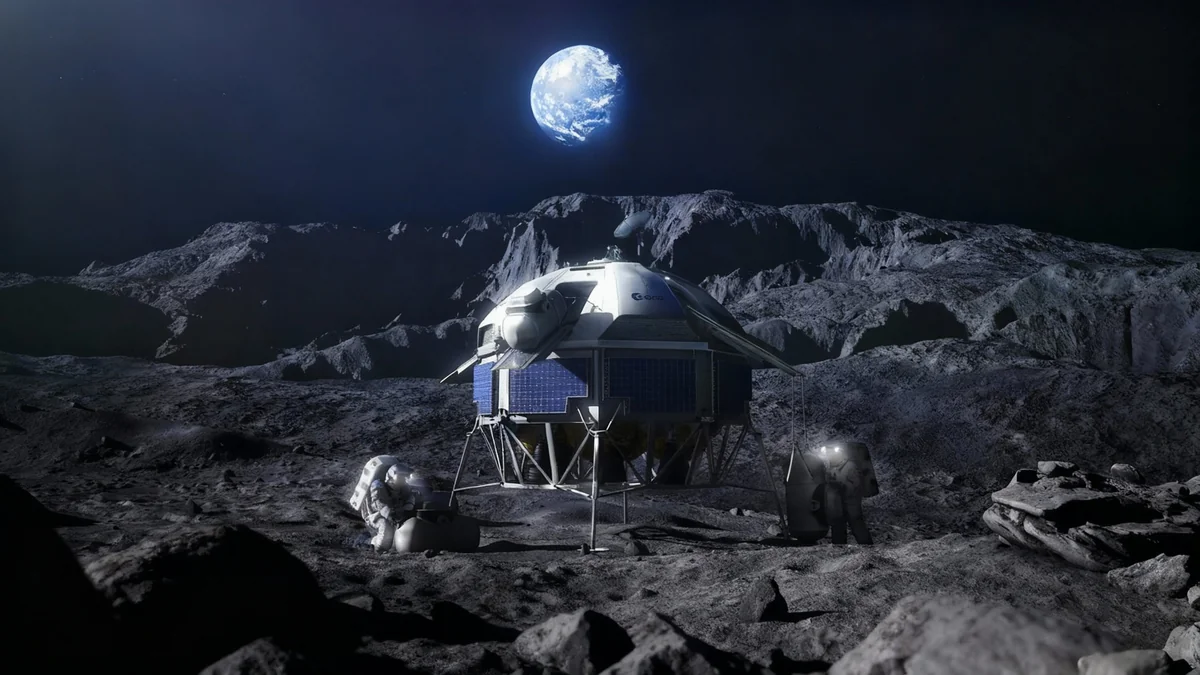

Future lunar landings could inadvertently contaminate crucial scientific sites on the Moon, particularly its permanently shadowed polar craters. New research indicates that exhaust from spacecraft engines, specifically methane, can spread widely across the lunar surface and become trapped in these ultra-cold regions. Scientists fear this contamination could compromise the search for ancient water ice and organic molecules, which may hold vital clues about the origins of life on Earth.
Key Takeaways
- Spacecraft exhaust, primarily methane, can travel across the Moon's surface.
- Methane molecules can become trapped in permanently shadowed polar craters.
- These craters are considered prime locations for finding ancient water ice and organic molecules.
- Contamination risks compromising evidence related to the origins of life on Earth.
- New models suggest a significant percentage of exhaust could reach polar regions.
The Unseen Threat of Lunar Contamination
As global space agencies and private companies gear up for a new era of lunar exploration, including plans for sustained human presence, the environmental impact of these missions is gaining attention. A recent study highlights a significant concern: the chemical footprint left by landers.
Many modern and planned lunar landers use propellants that produce methane as a byproduct during the engine burns required for a soft touchdown. This methane, once released, does not simply dissipate. The Moon's lack of a substantial atmosphere allows these molecules to travel freely, potentially reaching pristine scientific sites.
Fast Fact
Unlike Earth, the Moon's lack of a thick atmosphere means exhaust molecules travel ballistically, hopping across the surface rather than diffusing.
Polar Craters: A Scientific Treasure Trove at Risk
The Moon's polar regions contain craters that are perpetually in shadow. These areas are incredibly cold, allowing water ice and other frozen compounds to remain stable for billions of years. Scientists believe these ancient deposits could preserve organic material delivered by comets and asteroids over vast cosmic timescales.
These preserved materials might include prebiotic molecules, which are the building blocks linked to the emergence of life on Earth. Studying them could offer an unparalleled window into the early solar system and the conditions necessary for life to begin. The Moon acts as a frozen archive, largely unchanged compared to Earth's geologically active and atmospheric environment.
"We have laws regulating contamination of Earth environments like Antarctica and national parks. I think the moon is an environment as valuable as those."
Tracking Methane Across the Lunar Surface
To understand the potential spread of spacecraft exhaust, researchers developed a computer model. This model tracked the movement of methane, a common organic compound produced by typical spacecraft propellants. The team used the European Space Agency's (ESA) planned Argonaut lander mission as a hypothetical case study.
Simulations focused on methane released during a modeled descent approximately 19 miles (30 kilometers) above the Moon's south pole. The model tracked the methane molecules over seven lunar days, equivalent to about two Earth months. The results were clear: the molecules traveled unimpeded across the lunar surface.
Understanding Lunar Days
A lunar day, the time it takes for the Moon to complete one rotation relative to the Sun, is approximately 29.5 Earth days. This means that within a few Earth months, exhaust molecules could travel significant distances across the lunar surface.
Reaching Distant Poles
The simulations revealed that methane could reach the Moon's opposite pole in less than two lunar days. This demonstrates how quickly contaminants could spread across the entire lunar body. Within seven lunar days, a significant amount of the exhaust methane became trapped in polar cold regions.
- Nearly 54% of the exhaust methane settled in polar cold regions.
- About 12% of this trapped methane was found at the north pole, far from the original south pole landing site.
This widespread distribution highlights the challenge of protecting specific lunar areas. Even a landing far from a sensitive zone could still result in contamination due to the Moon's airless environment.
"We showed that molecules can travel across the whole moon. In the end, wherever you land, you will have contamination everywhere."
Shaping Future Mission Planning
The findings emphasize the need for thoughtful mission planning and planetary protection measures. While more research is needed to determine if contaminants only settle on the surface or penetrate deeper ice layers, the current results serve as a crucial warning. Safeguarding the Moon's pristine scientific value is essential for responsible lunar exploration.
The authors of the study suggest that similar modeling of future spacecraft landings could help guide policies. These policies would aim to reduce the chemical footprint of missions and protect scientifically sensitive areas. The discussion about these findings is already reaching mission teams, turning a theoretical concern into a practical consideration for upcoming missions.
Implementing instruments on future spacecraft to validate these models would be a critical next step. This would provide real-world data to refine our understanding of contaminant spread and inform better protection strategies for Earth's closest celestial neighbor.