
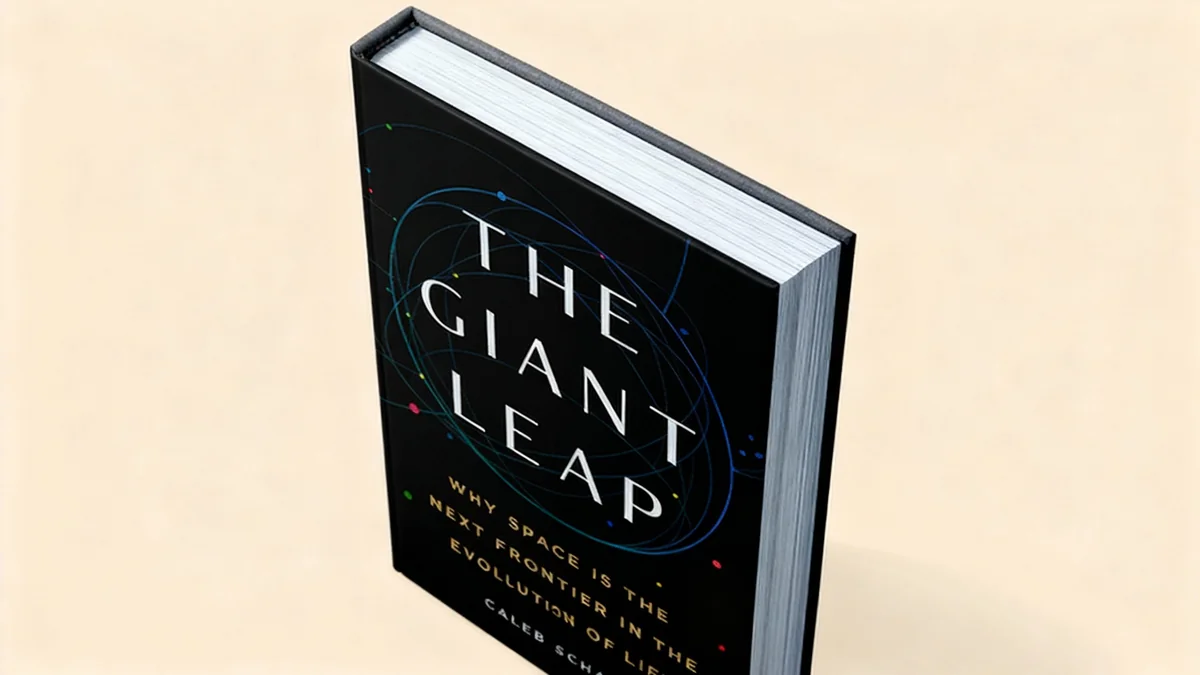


A NASA astrobiologist suggests that humanity's push into space is more than just exploration; it's a fundamental evolutionary step for life itself. In his new book, Caleb Scharf presents the concept of the “Dispersal,” arguing that expanding beyond our planet is a natural, perhaps necessary, progression for life on Earth, driven by the same imperatives that saw organisms move from the sea to the land.
This perspective reframes the modern space race not as a technological competition, but as a biological phenomenon. As humanity gains the ability to permanently leave its home world, it may be answering a deep-seated evolutionary call to spread life further into the solar system, especially as Earth faces mounting environmental pressures.
Key Takeaways
- NASA astrobiologist Caleb Scharf proposes that space travel is an evolutionary leap for life on Earth, a process he calls the “Dispersal.”
- He argues that engineered orbital habitats may be a more practical long-term solution for human settlement than colonizing planets like Mars.
- The physical constraints of the solar system, such as sunlight intensity and radiation, create a “zone of easiest exploration” that will shape our expansion.
- Scharf suggests a new approach to Mars exploration focused on deep scientific collaboration with advanced robotics, rather than immediate colonization.
The Dispersal: A New Evolutionary Leap
For billions of years, life on Earth has been defined by major transitions. The development of the cell, the emergence of multicellular organisms, and the expansion from oceans to land and air were all pivotal moments. According to Caleb Scharf, a senior scientist for astrobiology at NASA's Ames Research Center, humanity is now on the cusp of the next great transition: moving beyond our planet.
In his book, The Giant Leap, Scharf calls this process the “Dispersal.” He views our current spacefaring age not just through the lens of rockets and human ambition, but as a planetary phenomenon. From this broader perspective, Earth itself is beginning to disperse materials, machines, and organisms back into the cosmos from which it was formed.
This isn't just about sending humans to other planets. It's about what happens when a life-form encounters the vast resources and differing environments of a solar system. Just as isolated animal populations on islands evolve into new species, life that disperses beyond Earth could follow wildly divergent evolutionary paths. This means the future of humanity in space may not look like us at all, but rather like something entirely new, adapted for life off-world.
Navigating the Solar System's Real Estate
Where humanity goes next will be dictated by fundamental physical laws. Scharf emphasizes the importance of understanding these “boundary conditions,” which define what is possible and practical in different regions of the solar system.
These conditions create what might be called a “zone of easiest exploration.” Factors like the intensity of sunlight, exposure to solar flares and cosmic radiation, and the energy required to travel to a destination all play a role.
Solar System by the Numbers
Sunlight at Mercury is approximately seven times stronger than at Earth, while at Pluto it is more than 1,000 times fainter. These vast differences in available energy fundamentally shape the possibilities for technology and settlement.
For example, while Mercury is relatively close, reaching it requires a tremendous amount of energy to slow down against the sun's powerful gravity—comparable to the energy needed to reach Jupiter. Destinations closer to the sun also face intense radiation from solar flares. Conversely, the outer solar system has less solar radiation but higher exposure to dangerous cosmic rays.
These constraints suggest that our expansion will not be a simple land grab. Instead, it will be a strategic process, guided by the specific challenges and opportunities that each location in the solar system presents.
The Great Debate: Planets or Artificial Habitats?
A central question in the future of space settlement is where humans should live. The popular vision, championed by figures like Elon Musk, involves building cities on Mars. However, Scharf offers a counter-argument, suggesting that in the long run, planets can be a “real pain in the ass.”
He points out that even with advanced habitats, settlers on Mars or the Moon would be subject to permanently low gravity, which has known detrimental effects on human biology. Adapting an entire planet to be habitable is a monumental task.
"In the long term, it’s far better to engineer what you really need—to create environments that place fewer stressors on life that evolved on Earth over four billion years."
The alternative is to build entirely artificial habitats in space, perhaps by hollowing out asteroids or constructing them from scratch. This approach offers significant advantages:
- Artificial Gravity: Habitats can be spun to create Earth-normal gravity, mitigating health risks.
- Controlled Environments: Atmospheres can be precisely engineered to meet human biological needs.
- Mobility and Protection: Habitats can be moved to optimal orbits and can be designed with robust shielding against cosmic radiation.
While planets like Mars are invaluable for scientific study, Scharf argues they may not be the ideal places for long-term human settlement. Engineered environments would give us far more control and flexibility than any planetary surface.
Rethinking the Mars Mission
The current focus on Mars is often framed as a way to create a “backup for humanity” in case of a catastrophe on Earth. Scharf finds this motivation unconvincing, criticizing the utopian rhetoric that often accompanies it. He notes that life on Mars would likely be difficult and dystopian, not a glorious new society.
Four Views on Mars Exploration
- The Colonizers: Settle Mars immediately as an existential backup, regardless of the environmental impact.
- The Scientists: Explore Mars cautiously to preserve its environment and search for clues about the origin of life.
- The Earth-Firsters: Halt space exploration to focus resources on solving problems on Earth.
- The Innovators: A fourth approach, advocated by Scharf, that uses Mars as a testbed for new ways of integrating humans and machines for remote exploration.
Instead of a rush to colonize, Scharf proposes a fourth approach. This path would leverage our advanced capabilities in robotics, sensors, and digital connectivity to explore Mars in a deeply immersive but less intrusive way. It would involve a tight-knit collaboration between humans and machines, allowing us to conduct science and learn to exist in a new environment without the massive cost and risk of building a self-sustaining city immediately.
This measured approach recognizes the immense scientific value of Mars—particularly in the search for the origins of life—while remaining grounded in the practical realities of such a difficult undertaking.
A New Era for Space
Despite current uncertainties in funding for agencies like NASA, Scharf remains optimistic about the long-term trend. The landscape of space exploration has changed dramatically since the Apollo era. It is no longer a simple two-nation race.
Today, there are around 10,000 space-oriented companies worldwide. The rapid increase in launch frequency and the diverse interests—from national security to economic opportunity and scientific curiosity—have created a critical mass of activity.
This complex, multi-player environment makes the future harder to predict, but it also makes it more robust. The “Dispersal” is not likely to be a single, centrally planned project. Instead, it will be the result of many competing and collaborating efforts, pushing the boundaries of what is possible. For Scharf, this chaotic but energetic new era is precisely what makes the prospect of humanity's expansion into the cosmos so compelling and, perhaps, inevitable.