

The James Webb Space Telescope (JWST) has detected phosphine in the atmosphere of a distant brown dwarf, a finding that adds a new layer of complexity to the search for extraterrestrial life. This discovery of a chemical once controversially linked to potential life on Venus highlights that non-biological processes can produce it, urging caution in its use as a biosignature.
Key Takeaways
- The James Webb Space Telescope detected phosphine on a brown dwarf named Wolf 1130C.
- This discovery reinforces the idea that phosphine can be created through non-biological geological and chemical processes.
- The finding directly impacts the ongoing debate about a 2020 claim of phosphine in Venus's atmosphere, which was suggested as a possible sign of life.
- Scientists remain uncertain why phosphine is present on some celestial bodies, like Jupiter and Saturn, but absent on others where it is expected.
A Chemical Signature in a Distant System
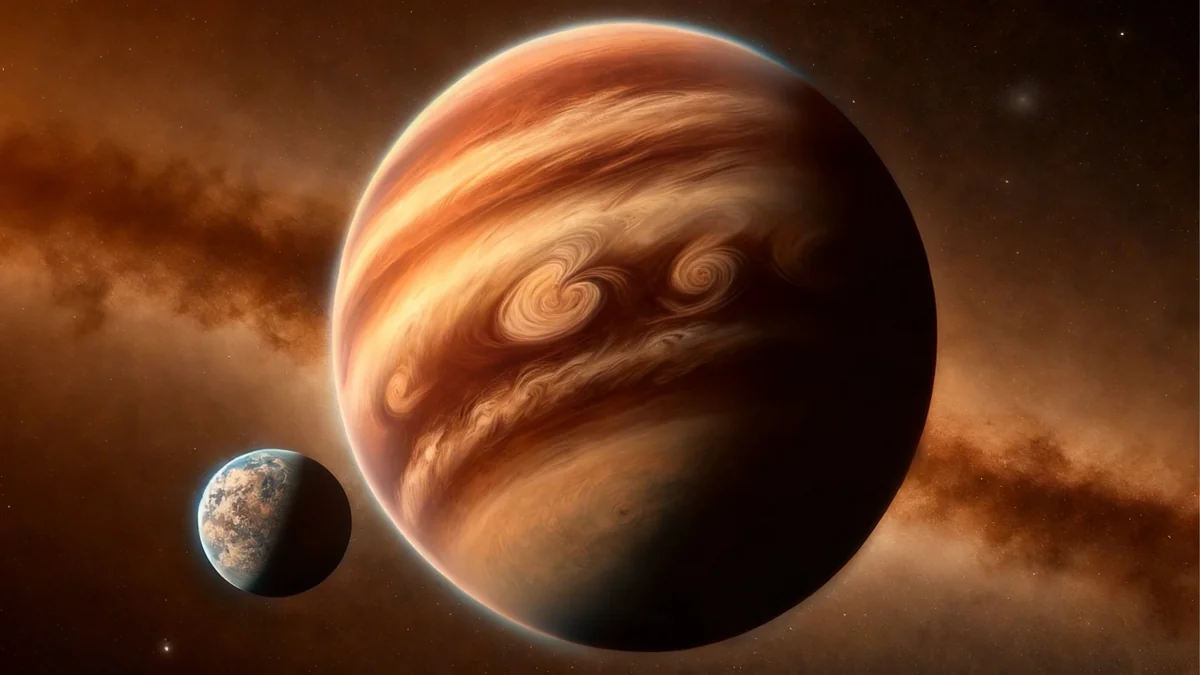
Astronomers using the JWST identified phosphine in the cold atmosphere of Wolf 1130C, an object known as a brown dwarf. Brown dwarfs are often called "failed stars" because they are more massive than planets but not massive enough to sustain the nuclear fusion that powers stars like our sun.
The brown dwarf is part of a triple system, orbiting a pair of other stars: a low-mass red dwarf and a compact white dwarf. According to the study published in the journal Science, the phosphine was measured at an abundance of 0.1 parts per million.
Comparable to Our Solar System
The amount of phosphine found on Wolf 1130C is remarkably similar to the levels detected in the atmospheres of Jupiter and Saturn. This consistency with models for gas giants suggests a common, non-biological formation mechanism.
Phosphine is a molecule made of one phosphorus atom and three hydrogen atoms. It is known to be chemically unstable in atmospheric conditions, meaning it breaks down relatively easily. Its presence in the clouds of Jupiter and Saturn is explained by deep convection currents that transport the chemical from the hot planetary interiors, where it forms, to higher altitudes faster than it can be destroyed.
The Venus Controversy Revisited
The detection of phosphine on Wolf 1130C is significant because of a heated scientific debate that began in 2020. A research team led by Jane Greaves of Cardiff University announced the detection of phosphine in the clouds of Venus, a planet with a highly toxic and acidic atmosphere.
On Earth, phosphine is naturally associated with biological processes, often found in environments with little to no oxygen. This association led the research team to suggest that microbial life floating in Venus's clouds could be a possible explanation for their finding, sparking global headlines about alien life.
A Contentious Claim
The 2020 Venus phosphine claim was met with significant skepticism from the wider astronomical community. Other scientists questioned the data analysis methods used and struggled to replicate the detection. Despite the controversy, the original team has maintained its findings, and the presence of phosphine on Venus remains an unresolved issue.
One of the main arguments against the Venus biosignature theory is the difficulty in explaining how phosphine could survive in the planet's harsh atmosphere without a constantly replenishing source. The new JWST data from Wolf 1130C provides a clear example of phosphine existing in a completely lifeless environment, strengthening the case for abiotic, or non-biological, origins.
Solving the Phosphine Puzzle
While the discovery on Wolf 1130C clarifies that phosphine is not exclusively a biosignature, it also deepens an existing mystery: why is it detectable on some brown dwarfs and not others? Theoretical models predict that many similar objects should have phosphine, yet observations often come up empty.
Researchers explored several hypotheses to explain its presence in this specific system.
Did a Dying Star Seed the Brown Dwarf?
One theory proposed that the white dwarf in the system, Wolf 1130B, could have been the source. Before becoming a white dwarf, this star was much larger, with a mass six to eight times that of our sun. In its final stages, it would have expanded into a red giant and ejected its outer layers, which are rich in elements like phosphorus, into space.
The idea was that this phosphorus-rich material could have been deposited onto the nearby brown dwarf, providing the raw material for phosphine. However, this explanation was ruled out. The white dwarf's companion star, Wolf 1130A, does not show a similar over-abundance of phosphorus, which it should if this scenario were correct.
The Role of Chemical Composition
A more promising explanation relates to the brown dwarf's intrinsic chemical makeup. Wolf 1130C appears to have a very low abundance of heavy elements, a property astronomers refer to as low "metallicity." Jupiter and Saturn also share this characteristic.
A low-metallicity atmosphere might create conditions that are more favorable for phosphine to form and survive. Furthermore, with fewer other molecules present, the spectral signal of phosphine would be easier to detect, making it stand out more clearly in JWST's observations.
However, this theory is not a perfect fit either. Other low-metallicity brown dwarfs studied by JWST have not shown the expected levels of phosphine, indicating that scientists still have an incomplete picture of phosphorus chemistry in these environments.
A Word of Caution for Astrobiology
The ambiguities surrounding phosphine's formation have led the study's authors to issue a strong caution. The team, led by Adam Burgasser of the University of California, San Diego, emphasizes that our understanding of phosphorus chemistry in extraterrestrial atmospheres is incomplete.
"The inability of models to consistently explain all these sources indicates an incomplete understanding of phosphorus chemistry in low-temperature atmospheres," the authors stated. "We therefore caution against the use of phosphine as a biosignature until these discrepancies are resolved."
This new research serves as a critical reminder in the field of astrobiology. Even if the phosphine detection on Venus is eventually confirmed, its origin could very well be geological or chemical, not biological.
The JWST's powerful capabilities are not only discovering new worlds and chemicals but are also helping to refine the methods scientists use to search for life beyond Earth. For now, the story of phosphine shows that identifying potential signs of life requires a deep understanding of the complex, non-biological chemistry that can mimic them.