

A pioneering mission to brew Japanese sake in space is scheduled for launch on October 21, 2025. The project, a collaboration between sake producer DASSAI Inc. and Mitsubishi Heavy Industries (MHI), will send brewing equipment and ingredients to the International Space Station (ISS) to conduct the first-ever fermentation of sake in orbit.
This initiative, part of the larger "DASSAI MOON Project," aims to understand the effects of a low-gravity environment on the delicate fermentation process. The experiment will be carried out by astronaut Kimiya Yui inside the Japanese Experiment Module, Kibo.
Key Takeaways
- The world's first sake brewing experiment in space is set for late 2025.
- The mission is a joint effort by DASSAI Inc., Mitsubishi Heavy Industries (MHI), and the Japan Aerospace Exploration Agency (JAXA).
- The launch is scheduled for October 21, 2025, from Japan's Tanegashima Space Center.
- The experiment will simulate the Moon's gravity (1/6G) aboard the International Space Station.
- Data from the project will inform future space industry development and the long-term goal of lunar brewing.
A Historic Mission to Orbit
The ambitious project will begin with a launch from the Tanegashima Space Center in Japan. The mission is slated to lift off at approximately 10:58 AM on Tuesday, October 21, 2025. This launch represents a significant milestone for Japan's space program, utilizing the nation's new H3 rocket for its seventh flight.
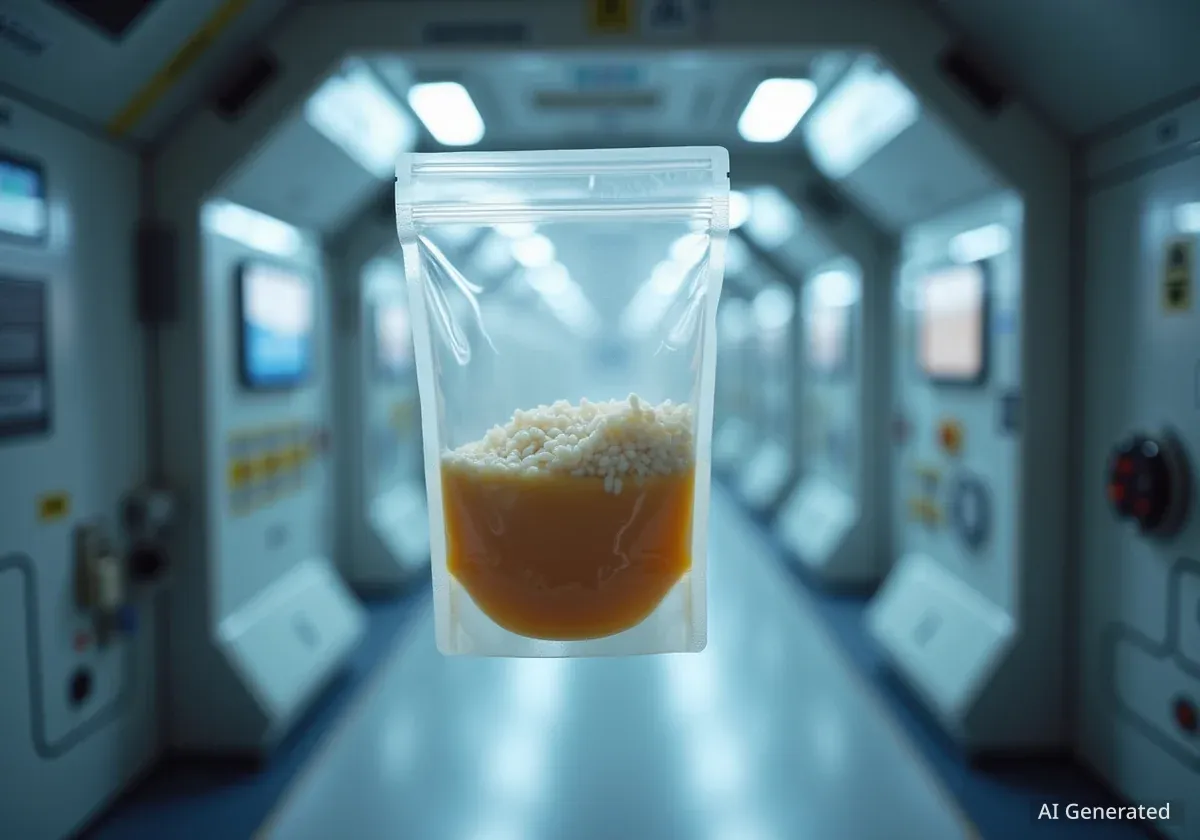
The payload will include all necessary components for the brewing process: rice, malt, yeast, and water provided by DASSAI, along with specialized brewing equipment developed by MHI. These materials will be transported to the ISS aboard the HTV-X, a new unmanned Japanese cargo spacecraft making its first demonstration flight.
An All-Japanese Endeavor
The mission highlights the capabilities of Japan's domestic space industry. From the H3 launch vehicle to the HTV-X cargo ship and the Kibo experiment module on the ISS, every major component of the project is Japanese-developed. The collaboration involves JAXA, private companies like MHI, and administrative bodies, showcasing a unified national effort in space technology.
The Science of Brewing in Low Gravity
The core of the mission is to test the feasibility of brewing sake in an environment different from Earth's. Upon arrival at the ISS, astronaut Kimiya Yui will set up the custom-designed equipment in the Kibo module. The experiment is designed to simulate the gravitational pull of the Moon, which is about one-sixth that of Earth (1/6G).
Specialized Equipment for Space
Mitsubishi Heavy Industries was tasked with engineering a system that could manage the complex fermentation process in space. Sake brewing relies on a unique method called multiple parallel fermentation, where starch is converted to sugar and sugar is converted to alcohol simultaneously in the same tank. Managing this biological process without standard gravity presents significant technical challenges.
The equipment developed by MHI is designed to contain the ingredients and control the environment precisely. It will allow for the controlled introduction of water to start the fermentation process once in orbit.
Mission Timeline
- Launch: October 21, 2025
- Arrival at ISS: A few days after launch
- Experiment Start: Approximately 10 days after launch
- Fermentation Period: Around two weeks
- Return to Earth: No sooner than the end of 2025
Throughout the two-week fermentation period, teams on Earth will monitor various data points from the experiment. This will provide invaluable information on how yeast and koji mold behave in a low-gravity setting.
From the Space Station to Earth
Once the fermentation process is complete, the resulting raw sake, known as moromi, will be frozen and stored aboard the ISS. Its journey back to Earth is planned for a later date, likely at the end of 2025 or early 2026. After its return, the precious cargo will be carefully thawed and refined.
"This project aims to build a brewery on the surface of the moon and brew its sake there with the aim of improving quality of life in activities on the moon in future," DASSAI Inc. stated regarding the long-term vision of the project.
The final product will be divided. Half of the space-brewed sake will be sent to the project's purchaser, while the other half will undergo extensive scientific analysis. Scientists will study its chemical composition, flavor profile, and other characteristics to compare it with its Earth-brewed counterparts.
The insights gained are expected to contribute significantly to Japan's space industry, particularly in the fields of life support systems, food production in space, and the broader study of microbiology in extraterrestrial environments.
The DASSAI MOON Project Vision
This orbital brewing test is just the first phase of a more audacious long-term plan called the DASSAI MOON Project. Initiated in 2024, the project's ultimate goal is to establish a fully functional sake brewery on the Moon. This vision is tied to the future of human space exploration and settlement, where producing familiar comforts like food and beverages could be crucial for psychological well-being and quality of life.
While a lunar brewery remains a distant goal, this initial experiment on the ISS is a critical first step. It will provide the foundational data needed to understand the fundamental challenges and possibilities of producing complex fermented goods beyond Earth.
The project represents a unique fusion of traditional craftsmanship and cutting-edge space technology. It pushes the boundaries of what is possible not only in space exploration but also in the ancient art of sake brewing.