
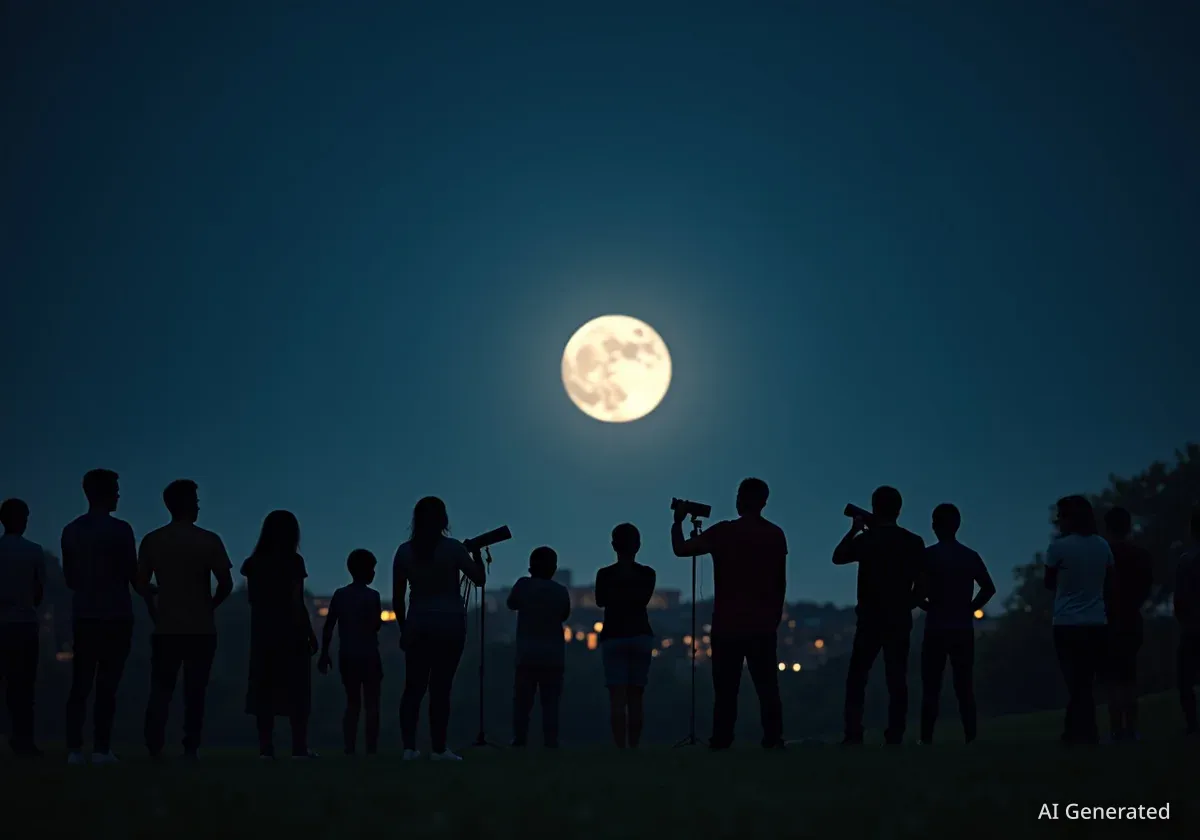


Residents of Gainesville, Florida, joined a global initiative on Saturday, October 4, 2025, to celebrate International Observe the Moon Night. The local event, held at the Kika Silva Pla Planetarium at Santa Fe College, brought together families, students, and astronomy enthusiasts to view the moon through high-powered telescopes and learn about space science.
The gathering was part of a worldwide effort coordinated by NASA, with similar events taking place in over 120 countries. In Gainesville, the Alachua Astronomy Club collaborated with the planetarium to provide equipment and share their knowledge with the public, making the celestial event accessible to all ages.
Key Takeaways
- Gainesville residents participated in NASA's International Observe the Moon Night on October 4, 2025.
- The event was hosted at the Kika Silva Pla Planetarium at Santa Fe College in partnership with the Alachua Astronomy Club.
- The initiative is a global outreach program designed to make space science accessible and engaging for the public.
- Participants had the opportunity to view the moon's craters through telescopes and connect with local astronomy experts.
A Worldwide Celebration with a Local Touch
International Observe the Moon Night is an annual public outreach event sponsored by NASA's Lunar Reconnaissance Orbiter mission and the Solar System Exploration Division. Its primary goal, according to NASA, is to unite people across the globe in learning about lunar science and exploration.
At Santa Fe College, this global mission was brought to a local level. Telescopes were arranged on the concrete plaza outside the planetarium, allowing attendees to get a close-up look at the waxing gibbous moon. Despite intermittent cloud cover, the event fostered a sense of community as strangers discussed astronomy and shared their viewing experiences.
Connecting with the Cosmos
For many, the night was about more than just science; it was a chance to connect with something larger than themselves. Warren Schmitt, a member of the Alachua Astronomy Club, explained that the allure of the night sky was a significant factor in his move from Orlando to Gainesville, a city with less light pollution.
"It’s awesome, seeing [the moon] up there. It’s almost like a spiritual thing. We go through life and don’t realize how beautiful these objects are in the night sky," Schmitt said. "We’re just little things here for a few seconds. Really, our lifetimes are nothing to them."
This sentiment of wonder was a common theme throughout the evening, reflecting the event's success in inspiring awe and curiosity.
Background on the Event
NASA's International Observe the Moon Night began in 2010. It encourages people to host or attend events celebrating Earth's nearest celestial neighbor. The timing is typically in September or October, when the moon is around its first quarter—a phase that provides excellent viewing of lunar terrain along the terminator, the line between light and shadow.
Making Science Accessible and Welcoming
A key objective of the event is to demystify astronomy and create an inviting atmosphere for newcomers. Organizers and volunteers at the Gainesville event focused on making complex topics understandable for everyone, from young children to adults with no scientific background.
Sam Palacios, an astrophysics major at Santa Fe College, highlighted the welcoming nature of the local astronomy community. He noted that the experts were skilled at explaining scientific concepts in a clear and engaging manner.
"[Everyone] has been so welcoming and open when it comes to sharing information," Palacios said. "They just make it so inviting … not dumbing it down, but making it digestible. It’s cool to be part of this community and look at the moon together, just enjoy something so simple and complex at the same time."
A Shared Experience
The sense of unity was also noted by John Terrones, another astronomy major at the college. "We’re united for one single goal of admiring the moon," he observed. "At the same time we’re looking at the moon, the moon is looking at us."
This shared perspective is central to the event's appeal, connecting millions of people worldwide through their view of a single celestial body.
The Moon's Phase
On October 4, 2025, the moon was in its waxing gibbous phase. This means it was more than half-illuminated and the illuminated portion was growing. This phase is excellent for observation as it reveals significant detail on the lunar surface without being overwhelmingly bright like a full moon.
Inspiring the Next Generation of Explorers
The event also served as a reminder of humanity's ongoing journey into space. With NASA's Artemis missions aiming to return astronauts to the lunar surface, public engagement in space science is more relevant than ever.
James Albury, the director of the Kika Silva Pla Planetarium, emphasized the importance of using celestial events to spark public interest in science.
"When you look at [the moon] through a telescope, it seems like you can almost reach out and touch it … it can be intoxicating," Albury explained. "We look for events that will interest the public — meteor showers, eclipses, comets — and use them to introduce people to the wonders of the night sky and science."
A Gateway to Astronomy
For many, the moon is the first object they observe through a telescope. Lisa Eager, the public outreach coordinator for the Alachua Astronomy Club, described the moon as an ideal entry point into the hobby.
Eager, who joined the club without a formal science background, knows firsthand how captivating the experience can be. "When someone looks through a telescope for the first time at the moon, they see it and it blows them away," she said. "It’s showing people there’s more out there, and expanding their horizons."
A Legacy of Lunar Fascination
The human connection to the moon spans generations. For attendee Donna Blanchard, the evening brought back memories of a pivotal moment in history: the 1969 moon landing.
"I remember holding my dad’s hand in front of the television and him saying, ‘This is history. Remember this,’" she recalled. That early experience ignited a lifelong interest in space. Standing under the moon decades later, she reflected on its universal nature.
"We’re all together looking up at the moon," Blanchard remarked. "It belongs to everybody." This simple but profound statement captured the spirit of the night, where a community gathered to share in the wonder of the cosmos.