

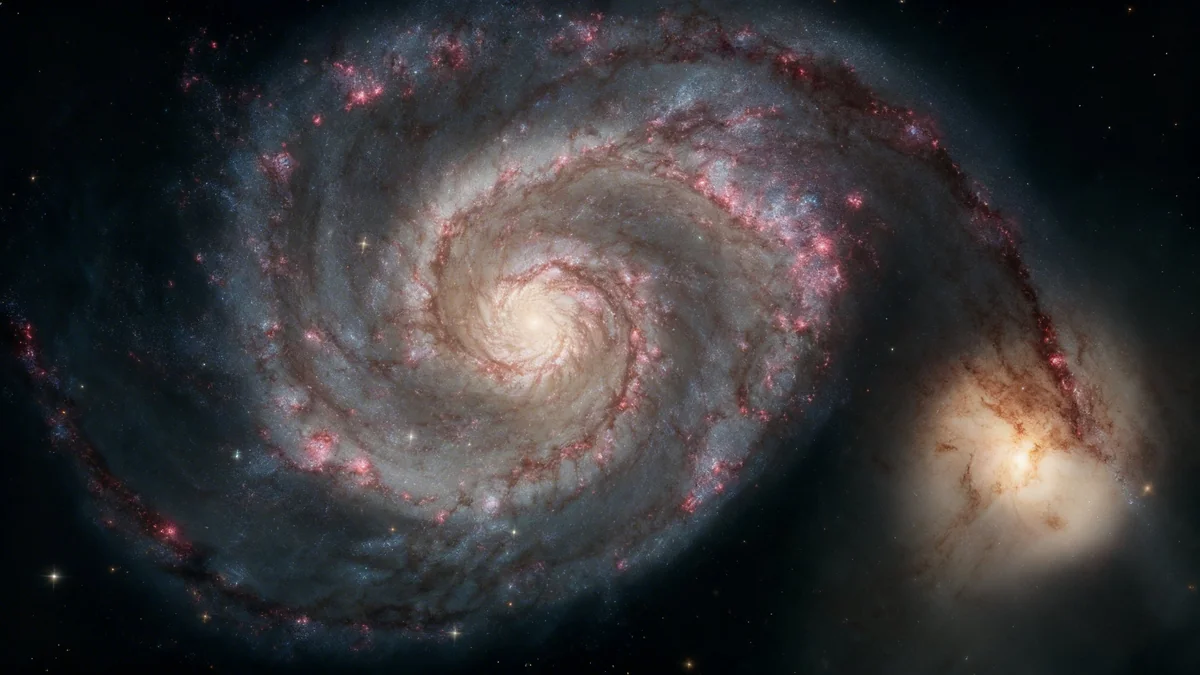
Astronomers using data from the European Space Agency’s Gaia space telescope have discovered a massive wave of stars moving through the outer disk of the Milky Way. This large-scale ripple, spanning tens of thousands of light-years, adds a new layer of complexity to our understanding of the galaxy's dynamic structure.
The discovery, detailed in the journal Astronomy and Astrophysics, reveals a vertical disturbance where stars move up and down in a coordinated pattern, similar to a ripple spreading across the surface of a pond. The origin of this galactic wave remains unknown, though scientists suggest a past interaction with a smaller galaxy could be a possible cause.
Key Takeaways
- Data from the ESA's Gaia mission has identified a large-scale wave of stars in the Milky Way's outer disk.
- The wave is a vertical corrugation, causing stars to move up and down relative to the galactic plane.
- This structure affects stars located between 30,000 and 65,000 light-years from the galactic center.
- The cause is currently unknown, but a collision with a dwarf galaxy is a leading hypothesis.
A Galaxy in Constant Motion
Our Milky Way galaxy is far from static. For over a century, scientists have known that its stars rotate around a central point. Later discoveries in the 1950s confirmed that the flat disk of the galaxy is not perfectly level but is warped, with edges curving in opposite directions.
More recently, in 2020, data from the Gaia mission showed that this warped disk also wobbles over time, much like a spinning top. This newly identified wave represents another fundamental motion, demonstrating that the galaxy is a constantly evolving and active system.
This latest finding moves beyond the known warp and wobble, identifying a propagating wave that actively stirs the motions of stars across a vast expanse of the galactic disk.
Understanding Gaia's Vision
The Gaia space telescope is a revolutionary mission designed to create the most precise three-dimensional map of the Milky Way. It tracks the positions, distances, and motions of over a billion stars. By measuring both the 3D position and 3D velocity of each star, Gaia provides an unprecedented six-dimensional view of our galaxy, making discoveries like this galactic wave possible.
Mapping a Galactic Ripple
The research team, led by astronomer Eloisa Poggio of the Istituto Nazionale di Astrofisica (INAF) in Italy, analyzed the precise movements of specific types of stars to uncover the wave. They focused on young giant stars and Cepheid variable stars, which are bright and can be observed over great distances.
The wave structure extends over a significant portion of the Milky Way's outer disk. According to the study, it influences stars located at least 30,000 to 65,000 light-years away from the galactic center. This is a substantial area, considering the entire Milky Way is approximately 100,000 light-years in diameter.
The Evidence for a Propagating Wave
What makes this discovery particularly compelling is not just the shape of the structure but also the motion of the stars within it. The team found that the stars' vertical movements are slightly out of sync with their vertical positions. This offset is a classic sign of a propagating wave.
“The intriguing part is not only the visual appearance of the wave structure in 3D space, but also its wave-like behaviour when we analyse the motions of the stars within it,” stated Eloisa Poggio, the lead author of the study.
Poggio and her colleagues use the analogy of a stadium wave. If you were to freeze a moment in time, you would see some people standing, some sitting, and others in the process of standing up. The people with the greatest upward motion are those just ahead of the wave's peak. Similarly, the stars with the largest vertical velocities are slightly ahead of the wave's crest, confirming that the disturbance is moving through the galaxy.
Galactic Wave by the Numbers
- Affected Region: 30,000 to 65,000 light-years from the galactic center.
- Galaxy Diameter: Approximately 100,000 light-years.
- Data Source: ESA's Gaia mission, measuring 6 dimensions of stellar data (3D position + 3D velocity).
Searching for the Source
While the existence and motion of the wave are now clearly mapped, its origin remains a mystery. One of the primary theories is that a past collision or close encounter with a dwarf galaxy sent ripples through the Milky Way's disk. Such gravitational disturbances are believed to be a major factor in shaping galactic structures over cosmic timescales.
The research team suggests that the gas from which young stars are born may also be part of this large-scale ripple. If so, newly formed stars would inherit the wave's motion, carrying a memory of the initial disturbance for millions of years.
Connection to Other Structures
Scientists are also exploring a potential connection to another, smaller structure known as the Radcliffe Wave. Discovered previously, the Radcliffe Wave is a filament of gas and star-forming regions located much closer to our Sun, about 500 light-years away, and stretching over 9,000 light-years.
However, the two structures are in very different parts of the galaxy. “The Radcliffe Wave is a much smaller filament, and located in a different portion of the galaxy’s disc compared to the wave studied in our work,” Poggio explained. “The two waves may or may not be related. That’s why we would like to do more research.”
The Future of Galactic Cartography
This discovery highlights the transformative power of the Gaia mission in revealing the intricate dynamics of our home galaxy. The ongoing collection of data promises to uncover even more details about the Milky Way's structure and history.
According to Johannes Sahlmann, ESA’s Gaia Project Scientist, future data releases will be even more powerful. “The upcoming fourth data release from Gaia will include even better positions and motions for Milky Way stars, including variable stars like Cepheids,” he said. “This will help scientists to make even better maps, and thereby advance our understanding of these characteristic features in our home galaxy.”
Further analysis of this great wave and other galactic structures will help astronomers piece together the Milky Way's violent past and predict its long-term evolution.