


Astronomers have achieved a significant breakthrough, confirming for the first time a massive coronal mass ejection (CME) erupting from a star far beyond our solar system. This powerful stellar blast, similar to those observed on our Sun, was so intense it could strip the atmosphere from any planet in its direct path.
The discovery provides critical new insights into space weather around other stars, particularly red dwarfs, which are common hosts for exoplanets. This observation has major implications for our understanding of planetary habitability.
Key Takeaways
- Astronomers confirmed a coronal mass ejection (CME) from a distant star for the first time.
- The CME was detected on a red dwarf star, which is smaller, cooler, and magnetically stronger than our Sun.
- The blast moved at 2400 kilometers per second, fast enough to strip planetary atmospheres.
- This finding helps scientists understand the habitability of exoplanets, especially those orbiting active red dwarfs.
First Direct Evidence of Stellar CME Beyond Our Sun
For decades, scientists have sought definitive proof of coronal mass ejections occurring on stars other than our Sun. While previous studies hinted at their existence, direct confirmation remained elusive. This new observation marks a significant milestone in astrophysics.
Researchers used a combination of the European Space Agency’s XMM-Newton space observatory and the LOFAR radio telescope to make this groundbreaking detection. The telescopes worked together to capture the explosive burst of stellar material.
Fast Facts About CMEs
- CMEs are powerful ejections of plasma and magnetic energy from a star's corona.
- On Earth, solar CMEs cause auroras and can affect power grids and satellites.
- The newly observed CME moved at an incredible 2400 km per second.
- This speed is only seen in about 5% of CMEs originating from our Sun.
According to Joe Callingham of the Netherlands Institute for Radio Astronomy (ASTRON), a lead author of the research, astronomers have wanted to spot a CME on another star for decades. He stated,
"Previous findings have inferred that they exist, or hinted at their presence, but haven’t actually confirmed that material has definitively escaped out into space. We’ve now managed to do this for the first time."
The Red Dwarf: A Stellar Powerhouse
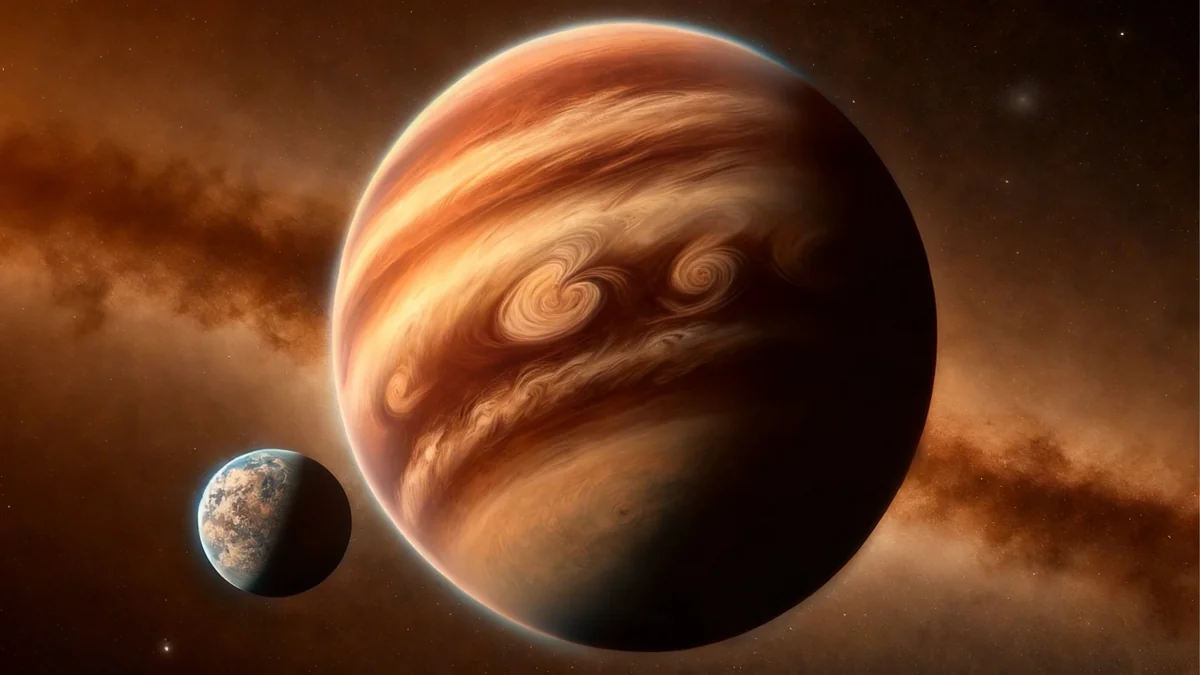
The star at the center of this discovery is a red dwarf, located approximately 40 light-years away. Red dwarfs are notably different from our Sun. They are typically fainter, cooler, and much smaller.
This particular red dwarf has about half the mass of our Sun. It also rotates 20 times faster and possesses a magnetic field that is 300 times more powerful. These characteristics contribute to its intense activity.
Understanding Red Dwarfs
Red dwarfs are the most common type of star in the Milky Way galaxy. Many of the exoplanets discovered so far orbit these stars. Their prevalence makes understanding their activity crucial for assessing the potential for life in the universe.
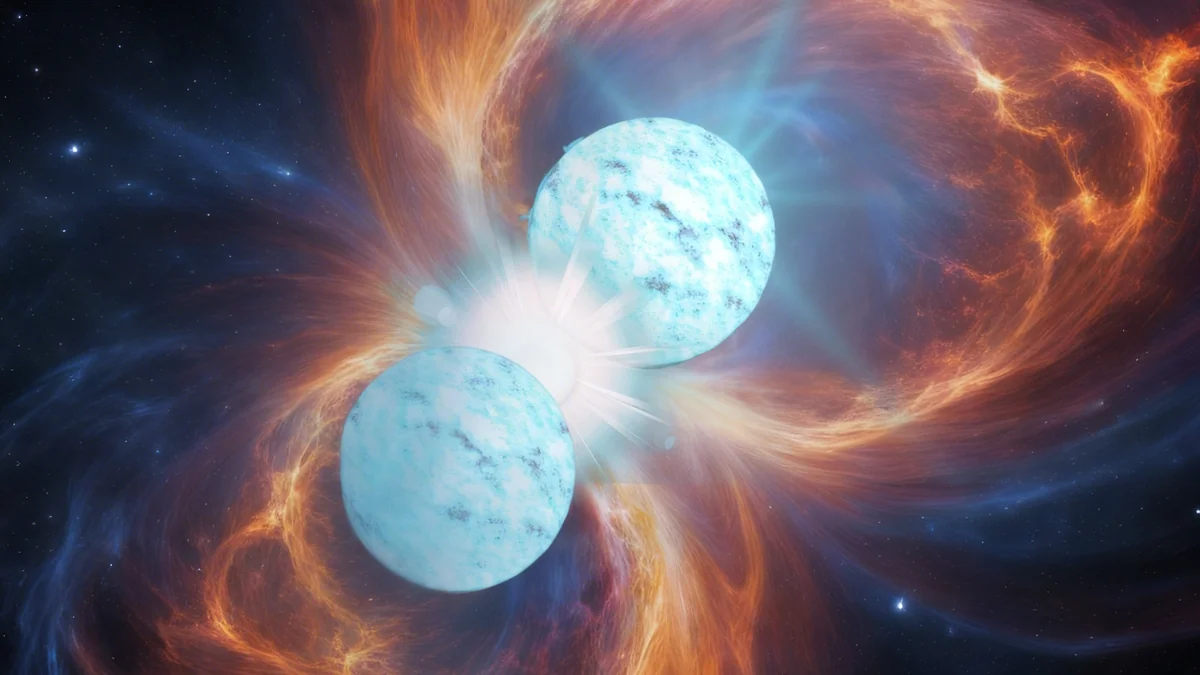
The CME generated a shock wave as it traveled through the star’s outer layers and into interstellar space. This shock wave, in turn, produced a burst of radio waves. Joe Callingham's team successfully detected this brief but intense radio signal.
The detection of this specific radio signal was key. Joe Callingham explained,
"This kind of radio signal just wouldn’t exist unless material had completely left the star’s bubble of powerful magnetism. In other words: it’s caused by a CME."
Telescopes Working Together
The success of this observation relied on the combined capabilities of two powerful instruments. The Low Frequency Array (LOFAR) radio telescope initially spotted the radio signal, thanks to advanced data processing methods developed by Cyril Tasse and Philippe Zarka at the Observatoire de Paris-PSL.
Following this, ESA’s XMM-Newton space observatory played a crucial role. It helped determine the star's temperature, rotation rate, and brightness in X-ray light. This information was vital for interpreting the radio signal and understanding the dynamics of the CME.
David Konijn, a PhD student working with Joe Callingham at ASTRON, highlighted the necessity of both telescopes.
"We needed the sensitivity and frequency of LOFAR to detect the radio waves. And without XMM-Newton, we wouldn’t have been able to determine the CME’s motion or put it in a solar context, both crucial for proving what we’d found. Neither telescope alone would have been enough – we needed both."
Implications for Planetary Habitability
The speed of this stellar CME, measured at 2400 kilometers per second, is remarkably fast. This speed is typically observed in only about 1 in every 20 CMEs from our Sun. The ejection was not only fast but also dense enough to completely strip away the atmospheres of any planets orbiting closely to the red dwarf.
This finding has profound implications for the search for life beyond Earth. A planet's habitability often depends on its location within the 'habitable zone' of its star, where liquid water could exist. This is often called the 'Goldilocks scenario'—not too hot, not too cold, but just right.
However, an active star that frequently ejects powerful CMEs could render a perfectly positioned planet uninhabitable. Such events could erode a planet's atmosphere over time, leaving behind a barren, rocky world.
Why Atmosphere Matters for Life
- A stable atmosphere protects a planet from harmful radiation.
- It helps regulate surface temperature, allowing liquid water to exist.
- Atmospheres contain gases essential for many forms of life, like oxygen and nitrogen.
- Loss of atmosphere can turn a potentially habitable world into a sterile one.
Henrik Eklund, an ESA research fellow, emphasized the significance of this work.
"This work opens up a new observational frontier for studying and understanding eruptions and space weather around other stars. We’re no longer limited to extrapolating our understanding of the Sun’s CMEs to other stars."
He added that intense space weather might be even more extreme around smaller stars, which are the primary hosts of many potentially habitable exoplanets. This directly impacts how these planets retain their atmospheres and remain habitable over long periods.
The study also enhances our broader understanding of space weather, a field continuously explored by ESA missions like SOHO, Proba, Swarm, and Solar Orbiter. XMM-Newton continues to be a vital instrument for exploring the extreme universe, from galactic cores to distant stars.
ESA XMM-Newton Project Scientist Erik Kuulkers concluded,
"XMM-Newton is now helping us discover how CMEs vary by star, something that’s not only interesting in our study of stars and our Sun, but also our hunt for habitable worlds around other stars. It also demonstrates the immense power of collaboration, which underpins all successful science. The discovery was a true team effort, and resolves the decades-long search for CMEs beyond the Sun."